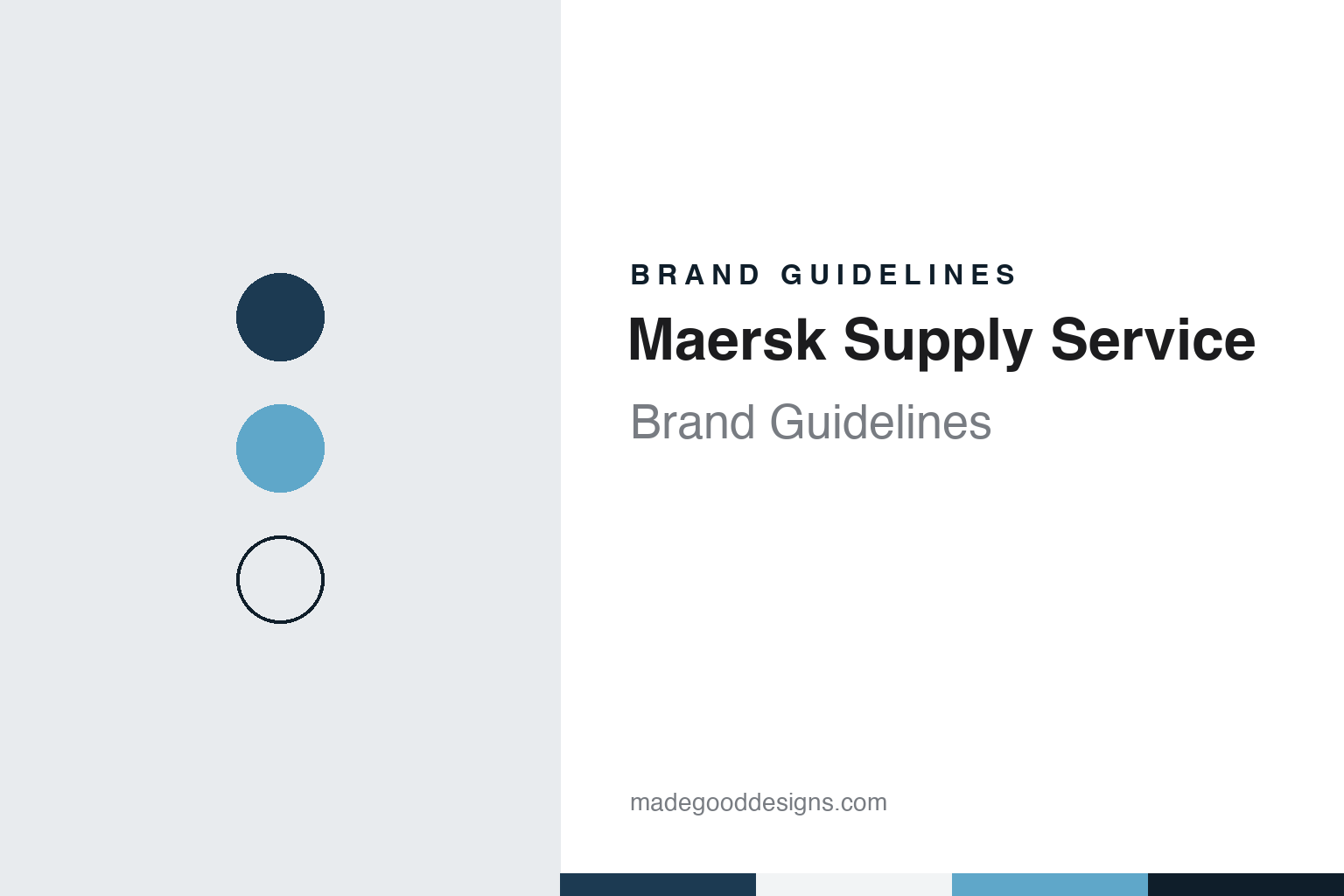
Maersk Supply Service Brand Guidelines
Maersk’s offshore support arm, from anchor-handlers to DOF Denmark.
Aa
Two constants: a deep blue, sky blue and deck white palette and a modern sans register. Abstract homage — not a Maersk Supply Service vessel or mark; no ship, logo or star is reproduced.
A Maersk Company
The offshore-vessel arm of a Danish shipping group.
Maersk Supply Service was the offshore-vessel arm of the Danish group A.P. Møller – Maersk. The Danish maritime news site Maritime Danmark reported in July 2024 that it became an independent company within A.P. Møller – Maersk in 1974. When the group agreed to sell it in March 2023, an executive at the buyer, A.P. Moller Holding, spoke of capabilities and vessels built “over more than 50 years” supporting the oil and gas industry, Offshore Energy reported. Its work was the support side of offshore energy: anchor-handling tug supply vessels that move and moor rigs, tow and carry cargo, and later subsea support and construction vessels.
Maersk’s retreat from energy shaped the company’s final chapter as a Maersk business. In 2016 A.P. Møller – Maersk began separating its energy-related activities to concentrate on transport and integrated logistics. Offshore Energy listed the steps on 20 March 2023: Maersk Tankers, Maersk Oil & Gas and Maersk Drilling had been sold between 2017 and 2019, and Maersk Supply Service was the last piece. The buyer was A.P. Moller Holding, the parent company of the A.P. Moller Group, so the company stayed within the wider A.P. Moller Group; Maritime Danmark dates completion of that sale to May 2023.
At the time of the 2023 agreement the company had 36 vessels, more than 1,300 crew members and around 300 onshore staff, Offshore Energy reported. It was to keep trading under its own name and keep using the Maersk seven-pointed star as part of its brand. The deal also included a wind turbine installation vessel ordered in March 2022 at Sembcorp Marine in Singapore, which already had a first contract from Equinor and BP for the Empire Wind 1 and 2 projects.
Colour
Anchor-handlers, subsea vessels and a cable-layer.
The fleet that defined Maersk Supply Service in its last years was mostly two kinds of ship. When DOF agreed to buy it in July 2024, the 22 vessels in the deal were eight construction support vessels (CSVs), 13 anchor-handling tug supply (AHTS) vessels and one cable-laying vessel, Maritime Danmark reported; gCaptain described the same fleet as 22 subsea and AHTS vessels. The ships carried Maersk names, such as the sister AHTS vessels Maersk Tender and Maersk Trader.
Those two ships show how the company described its work outside the oil field. The Maritime Executive reported in May 2021 that Maersk Supply Service had project-managed and delivered offshore work for The Ocean Cleanup, the foundation developing systems to remove plastic from the ocean, since 2018, including towing and testing its systems. In January 2021 the arrangement was extended for three years, and Maersk Tender was joined by Maersk Trader for a year’s work in the Pacific from the summer of 2021. The magazine described both as multi-purpose AHTS vessels designed for deepwater anchor handling and mooring, rig towing, support work and general supply and cargo runs. Maersk also helped put scientific sensors on its ships to map floating plastic, the report said.
New work kept arriving while the sale was under way. On 16 September 2024 gCaptain reported that Cenovus Energy had awarded Maersk Supply Service a contract for a custom-built field support vessel for the White Rose field off Newfoundland and Labrador, in Canada. The 110-metre ship was to be built by Crist in Gdynia, Poland, to a design by MMC Ship Design & Marine Consulting, with DP3 dynamic positioning, an ice-class notation and accommodation for 164 people, for delivery in 2027.
Typography
Design and documentation.
Offshore support vessel operators sell a service rather than a product, so their public face is the fleet itself. Their websites lead with photographs of platform supply vessels, anchor-handling tugs, fast crew boats and liftboats as the companies publish them, usually at sea or alongside a quay, with the working deck and the bridge in view.
Behind those photographs sits the fleet list. Operators sort their vessels by type, from supply vessels and anchor handlers to crew boats, liftboats and specialist ships, and give each class a short description, a named example and a length or deck size. Vessel names often run in families, such as a shared prefix, a family surname or a set of animal or place names, and those naming habits become part of how an operator is recognised in port and on charter lists.
Colour plays a similar role. Hull paint, superstructure colour and the mark on the funnel or the side of the bridge are what people see first from a distance, and many operators repeat the same few colours across a whole fleet. In this guide those colours are described in plain words rather than copied, and the palettes shown are our own interpretation.
The rest of an operator’s identity lives in plainer pages: contract and charter news, regional contact lists, sustainability reports and, for listed companies, investor pages with results and presentations. Ownership in the sector has changed often through mergers, restructurings and sales, so each guide sets out who owns the company today, what it says about its fleet, and which facts come from the company and which from independent reports.
Aa
A modern sans for a vessel operator’s plain register. (Specimen set in Archivo, a sans STAND-IN; NOT the Maersk Supply Service or Maersk logo lettering.)
Maersk Supply Service
Renamed DOF Denmark in November 2024.
The Maersk Supply Service name is no longer used for an operating company. DOF Group, the Norwegian offshore and subsea company that says it started at Austevoll in 1981, agreed on 2 July 2024 to buy Maersk Supply Service A/S from A.P. Moller Holding. The combined business was to run under the DOF Group name, gCaptain reported, and the offshore wind installation business and the operations in Brazil were left out of the deal.
DOF said on 1 November 2024 that the transaction was complete, Offshore Energy reported. Maersk Supply Service A/S was renamed DOF Denmark, and Maersk Supply Service Holding, an A.P. Moller Holding subsidiary, received new shares that left it holding 25% of DOF. The combined group then had more than 5,000 employees and a fleet of 78 vessels, 65 of them owned.
The parts left outside the deal went their own ways. The wind activities had been transferred to Maersk Offshore Wind, a company owned by A.P. Moller Holding, Maritime Danmark reported. In Brazil, the former Maersk Supply Service operation began trading independently as NAVVIK after a consortium led by ASM Texas Corp and FV Star One Limited acquired it, the Brazilian port newspaper Jornal Portuário reported on 1 June 2026; its fleet is made up of AHTS vessels and platform supply vessels.
For a design guide, Maersk Supply Service shows how a parent’s mark can carry a specialist subsidiary: in 2023 the company was to keep the Maersk seven-pointed star even after leaving the listed group, until DOF’s purchase put the Danish business under a new name. Compare Maersk, Tidewater and REM Offshore. For this guide we use a North Sea blue, a sky deck blue and deck white with a modern sans, an unofficial interpretation; no product or logo is reproduced.
Explore & save
Keep Maersk Supply Service’s identity on hand — save it to a board in the Made Good inspiration library.
Maersk Supply Service identity set
Pin the deep blue, sky blue and deck white palette and the modern sans register to your own board.