West Atlantic Brand Guidelines
A Karlstad mail carrier and a Coventry freight airline, flying the night shift as one.
Aa
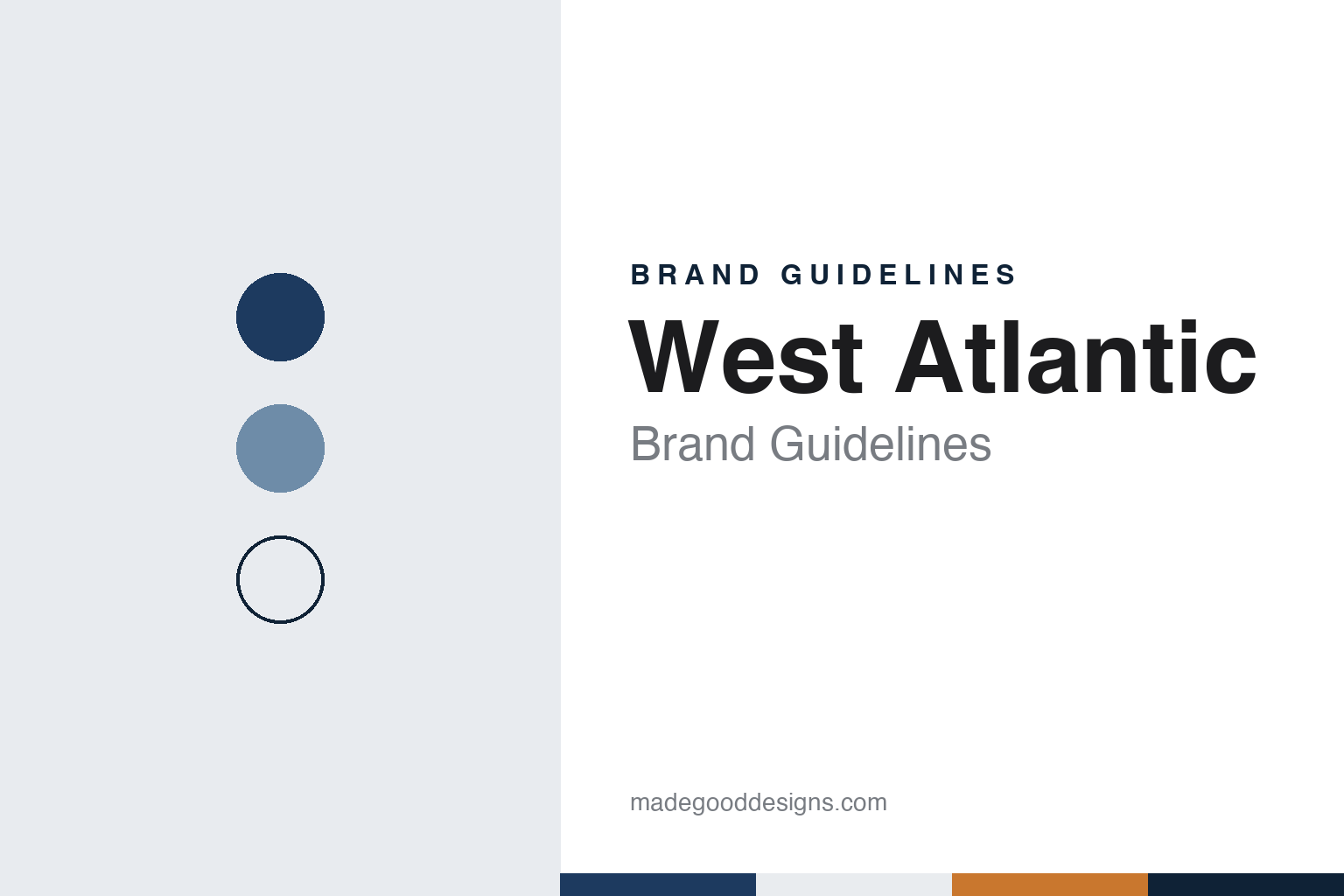
Two constants: a West Atlantic deep blue, grey-blue and amber palette and a Sturdy grotesque register. Abstract homage — not a West Atlantic aircraft, livery or mark; no logo is reproduced.
Two night carriers
A small Karlstad airline and a British freight operator.
West Atlantic is a cargo airline group with two halves, one Swedish and one British. The Swedish half is older. In a 2010 profile, the Swedish aviation news site Flygtorget traced it to West Air Sweden, a small airline from Karlstad that had existed since the 1950s and was up for sale in the mid-1990s. Swedish Wikipedia gives its founding year as 1955 and says it was started by the Karlstad coffee roaster Löfbergs, which needed fast transport; the group’s own website says it has been in air cargo logistics since 1962.
The modern business began with Sweden’s mail. According to Flygtorget, when the Swedish postal service moved away from sorting mail on trains in the mid-1990s, a group of founders including Gustaf Thureborn, Ruben Werjefelt and Göran Berglund decided to launch a dedicated air freight company. Rather than start one from scratch, they bought West Air Sweden. In the postal tender advertised in 1996, it won three of thirteen contracts and began flying with three Hawker Siddeley 748 freighters. A brief passenger service between Gothenburg and Sundsvall was dropped, and the airline concentrated on freight.
The British half is Atlantic Airlines. English Wikipedia says it was formed in 1994 by the British operator Air Atlantique to supply contract and ad hoc cargo flights, became Atlantic Airlines Limited after a management buy-in in March 2001, and passed fully to its managers in a buyout in May 2004. It flew from Coventry Airport, and was known for keeping Lockheed Electra freighters in service until 2013.
In 2008 West Air Sweden bought Atlantic Airlines, and the two were brought together under the shared name West Atlantic, Flygtorget reported in 2010, calling the combined business one of Europe’s largest cargo airlines. In 2014 the same site described the group as Gothenburg-based. The British company kept the Atlantic Airlines name until 31 October 2017, when it became West Atlantic UK Limited, according to English Wikipedia.
Colour
Mail, parcels and express freight, mostly at night.
West Atlantic’s customers are other logistics businesses rather than shippers walking in from the street. The group describes its airline as tailored aircraft solutions for global integrators, national mail organisations and business-to-business e-commerce suppliers, sold as wet leasing, ACMI and full charter. It holds two air operator certificates, one in the UK and one in Sweden, a point repeated by Air Cargo News in December 2025.
Its British operation moved in November 2017. East Midlands Airport announced that month that West Atlantic UK had relocated from Coventry, leasing hangar space close to its key customers DHL and Royal Mail. The airport also hosted the group’s next step: in April 2018 it announced that West Atlantic had received the first 737-800 Boeing Converted Freighter, the first of four it was leasing, to fly a twice-nightly route to Belfast for Royal Mail. The 737-800 lease, from GECAS, had been announced in June 2017. A company post from September 2018 describes a second 737-800 entering service for FedEx, flying routes to Liège and Oslo.
The fleet has changed several times. Flygtorget reported in January 2014 that the American group ATSG was buying a quarter of West Atlantic and adding larger aircraft; at that time the group flew more than forty BAe ATP turboprops. Boeing 767 freighters followed in 2015, and the ATPs were later retired. The group now lists ATR 72 freighters, Boeing 737-300, 737-400 and 737-800 freighters and the Boeing 757-200 on its website. In December 2025, Air Cargo News reported that the lessor World Star Aviation had delivered another 737-800 converted freighter to West Atlantic UK, the first of two more after an initial three.
The group also sells services beyond flying. Its aircraft management arm, West Atlantic Aircraft Management, buys, sells and dry-leases aircraft and engines, and its maintenance organisation holds an EASA Part 145 approval, with base maintenance in East Midlands, the Isle of Man and Oslo, the company says.
Its own stories show the range of cargo. One describes racehorses flown from Dublin to Dubai on a 737, standing in custom-built boxes with grooms on board; another, a weekday mail run that carries letters, cards and parcels as far north as Svalbard, in the Norwegian Arctic.
Typography
How cargo airlines present themselves.
Cargo airlines address a particular audience: freight forwarders, shippers and airport partners. Much of their identity travels on the aircraft itself. A freighter carries the livery of its parent airline or of its own cargo brand, and the fleet photographs that airlines publish on their websites and in press releases are among the most visible images of the business. In this group, the guides describe those liveries only as dated sources describe them.
Maps and schedules do a large share of the work. Cargo airlines publish network maps, hub information and seasonal timetables, because customers plan around routings and capacity as much as destinations. Nippon Cargo Airlines, for example, posts its summer and winter timetables and its road feeder schedules on its website, while Qatar Airways Cargo announces new freighter routings with their stops and weekly capacity in tonnes.
Product names carry much of the rest. Special cargo is sold under short names that the airlines set out on their own pages and in press releases, covering services for pharmaceuticals, perishables, live animals, couriers and high-value goods, each described in the terms the airline chooses. Qatar Airways Cargo, for instance, names products such as Pharma, Fresh and TechLift. The guides quote these names as the airlines give them and do not compare one service with another.
The working end of a cargo brand is digital. Shipment tracking by air waybill number, online booking portals, fuel surcharge notices and schedule downloads are where customers meet the identity day to day. The guides in this group set out what dated sources say about each airline’s history, ownership, fleet and network, and treat the palettes and typefaces shown here as unofficial interpretations rather than official brand assets.
Aa
A sturdy grotesque for an airline that works the night shift. (Specimen set in Archivo, a sans STAND-IN; NOT the West Atlantic logo.)
West Atlantic
From Gothenburg to Malmö, and into a Spanish group.
Ownership has changed twice in the last dozen years. After ATSG took its stake, the group looked for more capital. In March 2019 Flygtorget reported that West Atlantic was negotiating with Lusat, the Spanish owner of the cargo airline Swiftair and the lessor Aviation Leasing. On 10 April 2019 The Loadstar reported that Lusat had taken control: a memorandum of understanding signed the day before set out a refinancing and the issue of new shares, which made Lusat the majority shareholder. Air Cargo News confirmed in October 2025 that Swiftair Group had acquired West Atlantic in 2019, the year after it bought Cygnus Air. English Wikipedia describes Swiftair as a sister airline that supplied West Atlantic UK with its first ATR 72 in November 2020, for a route between East Midlands and Guernsey flown for DHL.
The same October 2025 report said that a fund of Antin Infrastructure Partners had agreed to take a majority stake in Swiftair Group, with founder Salvador Moreno staying on as chief executive; the deal was announced on 2 October 2025.
The head office has moved too. From 1 July 2020 the Swedish companies moved to Malmö Airport at Sturup, the group announced, and its website now gives its group headquarters in Malmö, with the British airline at East Midlands Airport. Swedish Wikipedia says the Swedish certificate had three aircraft in November 2025 and that, in 2023, the group lost its contracts for Norway’s post to the Polish airline Sprint Air.
Visually, the group keeps things plain. Its website pairs the West Atlantic name with a wing symbol, and its pages lean on fleet photographs, aircraft specification sheets and a route map of current and past services rather than slogans. The site says the group operated more than 24,000 flights in 2017 and served more than fifty destinations.
For a design guide, West Atlantic shows how a business-to-business airline can merge two national histories under one quiet name. Compare ATSG, its former minority shareholder, and DHL, one of the customers it flies for. For this guide we use a deep blue, a grey-blue and an amber with a sans, an unofficial interpretation; no product or logo is reproduced.
Explore & save
Keep West Atlantic’s identity on hand — save it to a board in the Made Good inspiration library.
West Atlantic identity set
Pin the West Atlantic deep blue, grey-blue and amber palette and the Sturdy grotesque register to your own board.