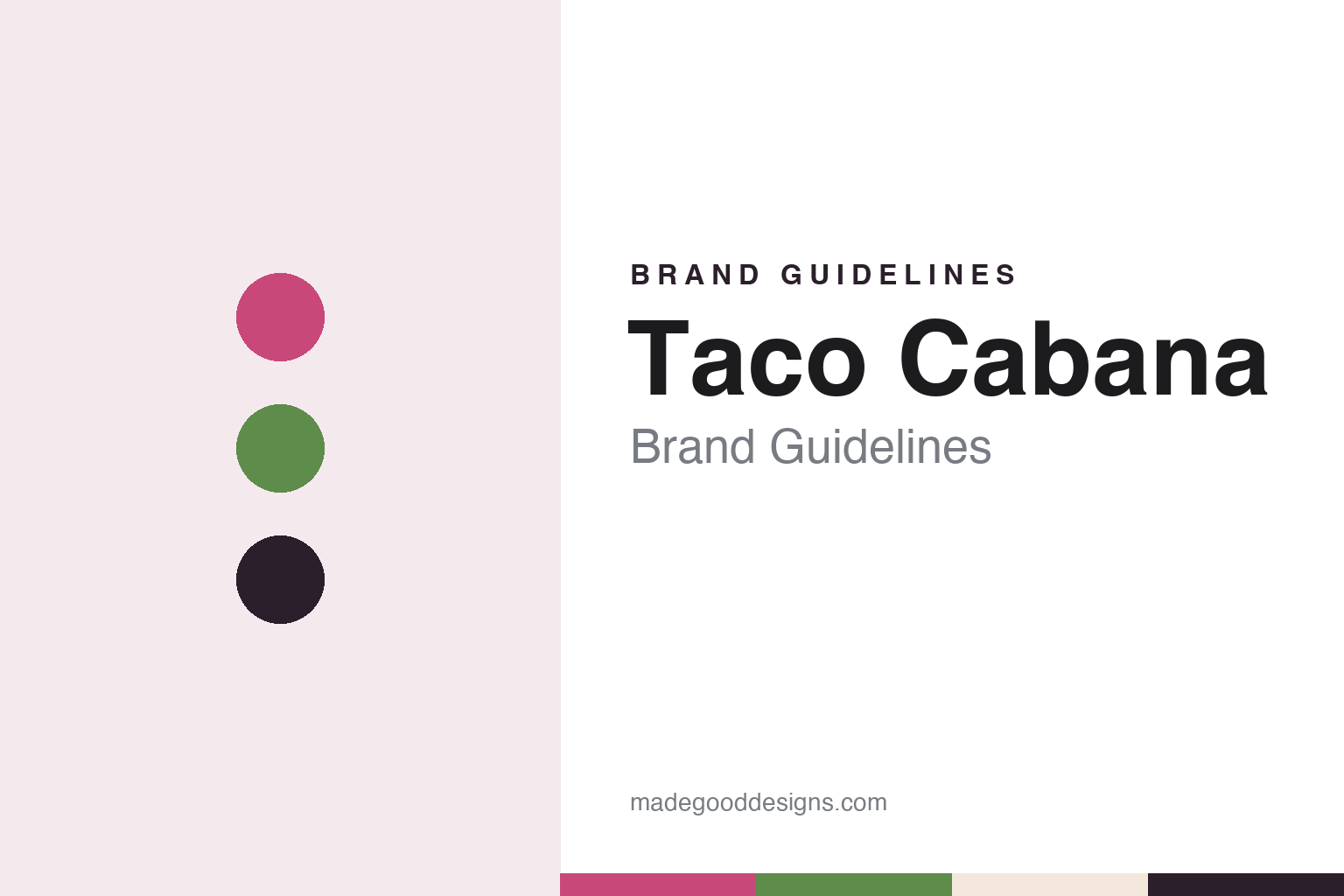
Taco Cabana Brand Guidelines
A 1978 San Antonio patio cafe and a Supreme Court trade dress.
Aa
Two constants: a patio pink, agave green and deep plum palette and a slab serif register. Abstract homage — not a Taco Cabana product or mark; no logo, sign or building is reproduced.
A taco stand on a patio
A former Dairy Queen in Midtown San Antonio.
Taco Cabana opened in San Antonio, Texas, in September 1978. The date comes from the US Supreme Court’s 1992 opinion in the chain’s trade dress case, and English Wikipedia adds the setting: Felix Stehling bought a vacant Dairy Queen in Midtown San Antonio, across the street from a bar his family ran, largely for the parking, and decided to put a taco stand in it. The building was open to the air, and English Wikipedia says that layout became the “patio cafe” plan behind every later restaurant. It also says the restaurant stayed open around the clock from its early days, served beer and margaritas, and cooked fresh food rather than prepared packs.
The chain grew slowly at first. The Supreme Court opinion says five more restaurants had opened in San Antonio by 1985, and that Taco Cabana entered Houston and Austin in 1986 before moving into Dallas and El Paso. English Wikipedia says Stehling’s brothers helped build the chain to nine restaurants, that expansion beyond Texas began in 1990 and that the company went public in 1992. In January 1993 Taco Cabana agreed to buy the restaurant assets of its rival Two Pesos, converting most of them into Taco Cabanas and closing others, English Wikipedia says.
Public ownership did not last. KSAT, citing the San Antonio Express-News, said in 2021 that the company was sold in 2000; English Wikipedia says it became a wholly owned subsidiary of Carrols Restaurant Group in 2001. In 2012 Carrols spun Taco Cabana and its sister chain Pollo Tropical off into a new listed company, Fiesta Restaurant Group. On 1 July 2021 Fiesta agreed to sell Taco Cabana to YTC Enterprises, an affiliate of Yadav Enterprises, a large franchisee of Jack in the Box, Denny’s, TGI Fridays and El Pollo Loco, Restaurant Dive, Restaurant Business and KSAT reported. The deal covered 142 company-run restaurants in Texas and six franchised ones, and English Wikipedia says it was completed in August 2021.
Colour
The look the Supreme Court protected.
Taco Cabana’s own description of its trade dress, quoted in the Court’s opinion in Two Pesos, Inc. v. Taco Cabana, Inc., decided on 26 June 1992, describes the building in detail: a festive eating atmosphere with interior dining and patio areas decorated with artifacts, bright colours, paintings and murals; an interior patio that overhead garage doors can seal off from the outside patio; a stepped exterior in a vivid colour scheme with top border paint and neon stripes; and bright awnings and umbrellas to carry the theme. English Wikipedia credits Billie Jo Stehling with the original décor and interior theme.
The case followed the opening of a Two Pesos restaurant in Houston in December 1985 with what the Court called a motif very similar to Taco Cabana’s. Taco Cabana sued in 1987 in federal court in Texas under section 43(a) of the Lanham Act. The jury found that the trade dress was non-functional and inherently distinctive, that it had not acquired secondary meaning in the Texas market, and that the copying was likely to confuse customers; the trial court held the infringement deliberate, and the appeals court affirmed. The Supreme Court then held that inherently distinctive trade dress can be protected without proof of secondary meaning, and upheld the judgment for Taco Cabana.
Colour sits at the heart of that look. English Wikipedia says the chain is known for its pink colour scheme and its semi-enclosed patios, with many menu items handmade each day in open cooking areas. On the menu, English Wikipedia says flautas became permanent in 2002 after a trial run; it also dates the Dozen Breakfast Tacos box to April 2004 and all-day breakfast items to January 2018.
Typography
Design and documentation.
Mexican and burrito fast-casual chains tend to present themselves through the counter as much as the sign. The format is usually the same in outline: a menu of burritos, bowls, tacos and nachos, a kitchen line where each order is made up in front of the customer, and a choice of eating in, taking away or ordering ahead. The Caterer described one Australian chain’s signature dishes in 2025 simply as “customisable burritos and bowls,” and companies in the category describe their own kitchens in terms of speed and made-to-order assembly.
Names in the category often borrow Spanish words or invented surnames, and the shortened form can matter as much as the full one. Guzman y Gomez, named after two of a founder’s childhood friends according to English Wikipedia, is generally shortened to three initials. The same company calls its head offices Hola Central, and Zambrero’s UK chief executive called the chain’s franchise partners the “Zam Fam” in 2025, so the naming habit often reaches past the menu into the business itself.
Visual identities in the category often lean on bright colour and hand-made graphic details, as the companies describe them. Guzman y Gomez says its logo letters are drawn to look like sticky tape, a nod to street art in Mexico, and Inside Retail reported in 2023 that Zambrero had moved to a brighter, more upbeat look for posters, decals, signage and menus while keeping its green colourway. In both cases a small set of colours and one recognisable graphic idea are meant to carry from the shop front to the menu board.
Behind the counters sit very different businesses: founder-owned franchisors, private-equity-backed groups, chains that have been through administration or Chapter 11, and companies listed on a stock exchange. Their corporate pages set out founding stories, founders and timelines of openings, while dated press and official records fill in owners, listings and closures.
Aa
A sturdy slab serif with a hand-painted-sign warmth. (Specimen set in Bitter, a serif STAND-IN; NOT the Taco Cabana logo or brand font.)
Taco Cabana
Remodels, a new owner and TC 3.0.
The building has been redrawn several times since the court case. English Wikipedia says that in 1996 the chain brought a design reminiscent of an old Mexican cafe to the Dallas–Fort Worth area, with a rounded front, clay tile roofing, aged wood panelling and stainless steel counters, and that in 2003 it built a prototype around an eight-foot char-grill. A system-wide renovation from 2012 hung decorative metal estrella, or star, lights from the ceilings, added papel picado accents and covered walls with large street-life photographs from Mexico.
Under Yadav ownership the chain has kept San Antonio as its home and built another prototype. When a new restaurant opened in Spring, Texas, on 14 June 2024, it showed a design called TC 3.0, with a patio, a walk-up window and two drive-through lanes, El Restaurante reported; it was the second restaurant built to the new look. The company’s website, run in 2026 by Texas Taco Cabana, L.P., calls the chain a Mexican fast casual restaurant and promotes catering and a rewards app, MY TC!. The chain has had three owners since 2001: Carrols, Fiesta and, from 2021, YTC Enterprises.
For a design guide, Taco Cabana shows how a restaurant’s whole setting, from its stepped front and awnings to its colour and patio, can work as a brand mark, strongly enough for the US Supreme Court to protect it. Compare Pollo Tropical, its former sister brand under Carrols and Fiesta, and Chuy’s, another Texas Tex-Mex chain. For this guide we use patio pink, agave green and deep plum with a serif, an unofficial interpretation; no product or logo is reproduced.
Explore & save
Keep Taco Cabana’s identity on hand — save it to a board in the Made Good inspiration library.
Taco Cabana identity set
Pin the Taco Cabana patio pink, agave green and deep plum palette and the slab serif register to your own board.