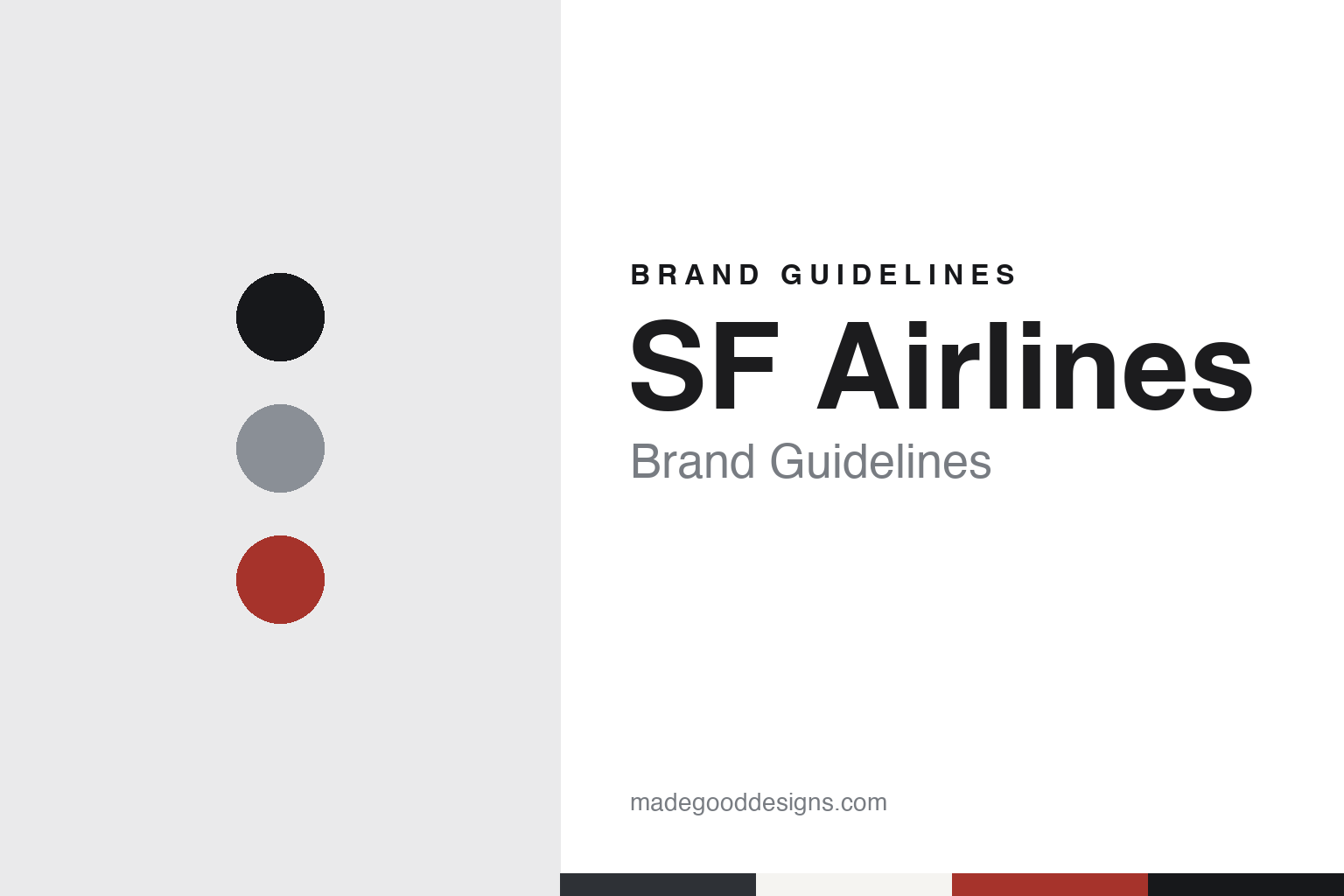
SF Airlines Brand Guidelines
SF Express’s Shenzhen freighter fleet, from one aircraft in 2009 to a hub at Ezhou.
Aa
Two constants: an ink, charcoal and freight red palette and a technical sans register. Abstract homage — not an SF Airlines asset or mark; no aircraft, livery or logo is reproduced.
A courier takes to the air
SF Express builds its own airline.
SF Airlines is the airline of SF Express, the Chinese courier that Wang Wei founded in 1993 in Shunde, Guangdong. English Wikipedia says SF Express began as a small service with six employees, carrying factory samples between Guangdong and buyers in Hong Kong. Its parent company, SF Holding, trades on the Shenzhen and Hong Kong stock exchanges. English Wikipedia says the courier’s cargo aircraft are owned by SF Airlines, and Chinese Wikipedia describes the airline as wholly owned by SF Holding.
The airline took several years to set up. English Wikipedia says a preparatory team was formed in 2005. The Civil Aviation Administration of China approved its preparation in 2008 according to Chinese Wikipedia, and in 2009 according to English Wikipedia; the two versions differ. Both agree that the maiden flight took place on 31 December 2009. Quoted by Air Cargo News in March 2025, SF Express said the airline started in 2009 with a single aircraft, and its Chinese website calls SF Airlines the first privately owned express airline in China.
The first aircraft were narrowbody freighters. English Wikipedia says a Boeing 757-200F was joined by a second soon after flights began in 2010, that the first Boeing 737-300F flew for the airline in 2011 and that a 737-400F followed in 2012. In 2011, the same article says, SF Airlines also gained approval to operate international routes.
The company is headquartered at Shenzhen Bao’an International Airport. Its English website describes SF Airlines as the cargo airline subsidiary of SF Express, operating through four main hubs at Shenzhen, Hangzhou, Beijing and Ezhou, and calls it a key part of the air network that SF names “SkyNet.” The site’s tagline asks to be the customer’s “most trustworthy air freight partner.”
Colour
From 757s to widebody freighters.
The fleet grew in steps, and the company’s own timeline marks each one. It says SF Airlines passed 10 aircraft by 2012. Between 2013 and 2016 it opened its first international route, Shijiazhuang–Incheon, put its first Boeing 767-300 widebody freighter into service, joined the International Air Transport Association and passed 30 aircraft. Between 2017 and 2019 its first Boeing 747-400 freighter arrived, the fleet passed 50 and the airline opened its first intercontinental route, a loop from Wuxi via Chongqing to Hahn in Germany and back. By 2022 the count had passed 70.
Outside reports fill in the detail. English Wikipedia says that in October 2014 Boeing announced it would convert an undisclosed number of 767-300ER passenger jets into freighters for SF Airlines, with the first entering service in 2015, and that the airline had 26 Boeing aircraft by the end of that year, when it also set up a hub at Hangzhou Xiaoshan. In November 2017, the same source says, SF Airlines bought two 747-400ERF freighters that had belonged to the defunct Jade Cargo International, at an auction.
On 17 March 2025 Air Cargo News reported that the airline’s 90th freighter, a converted 767-300, had arrived at Shenzhen, citing the Xinhua news agency. The same report said Boeing had delivered its 100th converted 767-300 freighter to SF Airlines the month before, and that the airline added its first Boeing 737-800 freighter in December 2024. It also noted that the fleet-tracking site Planespotters counted 80 aircraft in service at the time, a lower figure than the company’s own.
The company’s website now lists four 747s, 25 767s, 43 757s and 18 737s, 90 freighters in all, and says the fleet is counted as the freighters currently in operation. Its Chinese pages describe SF Airlines as the cargo airline with the largest freighter fleet in China. The website also records specialist work in its own words: a dedicated freighter route for Yunnan matsutake mushrooms in August 2021, a set of lychee routes in May 2025, and its first flight carrying a giant panda in the period since 2023.
Typography
How cargo airlines present themselves.
Cargo airlines address a particular audience: freight forwarders, shippers and airport partners. Much of their identity travels on the aircraft itself. A freighter carries the livery of its parent airline or of its own cargo brand, and the fleet photographs that airlines publish on their websites and in press releases are among the most visible images of the business. In this group, the guides describe those liveries only as dated sources describe them.
Maps and schedules do a large share of the work. Cargo airlines publish network maps, hub information and seasonal timetables, because customers plan around routings and capacity as much as destinations. Nippon Cargo Airlines, for example, posts its summer and winter timetables and its road feeder schedules on its website, while Qatar Airways Cargo announces new freighter routings with their stops and weekly capacity in tonnes.
Product names carry much of the rest. Special cargo is sold under short names that the airlines set out on their own pages and in press releases, covering services for pharmaceuticals, perishables, live animals, couriers and high-value goods, each described in the terms the airline chooses. Qatar Airways Cargo, for instance, names products such as Pharma, Fresh and TechLift. The guides quote these names as the airlines give them and do not compare one service with another.
The working end of a cargo brand is digital. Shipment tracking by air waybill number, online booking portals, fuel surcharge notices and schedule downloads are where customers meet the identity day to day. The guides in this group set out what dated sources say about each airline’s history, ownership, fleet and network, and treat the palettes and typefaces shown here as unofficial interpretations rather than official brand assets.
Aa
A technical sans for fleet tables and route maps. (Specimen set in IBM Plex Sans, a sans STAND-IN; NOT the SF Airlines logo.)
Ezhou
A cargo airport built around one network.
The largest change of recent years is Ezhou Huahu, an airport in Hubei province. English Wikipedia says it was developed by SF Express and Hubei province as a logistics hub, chosen partly because Ezhou sits at a similar distance from Shanghai, Beijing and Guangzhou. The airport opened for passengers on 17 July 2022, and cargo service began on 27 November 2022. English Wikipedia adds that it was renamed Ezhou Huahu International Airport in May 2025. Air Cargo News wrote in April 2026 that SF Express developed it to serve as China’s first cargo-focused airport.
SF Airlines says it opened the first international cargo route from Ezhou Huahu, to Liège in Belgium. Air Cargo News reported that the airline launched flights from Ezhou to East Midlands Airport in England on 8 March 2026, and that on 1 April 2026 a Boeing 747-400 freighter flew the first service from Ezhou to Paris-Charles de Gaulle. Other recent routes named in that report link Chongqing with Yangon and Zhuhai with Delhi. The company’s website counts more than 130 stations served since 2009.
Fuel has become part of the story too. On 19 August 2026 Air Cargo News reported that the fuel producer EcoCeres, SF Group and the China National Aviation Fuel Group had launched a programme under which sustainable aviation fuel blended by the state fuel group would be supplied to outbound SF Airlines freighter flights from Ezhou. The report noted that EcoCeres did not say how many of those flights would use it.
For a design guide, SF Airlines shows how a courier’s airline presents itself through fleet counts, hub names and route launches rather than passenger cabins. Compare FedEx, the US express group, and China Cargo Airlines, the Shanghai freighter carrier. For this guide we use ink black, hangar charcoal and a muted freight red with a technical sans, an unofficial interpretation; no product or logo is reproduced.
Explore & save
Keep SF Airlines’s identity on hand — save it to a board in the Made Good inspiration library.
SF Airlines identity set
Pin the ink, charcoal and freight red palette and the technical sans register to your own board.