Puma Energy Brand Guidelines
A 1929 Argentine forecourt name, carried across four continents by Trafigura.
Aa
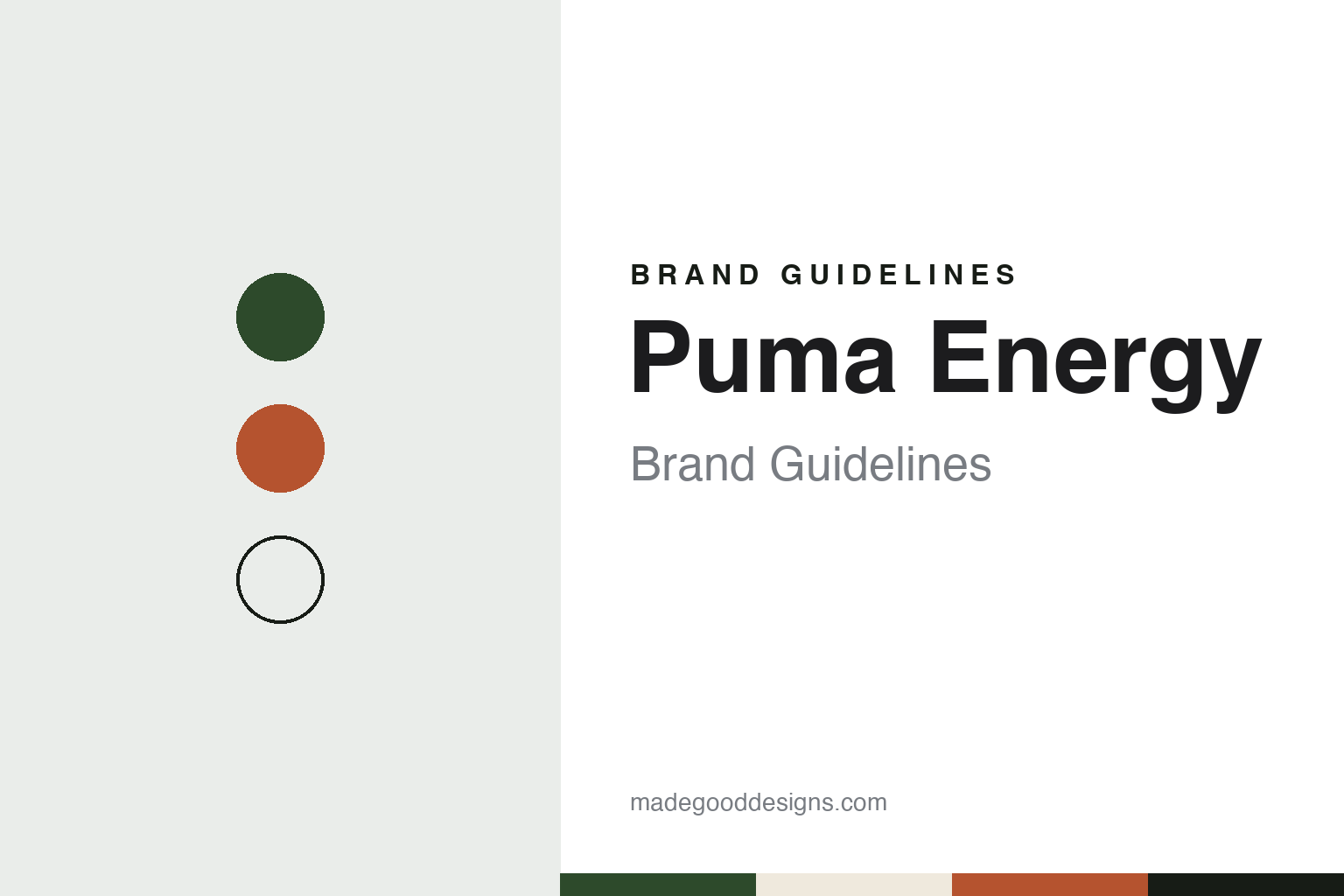
Two constants: a pampas green, clay red and dust palette and a sturdy grotesque register. Abstract homage — not a Puma Energy asset; no logo, animal mark or sign is reproduced.
A Name From Argentina
A 1929 forecourt brand, bought by Trafigura in 1997.
The Puma name is older than the company that now carries it. English Wikipedia says the brand was created in Argentina in 1929 by Compañía General de Combustibles (CGC), a company founded in 1920 to transport and market crude oil and its by-products. By the end of that decade CGC was running its own service stations under the Puma name. Over the following decades it added sites and spent on advertising, and it later took the brand to Ecuador alongside its oil exploration there.
In Argentina the name then went quiet. CGC merged with two other local oil companies in 1994 to form Eg3, which Repsol bought in 1997; Petrobras later took the business over and renamed the stations, English Wikipedia says. In 1997 the Swiss-based trader Trafigura bought the rights to the Puma brand. The company that grew from that purchase began in Central America the same year as an oil storage and distribution network, according to the same article.
Trafigura has stayed in control. In April 2021 Angola’s state oil company, Sonangol, announced the sale of its 31.78% holding in Puma Energy to Trafigura, the Portuguese news agency Lusa reported on 16 April 2021. Under the same three-way agreement Sonangol agreed to take over the Pumangol retail network of 79 fuel stations in Angola, several airport terminals and a storage terminal on Luanda Bay, with a one-year transition period to replace the Pumangol logo, Lusa said. English Wikipedia now gives Trafigura a 96% stake. Trafigura’s results statement of June 2026 lists Puma Energy among its operating businesses, as a fuel storage and distribution company.
Colour
Built by buying other companies’ forecourts.
Puma Energy grew by buying other companies’ downstream businesses and putting its own name on them. It entered Africa in Congo-Brazzaville in 2002, English Wikipedia says, and then expanded into Ghana, Mozambique, Nigeria and other markets. In September 2011 it completed the purchase of BP’s downstream interests in Namibia, Botswana, Zambia, Malawi and Tanzania, a package that included more than 190 service stations, according to the same article. In 2015 it added retail and lubricant assets in South Africa from Brent Oil and Drakensberg Oil.
The Americas followed a similar pattern. In March 2012 the company bought ExxonMobil’s downstream businesses in Guatemala, El Salvador, Honduras, Nicaragua, Panama and Belize, and in July 2012 Chevron’s fuel distribution and storage business in Puerto Rico and the US Virgin Islands, including 192 Texaco stations. In March 2015 it bought the Colombian distributor Save Combustibles, with 135 stations. The name came home in May 2016, when a station opened in Saladillo and about 250 former Petrobras stations in Argentina were rebranded as Puma after Trafigura bought Petrobras’s local assets, English Wikipedia says. In 2023, the article adds, Puma Energy agreed with Shell to use the Shell brand at some of its stations in Honduras and El Salvador.
In the Asia-Pacific region, Puma Energy entered Australia in January 2013 with Neumann Petroleum in Queensland, followed by Ausfuel, which included Gull. That chapter ended when Chevron completed its purchase of Puma Energy’s Australian business on 1 July 2020, and the stations were progressively rebranded as Caltex from early 2022, English Wikipedia says. In Papua New Guinea the company bought InterOil’s Napa Napa refinery and retail network in 2014. Puma Energy says it owns and operates two refineries, in Nicaragua and Papua New Guinea.
Typography
Canopies, shops and loyalty cards.
Fuel retailers rarely present a single face. Many forecourt groups run their stations under oil companies’ brands while building names of their own in the shop and the charging bay. Motor Fuel Group, the British operator, says its stations trade under six fuel brands — BP, Shell, Esso, Texaco, JET and Murco — alongside its own EV Power charging brand. In the United States, the British-founded EG Group renamed itself in 2026 after Cumberland Farms, its largest American store banner, and plans to convert hundreds more stores to that name, C-Store Dive reported.
Inside, the convenience store and the food-to-go counter carry much of the offer. MFG lists Londis, Budgens and Morrisons Daily shops alongside Greggs, Pret, Subway and Burger King, and in May 2026 hosted the first trial of Greggs Express, a compact self-service unit. Cumberland Farms plans to take Krispy Krunchy Chicken to 500 locations by 2030 and is piloting its own Maxi Fresh Bakery in Germany, according to the same publication.
Apps and maps do much of the remaining work. MFG’s Connect app lets drivers start and pay for charging sessions, and the station finder on its website covers both fuel stations and charging hubs. Coen Markets, the Pittsburgh-area chain that Cumberland Farms agreed to buy in March 2026, describes its Club Coen loyalty programme as part of its growth. In Australia, Ampol’s completion of its purchase of EG Australia in July 2026 came with plans for a wider rollout of the Woolworths Everyday Rewards programme across the sites, according to a TipRanks summary of Ampol’s announcement.
Charging is the newest addition. MFG announced plans in March 2021 for ultra-rapid chargers across 500 sites, said in July 2025 that it had passed 1,000 ultra-rapid bays, and since May 2026 has offered Plug & Charge across most of its network through Octopus Electroverse. The guides in this group set out what each company publishes about those formats, and what independent sources record about who owns them.
Aa
A sturdy grotesque for a one-word name that travels. (Specimen set in Archivo, a sans STAND-IN; NOT the Puma Energy logo.)
The Puma Forecourt
Super7, Shop Express and a loyalty scheme called Puma Pris.
On its website Puma Energy gives its retail network as around 2,201 sites and about 893 convenience stores in around 21 countries, alongside more than 6,000 business customers and around 107 airports and airfields served. Its convenience brands are Super7 and Shop Express, and it says it is rolling out a loyalty programme called Puma Pris. For mini-markets it partners with Circle K and OK Express, the company says, and it describes “rural stations” that bring fuel, banking and other everyday services to remote communities.
Much of the business sits behind the forecourt: commercial fuels, aviation fuel, lubricants, LPG, bitumen and solar projects. Puma Energy says it supplies Jet A-1 and Avgas to airlines and airports, and its website counts 27 bitumen terminals. English Wikipedia places the headquarters in Singapore, with regional offices in Geneva, Johannesburg and Panama City. In 2025, English Wikipedia says, the company became a partner of the CONMEBOL Libertadores and CONMEBOL Sudamericana football competitions in South America, after earlier sponsorship in Africa that included the Zambia International Rally and, in 2012, the Malawi Open Tennis Championship.
The name is what holds this together. The country list on the company website runs from Panama and Puerto Rico to Zambia, Ghana and Papua New Guinea, and in each case the stations came from another owner before they carried the Puma name. Puma is the same word in Spanish, Portuguese and English.
For a design guide, Puma Energy shows how a single short name can be carried across very different markets, one acquisition at a time. Compare Circle K, a partner in its mini-markets, and Vivo Energy, another trader-owned fuel group with a large African network. For this guide we use pampas green, clay red and dust with a sans, an unofficial interpretation; no product or logo is reproduced.
Explore & save
Keep Puma Energy’s identity on hand — save it to a board in the Made Good inspiration library.
Puma Energy identity set
Save the Puma Energy pampas green, clay red and dust palette and the sturdy grotesque register for your own reference.