Connected Kerb Brand Guidelines
Charging built into the kerb for drivers without a driveway.
Aa
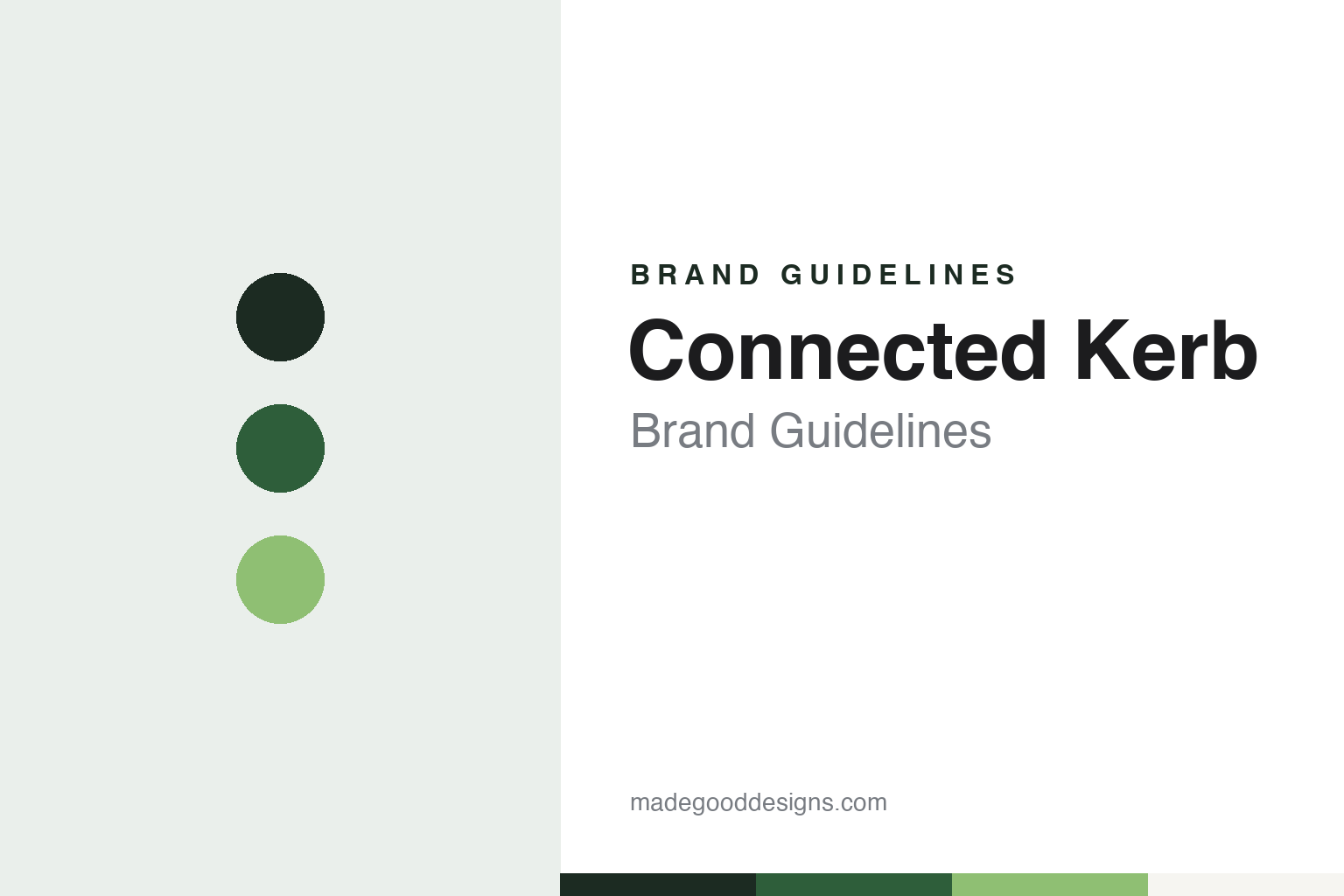
Two constants: a street green, ink and leaf palette and a rounded geometric sans register. Abstract homage — not a Connected Kerb product or mark; no charger, logo or app screen is reproduced.
A charger for the street
A design award before a network.
Connected Kerb dates itself to 2017, when, in its own words, a group of people “came together” with the aim of making electric-vehicle charging available to everyone. The company is registered in England and Wales and based in London, and a Reuters report from November 2021 described it in the same way, as a London-based charging-infrastructure company. Press coverage of a 2022 investment quoted Peter Howe as a co-founder, and Chris Pateman-Jones has spoken for the company as chief executive since at least 2021.
The company’s story starts with an object rather than a network. It says its first task was to design a charging point that would suit its surroundings and become part of a neighbourhood, and that in 2018 the design won a London Civic Innovation Award. From there it set out to supply on-street charging to people who park on the road, the group that its own pages describe as unable to charge at home.
That focus shaped the business. Reuters reported in November 2021 that Connected Kerb had about 1,000 public chargers in service and contracts for 10,000 more, and that it planned to install 190,000 on-street public chargers in the UK by 2030. The same report described its model: long contracts of 15 to 25 years, financed by large infrastructure banks and investors such as Equitix, with UK government subsidies used for some residential chargers.
The company now gives its size as more than 120 employees, and its impact page reports more than 3,000 charging sockets installed in 2025, taking it past 10,000 public sockets at more than 2,000 locations around the UK.
Colour
Infrastructure below ground, a post above it.
The signature idea is in the pavement. Describing the system in September 2022, CleanTechnica reported that Connected Kerb lays its charging infrastructure below ground and installs it once, leaving passive chargers that can be “switched on” later by adding the above-ground charge point as local demand grows. Each charge point, the same report said, delivers between 7 and 22 kW, a range meant for regular overnight or all-day charging by residents who park in the same street.
That approach matches the long contracts. CleanTechnica wrote that the company offers contracts of 15 to 25 years, far longer than the five to seven years it called typical for the industry, and that the long term lets it raise private finance on better terms and install chargers in places that would otherwise not pay. Payment is contactless through the Connected Kerb app, with one network and one price structure across its sites, the report said.
Much of its work is for councils. Transport + Energy reported in October 2026 that the company’s long-term contracts cover Ceredigion, Cardiff, Plymouth, South Tyneside, Oxfordshire, Surrey, Coventry and several London boroughs, and that in Scotland it has installed chargers for councils on the ChargePlace Scotland network as well as under its own name. Earlier, in 2022, the company planned 10,000 public chargers in West Sussex, CleanTechnica reported. Its website also names work with Lambeth council and with businesses, fleets and property developers.
In 2026 the product range grew through a purchase. Connected Kerb acquired the business and assets of Trojan Energy, an Aberdeen company, including its Flat & Flush charging technology, which both Traffic Technology Today and Transport + Energy described as an on-street system designed to limit its impact on streetscapes, particularly in historic and heritage locations.
On the public side, the company says it was named on-street charging network of the year for 2025/2026 in the driver-voted awards of the charging app Zapmap. Its tone is informal: its website calls itself “irreverent but ethical, cheeky but kind,” and its sign-off is “one charge at a time.”
Typography
How charging networks present themselves.
EV charging networks sell something drivers cannot see: electricity delivered in a car park or at a service area. Their identities therefore lean on what can be pictured — the charger units, the buildings and shelters around them, the app and the network map — and on the names they give to different kinds of site. Gridserve, for example, sorts its network into Electric Forecourts®, Electric Super Hubs on motorways and Electric Retail Hubs, while Osprey defines a hub as a site with six or more ultra-rapid bays.
Hardware is often shown by name. Networks publish the makers of their chargers and the power ratings they quote for them: Osprey lists units from Circontrol, Wallbox, Tritium and Kempower on its chargers page, and Gridserve has installed ABB units capable of 400kW at its newer sites, according to Transport + Energy. Speeds in this guide are given only as each network or a dated report states them.
The app and the map carry much of the brand. Network maps use colour as a key — Osprey’s marks its fastest sites with orange pins — and apps handle payment, receipts and membership schemes; in 2026 Osprey added a feature that starts a charge as soon as a car is plugged in. Photographs of hubs and forecourts illustrate the networks’ news pages and the partner announcements carried by the trade press.
The other audience is the landlord. Gridserve and Osprey both keep pages for landowners and partners, because their sites are hosted by supermarkets, retail parks, pubs, councils and motorway service areas. This guide sets out what can be checked about each network — who founded it, who owns or funds it, and how it names and presents its sites — and marks clearly what rests on a company’s own word.
Aa
A rounded geometric sans for a friendly street presence. (Specimen set in Outfit, a sans STAND-IN; NOT the Connected Kerb logo.)
Connected Kerb
Long-term investors and a factory in Aberdeen.
Connected Kerb has been funded by long-term investors. In September 2022 it said it had secured investment from Aviva Investors, the asset-management arm of Aviva, to support its plan for 190,000 on-street chargers by 2030, Just Auto reported; as part of the deal it was also to install charging across Aviva’s European property portfolio, which included more than 300 assets in the UK.
A second round followed. On 29 January 2025 a further investment was announced from the National Wealth Fund, the UK government’s investment fund, which was to take an equity stake, with Aviva also contributing, Auto Express reported. The reports cited here cover the announcement, agreed in January 2025; they do not state when it completed.
The newest chapter is manufacturing. In October 2026, Traffic Technology Today and Transport + Energy reported that Connected Kerb, through its subsidiary Urban EV Infrastructure, had opened a manufacturing and innovation hub at the W-Zero-1 facility in Aberdeen’s Energy Transition Zone, building on the Trojan Energy acquisition. The site brings product development, prototyping, environmental testing, 3D printing and volume production together, and is to make the company’s full range; the company expects more than 3,000 public chargers to be built there in 2027 and a further 25,000 by the end of 2030.
For a design guide, Connected Kerb shows a charging brand designed for residential streets rather than motorways: low-power posts, contracts measured in decades and hardware meant to sit quietly on the pavement. Compare Shell Recharge, whose ubitricity unit also installs on-street chargers, and Pod Point, another British charging company. For this guide we use a street green, a dark ink and a leaf green with a sans, an unofficial interpretation; no product or logo is reproduced.
Explore & save
Keep Connected Kerb’s identity on hand — save it to a board in the Made Good inspiration library.
Connected Kerb identity set
Keep the Connected Kerb street green, ink and leaf palette and the rounded geometric sans register on your own board.