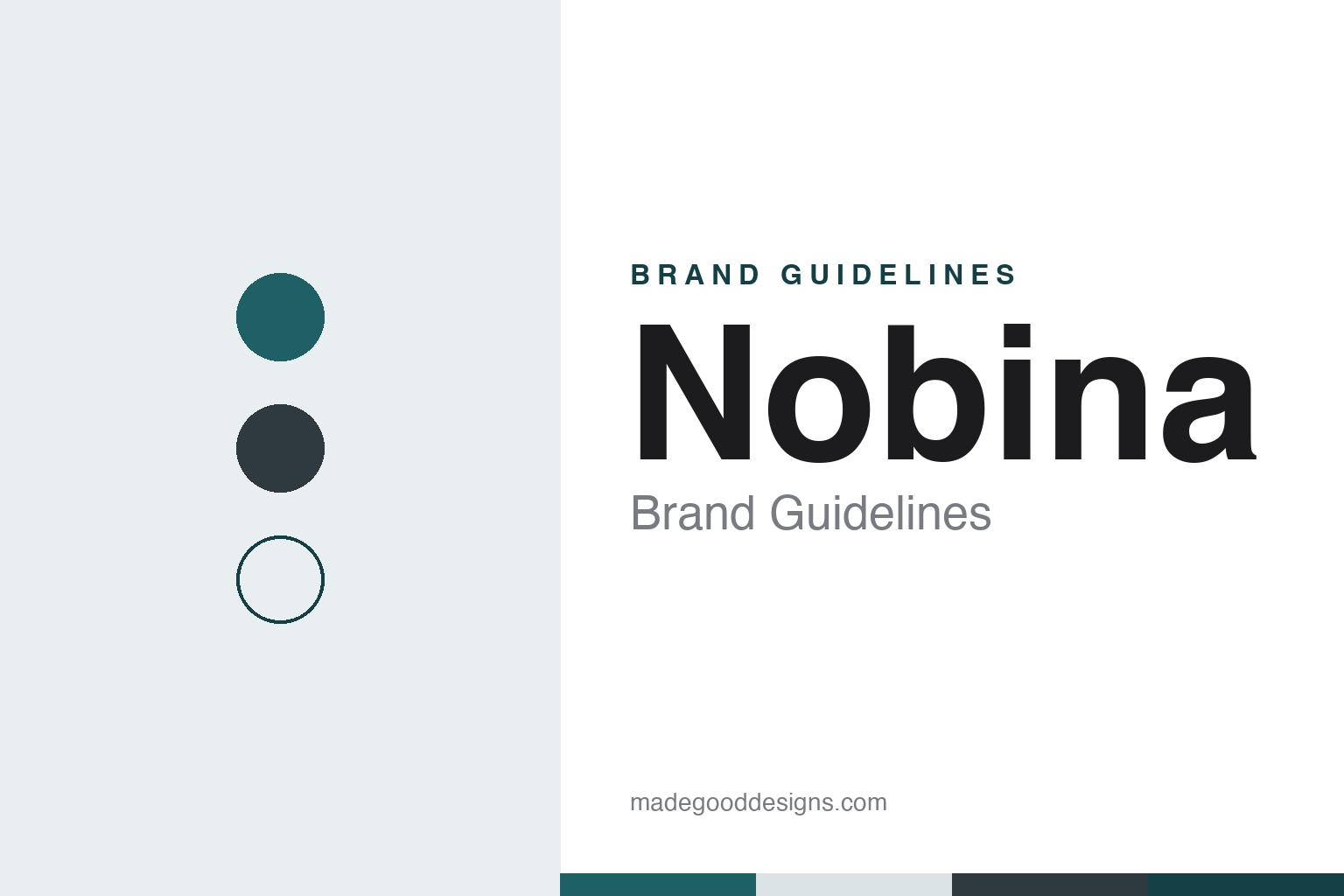
Nobina Brand Guidelines
One Nordic bus name over a century of local ones.
Aa
Two constants: a teal, slate and mist palette and a Nordic sans register. Abstract homage — not a Nobina asset; no livery, logo or vehicle is reproduced.
From SJ Buss to Concordia
A Swedish bus line in 1911.
Nobina is the group that runs public buses in Sweden, Norway, Denmark and Finland. It has carried the name only since 1 December 2009, when the Concordia Bus group renamed itself, English Wikipedia says. Its head office is in Solna, just north of Stockholm, according to Swedish Wikipedia.
The company traces its roots much further back. Its own history page says it all started in 1911, when SJ Buss, the bus arm of the Swedish state railways, opened a bus line from Tanum in Bohuslän, on Sweden’s west coast, with a 13-seat Büssing; the roads and vehicles were not ready, and the service was later stopped. In 1932 the railway company Trafikförvaltningen Göteborg-Dalarne-Gävle (GDG) started large-scale bus and truck operations. After the railway was nationalised in 1948, Nobina says, the bus business stayed with SJ as GDG Biltrafik. SJ then merged GDG and SJ Buss under the name Swebus, in 1991 according to Nobina and in 1990 according to Swedish Wikipedia.
Swebus changed hands as the Nordic markets opened to tendering. Stagecoach bought it from the state railways in 1996. In October 1999 Concordia Bus agreed to buy it from Stagecoach; the European Commission approved the deal that December and it was completed in January 2000, English Wikipedia says. Concordia Bus had been founded in 1997 by the Norwegian holding company Schøyen Gruppen and National Express; National Express left in 1999, when a Goldman Sachs subsidiary took a majority stake.
The Norwegian side came with Schøyen. Ingeniør M.O. Schøyens Bilcentraler, or SBC, was founded in March 1921 by Martin Olsen Schøyen, with its first routes on the Drøbak–Kristiania–Hønefoss axis, Norwegian Wikipedia says. The sources used for this guide do not say how SBC operated during the occupation of 1940–1945. In the late 1950s SBC ran route 30 in Oslo, which Norwegian Wikipedia calls the country’s busiest bus route at the time. Its ownership passed to Concordia Bus on 1 February 2001, and it became Concordia Bus Norge in 2007 and Nobina Norge in 2009.
Colour
Debt, a new name and a listing.
The Swebus purchase was partly financed with bonds. A restructuring completed in October 2005 converted those loans into shares, left the bondholders with almost all of the company and made the Swedish company Concordia Bus AB the head of the group, English Wikipedia says. In 2006 the group set up a fleet company to own its buses and lease them back to the operating companies; by March 2007 it held 3,503 buses. In October 2008 Concordia Bus Danmark started its first contract for Movia, the transport authority for the Copenhagen region, in North Zealand.
The 2009 rename to Nobina covered the whole group except the express coaches, which kept the old name and traded simply as Swebus. Nobina listed its shares on Nasdaq Stockholm on 18 June 2015, the company says, and on 2 May 2018 it sold Swebus to the German long-distance coach operator FlixBus, English Wikipedia says.
Growth then came through specialist transport as well as city and regional buses. Nobina says it completed the purchase of Samtrans, a Stockholm operator of special public transport services, in October 2018, and agreed to buy Göteborgs Buss in Gothenburg in December 2020 and Telepass in Skåne in 2021; Swedish Wikipedia lists all three among the group’s companies. Its website now presents three offerings: Nobina Bus, Nobina Care and Nobina Commercial.
Each country keeps its own operating company. Swedish Wikipedia lists Nobina Sverige, Nobina Norge, Nobina Danmark and Nobina Finland alongside a technology company and a fleet company. In Norway, Nobina Norge had about 1,200 employees and 312 buses in 2024, with routes in Oslo, Akershus and Østfold, Norwegian Wikipedia says.
Typography
Operators and their names.
Bus and coach operators present themselves first on the street. The vehicle carries the name, the colours and often a local or route brand, and liveries change gradually as buses are repainted or replaced. A group name can sit in the background while local names do the visible work: English Wikipedia says First’s purple, white and lilac “Olympia” livery reinstated local branding on its buses from 2012, after a decade in which the vehicles simply carried the First name.
Network maps, timetables and route names carry the identity onto stops, stations and screens, and who owns them depends on the contract. In London, operators such as Metroline tender for routes and run them as contractors under Transport for London, with fare revenue going to TfL, English Wikipedia says. Elsewhere an operator may run its own commercial network, its own coach brand or a franchise for a regional authority, such as the Bee Network services that Metroline Manchester began running for Transport for Greater Manchester in January 2025.
Ticketing has moved onto phones, and operators describe their apps in their own terms. FirstGroup says about 80% of First Bus ticket transactions are now digital and that its app and platform account for 35% of ticket revenue. ComfortDelGro brought taxi booking, ride-hailing and its driverless shuttle in Punggol under the Zig name and app, Marketing-Interactive reported in September 2026.
Depots and fleets are part of the picture too: FirstGroup counts around 70 depots for First Bus, and ComfortDelGro gives a bus fleet of more than 8,000 across three countries. The guides in this series set out each operator’s name, its history of mergers, sales and contracts, and the liveries and marks that dated sources document; fleet and depot counts appear only as a source gives them, and every palette and type specimen is an unofficial interpretation.
Aa
A plain Nordic sans for a group that keeps one name across four countries. (Specimen set in Work Sans, a sans STAND-IN; NOT the Nobina logo.)
Nobina
Private again since 2022.
Nobina’s years on the stock exchange were short. On 13 December 2021 the infrastructure investor Basalt Infrastructure Partners, through a company called Ride BidCo, announced a recommended public offer for all Nobina shares. By 24 January 2022 shareholders holding 92.8 percent of the shares had accepted, the offer was declared unconditional, and Nobina’s board applied to delist the shares from Nasdaq Stockholm, the company announced on 25 January 2022. Swedish Wikipedia gives 16 February 2022 as the last day of trading. Nobina’s history page says simply that in 2022 Basalt acquired the company and its shares were delisted.
Today Nobina describes itself as the Nordic region’s largest public transport operator, with 15,000 employees in four countries; that is the company’s own figure. Its operating companies run buses under contracts awarded by regional public transport authorities, such as Movia in Denmark and Region Värmland in Sweden. Contract awards remain the core of the business. On 3 November 2026 Region Värmland chose Nobina for a ten-year contract covering the county’s city, regional and demand-responsive buses, Bussmagasinet reported; Keolis, Vy Buss and Connect Bus also bid. Bussmagasinet gives December 2029 as the start, while Nobina’s own announcement says summer 2029.
For a design guide, Nobina shows how a group can carry one name across four countries while its history sits in older local names: SJ Buss, Swebus and SBC. Compare FlixBus, which bought the Swebus coaches in 2018, and Stagecoach, an owner of Swebus in the late 1990s. For this guide we use a deep teal, slate and a pale mist grey with a sans, an unofficial interpretation; no product or logo is reproduced.
Explore & save
Keep Nobina’s identity on hand — save it to a board in the Made Good inspiration library.
Nobina identity set
Save the Nobina teal, slate and mist palette and the Nordic sans register to your own board.