Mueller Industries Brand Guidelines
An inventor’s surname, a Port Huron brass works and a Tennessee group of metal mills.
Aa
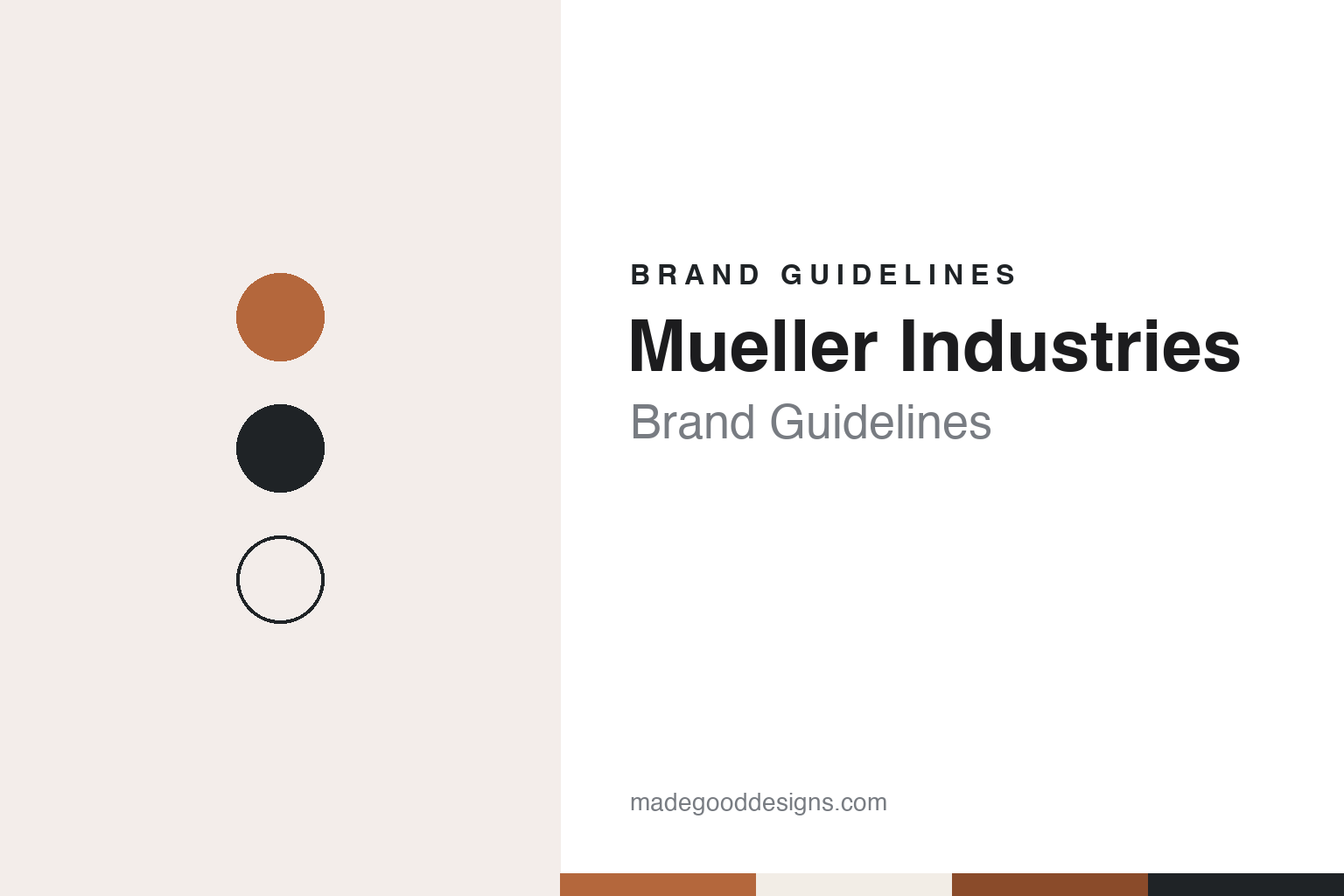
Two constants: a copper, graphite and off-white palette and a sturdy industrial sans register. Abstract homage — not a Mueller Industries product or mark; no fitting, logo or nameplate is reproduced.
Mueller Brass
An inventor’s name, a Port Huron plant and a new company in 1990.
Mueller Industries traces its history to Hieronymus Mueller, an inventor who came to the United States in 1852 and patented an improved water tapping machine in 1872, according to the International Directory of Company Histories, whose entry on the company is reprinted by FundingUniverse. He incorporated his plumbing-products business as the H. Mueller Manufacturing Company in 1893, the directory says. The same inventor and the same 1872 patent open the timeline published by Mueller Water Products, which dates his business in Decatur, Illinois, to 1857; the two are separately listed companies today.
The branch that became Mueller Industries grew up in Port Huron, Michigan. A forging plant there opened on 17 December 1917, and the business was reincorporated that year as Mueller Metals Company; it took the name Mueller Brass Company in 1925, the directory says. Through the 1920s it moved deeper into plumbing: soft copper tube for underground water lines in 1923, hard copper tube for indoor supply in 1924 and, by 1927, a full line of fittings and valves made in its own foundry. In 1930 it introduced the Streamline solder-type fitting, which the directory credits with helping to make all-copper plumbing and heating systems an industry standard.
The company widened its range in the 1950s and 1960s. It opened an impact extrusion plant at Marysville, Michigan, in 1958, shaping aluminum and copper by pressing it through a die. In 1965 the mining company U.S. Smelting Refining and Mining, which already held 72 percent of Mueller, took full control. Mueller began making plastic pipe and fittings in 1967 and completed a tube mill at Fulton, Mississippi, in 1971. The parent later renamed itself UV Industries, and in November 1979 Sharon Steel agreed to acquire it.
Sharon Steel filed for Chapter 11 bankruptcy in April 1987; Mueller itself did not file, the directory says. When Sharon’s affairs were settled on 28 December 1990, Mueller emerged after 25 years as a subsidiary as an independent company, Mueller Industries, Inc., and it gained a New York Stock Exchange listing in February 1991.
Colour
Copper tube, fittings and a run of acquisitions.
The new company moved its head office twice in its first years: from Port Huron to Wichita, Kansas, in 1991, and to Memphis, Tennessee, in May 1996, a move the directory links to the company’s plants in Tennessee and Mississippi. It also sold natural-resource holdings that came with the Sharon Steel settlement, including an Alaskan gold-mining subsidiary in 1999 and the Utah Railway, a short-line coal railroad sold to Genesee & Wyoming in 2002.
At the same time it bought more metalworking. In 1997 it added two European copper tube makers, Wednesday Tube of Bilston in England’s West Midlands and Desnoyers of France, its first significant footing in Europe, according to the directory. In 1998 it bought B&K Industries, an Illinois importer and distributor of plumbing products that sold to hardware stores and home centers; Lincoln Brass Works of Tennessee, a maker of gas appliance components; and Halstead Industries, a copper tube maker founded in Pittsburgh in 1936, which was renamed Mueller Copper Tube Products.
English Wikipedia describes the company today as a maker of piping, industrial metals and climate products, with operations in the United States, Canada, Mexico, China, South Korea, the Middle East and Great Britain. Its plumbing business covers copper tube in straight lengths and coils, copper and plastic fittings, line sets, plastic pipe and valves for water distribution, heating, air conditioning and refrigeration, as well as drainage, waste and vent systems. It also makes steel pipe nipples and resells imported brass and plastic plumbing valves, malleable iron fittings and faucets to plumbing wholesalers and building-materials retailers, Wikipedia says.
Typography
How flow-control makers present themselves.
Valve and flow-control makers sell to engineers, and their public material reads that way. Product pages are built around clear photographs of the hardware itself — a valve body, a fitting, an actuator housing — usually on a plain ground, so that shape, connection ends and materials can be read at a glance. Where a maker publishes cutaway drawings or sectioned views, they serve the same purpose: to show how a part is put together rather than to set a mood.
Colour on valves, fittings and pipes can be technical as well as decorative. Where a product range uses colour to mark a material, a medium or a pressure class, the maker’s own catalogue is the place to check what each colour stands for, since meanings can differ between companies, materials and markets. For a design guide, that is a reason to keep brand colour on paper and screens separate from the colours of the products themselves.
Much of the work happens in catalogues and tools. The tradition is old: Georg Fischer says its first fittings brochure, in 1865, listed 91 items for gas lighting. Today the same makers organise their websites by product family, industry and application, and offer downloads and online tools; Rotork, for example, publishes a sizing and selection toolkit for its actuators. Product range names, such as Rotork’s IQ, often do as much brand work as the company name.
The corporate pages tell a story of owners and divisions. Many of these companies have been reshaped by acquisitions, disposals and renamed divisions, and their sites set out which brands sit under which parent. This guide follows that record — when each company was founded, who owns it, and what it says about its own history — and marks clearly what rests on a company’s own word.
Aa
A sturdy industrial sans for a copper and brass maker. (Specimen set in IBM Plex Sans, a sans STAND-IN; NOT the Mueller Industries logo.)
Mueller Industries
A Collierville group of companies and brands.
The company is now based in Collierville, Tennessee. Reporting its third-quarter results in October 2026, the Associated Press described it as a Collierville-based copper, brass, aluminum and plastic products company. Gregory L. Christopher has been chief executive since 2009, English Wikipedia says, and the shares trade on the New York Stock Exchange as MLI.
The company’s own description is broader. In its press releases Mueller Industries calls itself an industrial corporation whose holdings make goods for markets including air, water, oil and gas distribution, climate comfort, food preservation, electrical transmission and automotive, through a network of companies and brands across North America, Europe, Asia and the Middle East. On 30 March 2026 it announced that it had acquired Bison Metals Technologies, a copper tube maker whose only plant is in Shawnee, Oklahoma. Its chief executive said the purchase expanded the group’s domestic tube capacity and its ability to make the tube it uses as feedstock for other products, which would help offset tariff costs on feedstock made at its foreign subsidiaries.
The result is a brand with layers rather than a single face. The surname is shared with another listed company; Mueller Brass served as the Port Huron name for decades; and the subsidiaries in the directory’s 2002 list mostly carry the Mueller name, from Mueller Brass Co. to Mueller Copper Fittings and Mueller Impacts, alongside bought names such as Lincoln Brass Works and Precision Tube.
For a design guide, Mueller Industries shows how a family surname can hold together a group of tube mills and fitting plants through changes of owner and head office. Compare Mueller Water Products, which traces its history to the same inventor, and Watts Water, another American plumbing and water name. For this guide we use a burnished copper, a graphite and a warm off-white with a sturdy sans, an unofficial interpretation; no product or logo is reproduced.
Explore & save
Keep Mueller Industries’s identity on hand — save it to a board in the Made Good inspiration library.
Mueller Industries identity set
Pin the Mueller Industries copper, graphite and off-white palette and the sturdy industrial sans register to your own board.