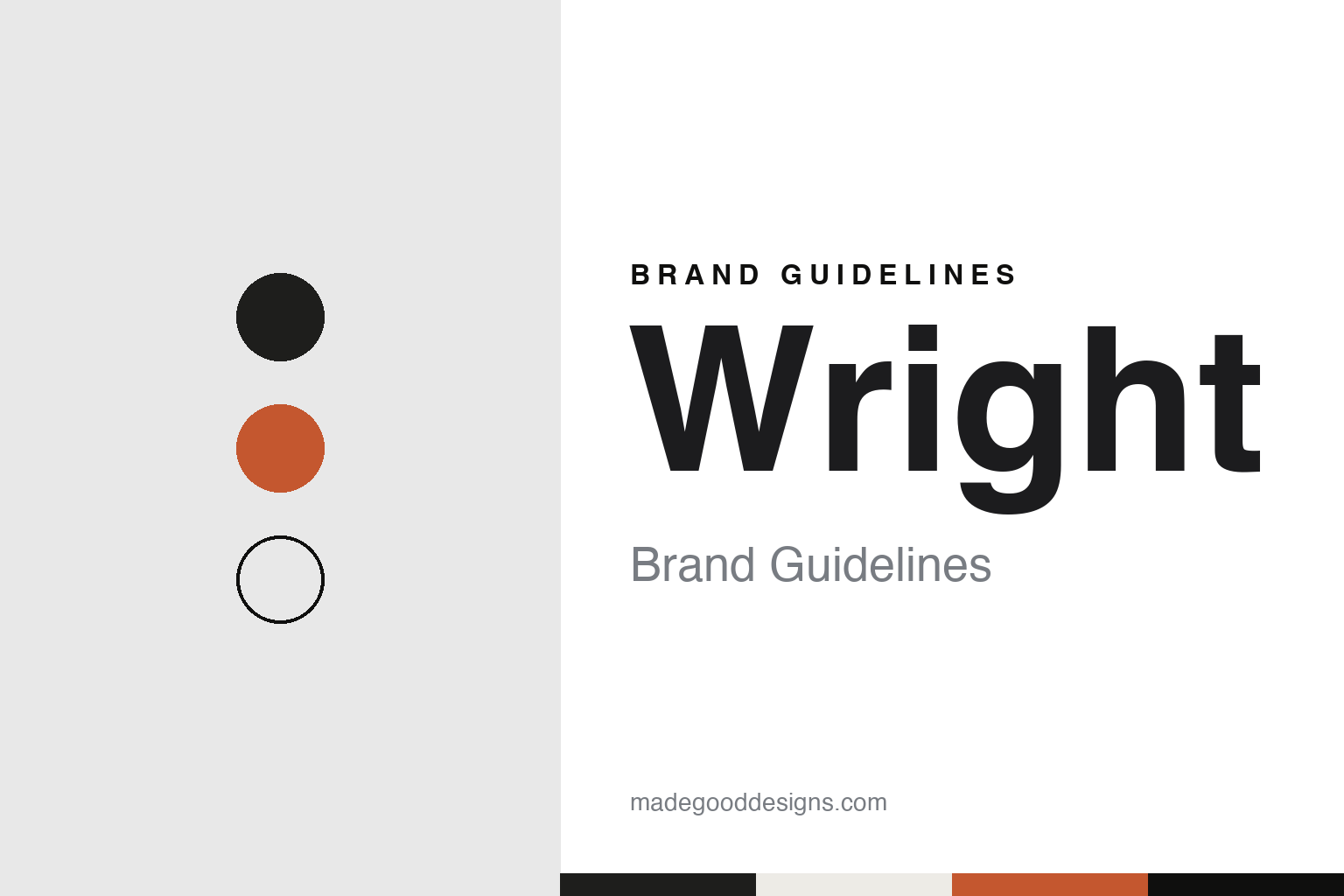
Wright Brand Guidelines
A Chicago auction house that sells design as design.
Aa
Two constants: a gallery black, plaster white and rust palette and a plain grotesque sans register. Abstract homage — not a Wright asset; no catalogue, logo or lot image is reproduced.
A design auction house
A dealer opens his own house in Chicago.
Wright is a Chicago auction house built around twentieth- and twenty-first-century design. Its founder, Richard Wright, told Interior Design magazine in February 2013: “When I opened in 2000, I didn’t appreciate how small the market was and how much room it had to grow.” Before starting the business he had been a dealer and had worked at another auction house, he said in the same interview.
The house carries his name. ARTnews described him in 2016 as the founder of “the Chicago-based auction house that bears his name,” and as its auctioneer at the rostrum. The firm’s web address is wright20.com, and English Wikipedia’s article on Pierre Koenig’s Case Study House #21 refers to it as “Wright 20.”
By early 2013, Interior Design reported, Wright had been in business for thirteen years with Richard Wright as founder and director, and had sold some 40,000 lots. He told the magazine that the company had 18 employees, that hardly anyone left, and that many staff held art degrees; one of his longest-serving employees, a painter, had bought from the house at its very first sale. He described a flat structure with little traditional hierarchy, and said he preferred careful growth to building a very large company, with more of the smaller, targeted sales built around single collections.
When Wright agreed to merge with Rago in 2019, Antiques and The Arts Weekly wrote that the Chicago house billed itself as a specialist in modern and contemporary design — “fine” or “high” design — and had always offered a curated selection of fine art alongside it. ARTnews described Wright at the time as a design auction house based in Chicago and New York.
Colour
Houses, interiors and graphic design.
Some of Wright’s sales have dealt with whole buildings and interiors. English Wikipedia says that in July 2006 the photographer Julius Shulman revisited Pierre Koenig’s Case Study House #21 in Los Angeles to photograph it for the catalogue of a coming Wright auction. In July 2016 Wright sold the furnishings of Philip Johnson’s Four Seasons restaurant in New York; ARTnews reported that bidding began at 10 a.m. on 26 July in the restaurant’s Pool Room, with Richard Wright at the rostrum for the opening lots, and that the auction ran for about 15 hours. Wright told Interior Design in 2013 that the house had recently sold the Ford Gyron, a concept car that was never produced, and a sale of thirty-five Italian lots from one collector.
Graphic design has had its own sales. Antiques and The Arts Weekly reported in July 2020 that Wright’s second graphic-design auction was “To Inform & Delight: The Collection of Milton Glaser,” 188 lots chosen by Glaser himself and sold on 14 July 2020 after more than a year of preparation; the first, in September 2018, was devoted to Paul Rand. Richard Wright told the paper that graphic design is “pretty hard to sell at auction” and remains a niche. In September 2023, English Wikipedia says, Wright presented “Every Day is Different,” the collection of the Chicago graphic designer and collector Jason Pickleman.
The company has since joined others. In June 2019 Wright and Rago, of Lambertville, New Jersey, announced a merger of their business operations. Antiques and The Arts Weekly reported that both houses would keep their own names while sharing technology, expertise and marketing, with Richard Wright as chief executive of the combined companies; ARTnews reported a combined staff of 75. Later reports describe the combination as the Rago/Wright merger of 2020. In August 2021 Rago/Wright announced that Los Angeles Modern Auctions (LAMA), founded by Peter Loughrey in 1992 according to English Wikipedia, was joining it; all three houses kept their names, and Richard Wright continued as chief executive. That announcement said that in 2020 Rago/Wright, with a team of 55 in Chicago, Lambertville and New York, offered nearly 16,000 lots across 56 auctions. In March 2026 ARTnews listed Rago/Wright among the middle-market auction houses, alongside Heritage Auctions, Bonhams, Freeman’s and Doyle.
Typography
Catalogues, salerooms and apps.
Auction houses and online auction platforms sell other people’s objects, so most of what they publish is about the lots rather than about themselves. The catalogue is the core document: a printed or online book for each sale, with a cover image chosen from the lots, a number and a description for each piece, and notes on where it came from. Many houses now publish the same catalogue as a web page and as a download, and some give a single important lot a catalogue of its own.
Lot photography sets much of the tone. Paintings are usually shown flat and square to the camera, furniture and objects against a plain ground, and jewellery and small pieces close up, so that a bidder in another city can judge them from a screen. The saleroom itself is the other stage: a rostrum, rows of chairs, a wall or screen for the lot on sale and a bank of telephones for absent bidders, as the houses show it in their own photographs and broadcasts.
Online bidding has added a third face. Houses and platforms publish apps and web pages for live and timed sales, with a lot image, the current bid, a countdown or a live video feed, and buttons for bidding and watching lots. Their sites also carry the practical pages, such as viewing hours, addresses of offices and salerooms, and how to consign or collect.
Corporate pages are usually short. They give a founding date, the offices and salerooms, and sometimes the names of owners or of the group a house now belongs to. This guide sets out what can be checked about each house — who founded it, who owns it and where it sells — and marks clearly what rests only on the company’s own word.
Aa
A plain grotesque sans — the register of a catalogue caption. (Specimen set in Archivo, a sans STAND-IN; NOT the Wright logo.)
Wright
The catalogue as the product.
Print sits near the centre of how Wright presents itself. In the 2013 interview Richard Wright said: “I find our print catalog to be a gorgeous, wonderful animal, and have come to have great respect for graphic design.” He described the next challenge as finding a comparable format on the internet, and said the house shares its images freely so that its catalogues feed online research. To win consignments, he said, Wright produces print-on-demand books for sellers before making a proposal, and of the thirty-five-lot Italian sale he said: “Our book was really special; we presented it in a fresh way.” Interior Design illustrated the interview with Wright’s exhibition space in Chicago, set up as a preview for its Important Design and Italian Masterworks auctions.
The same emphasis was named when Wright merged with Rago. Antiques and The Arts Weekly reported in June 2019 that the combined company would bring together Rago’s broad expertise in art, jewelry, ceramics and estates with “Wright’s focus on design and innovative presentation.” In the 2021 LAMA announcement, Richard Wright pointed to the group’s bidder platform and auction technology as assets it would share with the Los Angeles house, and the release spoke of bespoke digital presentations for each sale.
For a design guide, Wright shows a house treating its catalogues, previews and sale titles as design work in their own right, with the object photographed and captioned as carefully as it is sold. Compare Rago, its partner in Rago/Wright, and Hindman, another Chicago auction house. For this guide we use gallery black, plaster white and a rust tone with a sans, an unofficial interpretation; no product or logo is reproduced.
Explore & save
Keep Wright’s identity on hand — save it to a board in the Made Good inspiration library.
Wright identity set
Pin the Wright gallery black, plaster white and rust palette and the plain grotesque sans register to your own board.