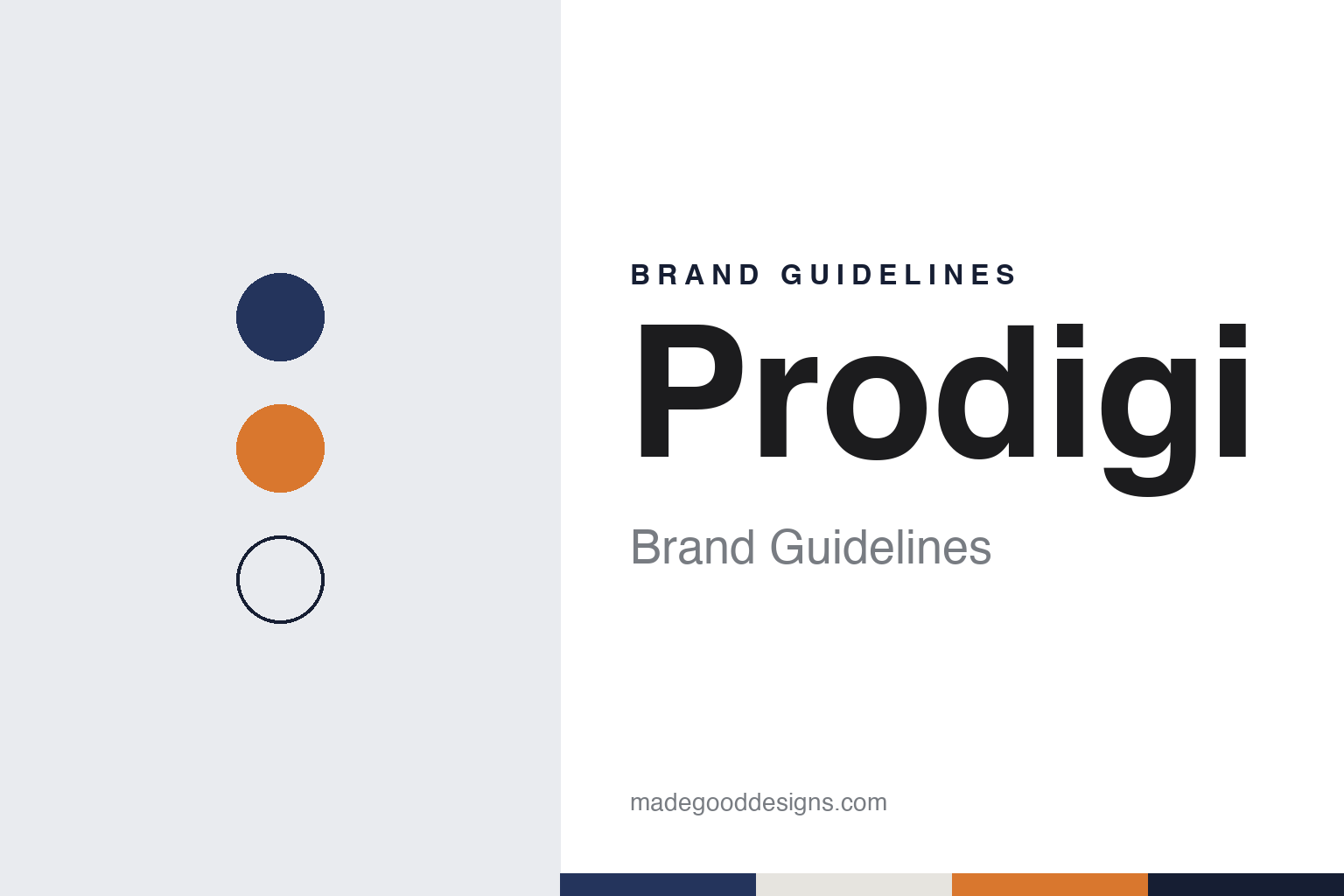
Prodigi Brand Guidelines
A print API group from Cardiff, with Pwinty, Kite and Peecho.
Aa
Two constants: an ink blue, orange and grey palette and a technical grotesque register. Abstract homage — not a Prodigi product or mark; no print, logo or packaging is reproduced.
Printing through software
A Cardiff start, three founders and an API.
Prodigi is a British print-on-demand business that sells printing through software. The company says it was founded in 2014, and the Sunday Times Virgin Atlantic Fast Track 100 league table for 2019, as reproduced by English Wikipedia, lists Prodigi Group as a digital printing company from Cardiff, founded in 2014, in 14th place. Companies House records a Prodigi (UK) company incorporated in April 2014 and the holding company, Prodigi Group Limited, incorporated on 30 June 2017; the group’s registered office is now in Alton, Hampshire.
Its founders, as listed on the company’s About page, are James Old, the chief executive, who leads strategy, sales and marketing; Tom Gallard, the chief technology officer, who leads engineering; and Steve Levin, the chief product officer, who oversees the manufacturing labs and production teams and brings new products to market. Gallard had founded Pwinty before it joined the group.
The model was set out early. In a July 2017 release datelined Cardiff, Prodigi described itself as a technology and manufacturing business headquartered in Cardiff and employing about 50 people, making fine art prints, photobooks, stretched wall prints and other print-on-demand products. It ran its own manufacturing in the UK and the Netherlands and linked to a global network of outsourced fulfilment partners, combining in-house printing with a print API: a software interface through which other businesses send orders to be printed and shipped direct to their own customers.
A company blog post from April 2017 sets out the problems the founders said they were solving for clients: finding print partners, ordering and testing samples, integrating with many manufacturers’ systems, sending each order to the lab closest to the buyer, and handling couriers, currencies and sales tax across countries. Prodigi’s answer, the post said, was a single platform that hid that complexity behind an API, a Shopify app and an online order form, under the line “made on demand, made simple”.
Colour
Pwinty, Kite and Peecho.
Growth came partly through acquisitions. On 5 July 2017 Prodigi announced that it had bought Pwinty, a Cardiff-based API platform for international print fulfilment, in a deal completed earlier that month. The release described the purchase as the result of several years of close work between the two companies, and Pwinty’s founder, Gallard, became Prodigi Group’s chief technology officer. Companies House shows that Pwinty Limited was incorporated in September 2013. After the deal the release described the Pwinty site as Prodigi’s own print API platform.
On 9 September 2019 Prodigi announced that it had acquired Kite, the Shoreditch technology company behind Kite.ly, from Canon Europe. According to the release, Kite had been founded in 2014 by Charlie Carpenter and Deon Botha and bought by Canon in 2017. Like Prodigi it was a print API business, and its team stayed in London to connect Kite’s Shopify and photo book products to Prodigi’s API. By then, the release said, Prodigi employed about 110 people and worked with more than 50 integrated print labs.
Later that year, in a post dated 29 November 2019, Prodigi marked its 14th place in the Fast Track 100. It said it had added dozens of labs to its network, opened a production facility in the Netherlands with Brexit in mind, and launched apps that let sellers without technical skills offer its products.
Peecho followed on 2 April 2024, when Prodigi announced it had acquired the Amsterdam cloud printing platform. Peecho’s software lets apps and websites built on their users’ own content offer printed products such as photo books and stationery, made near the buyer. Prodigi called it its fourth deal of this kind since its founding in 2014. The same post introduced the group board: Old, Gallard and Levin, with Eric Kickert as chief operating officer.
Typography
Design and documentation.
Online printers and print-on-demand platforms sell something the customer designs and the company makes. Their websites are therefore built around two things: the range of printed products on offer, and the steps for turning a file or an idea into an order. Product pages are organised by category — business cards, flyers and postcards, stickers and labels, signs and banners, packaging, apparel, and fabric or home goods — and each is shown through the company’s own photographs of finished pieces.
The ordering side is described in plain, practical terms. Customers either upload a finished print file or build a design in an editor that runs in the web browser, then choose size, quantity, paper and finish from a configurator. Cimpress, for example, describes its services as running from upload-and-print to logo design, with file checks before production. Papers and finishes are named rather than pictured in the abstract: weights in grams per square metre, coated or uncoated stock, matt or gloss lamination, and options such as rounded corners or spot varnish.
Behind the storefront, the companies differ in how they make things. Some run their own print plants; CEWE described SAXOPRINT’s Dresden site as a production facility when it agreed to sell it to Cimpress in May 2026. Others, such as HelloPrint in Rotterdam, describe themselves as platforms that pass orders to a network of partner printers and carriers. Several of the brands in this guide belong to larger groups, and their corporate pages set out owners, sites and the dates of takeovers.
This guide sets out what can be checked about each brand — who founded it, who owns it, where its products are made and how it presents itself — and attributes to the company anything that rests only on its own word.
Aa
A technical grotesque for a print API business. (Specimen set in Space Grotesk, a sans STAND-IN; NOT the Prodigi logo.)
Prodigi
Making global printing local.
Today Prodigi describes a network rather than a single works. Its About page lists its own manufacturing sites in Alton, Hampshire, Charlotte, North Carolina, and Venlo in the Netherlands, engineering teams in Harrogate and at Peecho in Amsterdam, and more than 100 staff across about half a dozen locations, supported by a global network of partner print labs. Its stated mission is “to make global printing, local”: printing products close to the people who buy them, which the company says makes delivery cheaper and faster.
The catalogue runs, the company says, to more than 200 products, grouped into wall art such as prints, posters, stretched and framed prints, and further ranges of stickers, books and magazines, cards and stationery, home goods and clothing. Sellers can send orders through the print API, a manual order form or a spreadsheet importer, or connect shops on platforms such as Shopify, Etsy and Wix. In March 2024 Prodigi introduced Ecocaps, paper end caps for the cardboard tubes in which it posts rolled prints and posters in the UK and the US; the company says they are made in-house from recycled paper materials.
Because its customers are mostly other businesses, much of Prodigi’s public face is written for sellers: product pages with specifications, a network status page that reports on print labs and shipping, API documentation and a blog of guides. Its clients page groups the people it prints for as artists, brands and museums.
For a design guide, Prodigi shows how a print business can present itself as a software company, with factories in the background. Compare Gelato, another print-on-demand network, and Printful. For this guide we use an ink blue, a lab orange and a proof grey with a sans, an unofficial interpretation; no product or logo is reproduced.
Explore & save
Keep Prodigi’s identity on hand — save it to a board in the Made Good inspiration library.
Prodigi identity set
Pin the Prodigi ink blue, orange and grey palette and the technical grotesque register to your own board.