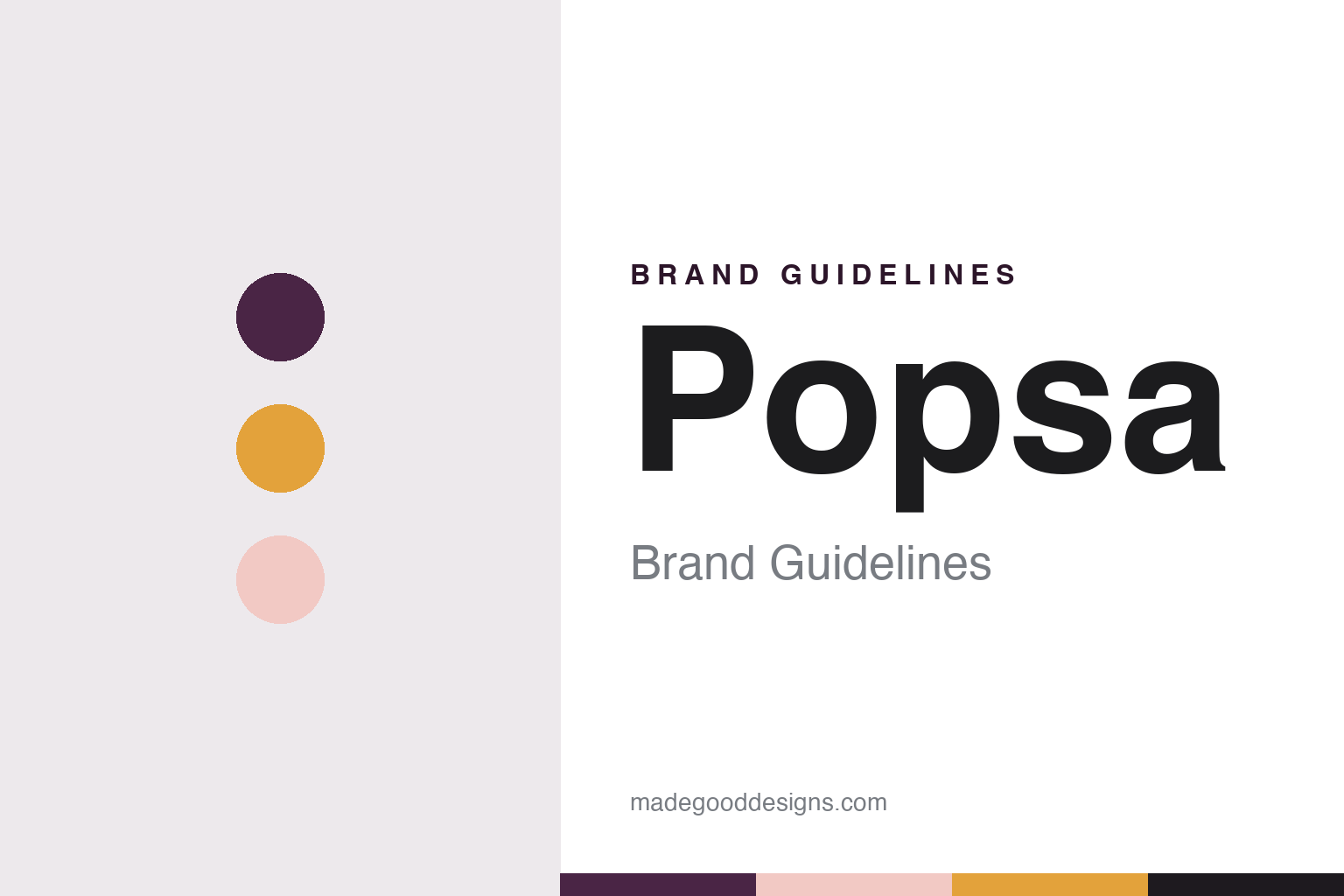
Popsa Brand Guidelines
A London app that lays out the photo book for you.
Aa
Two constants: a deep plum, blush and marigold palette of our own and a rounded sans register. Abstract homage — not a Popsa product or mark; no logo, book or app screen is reproduced.
A kitchen in Soho
An app-first photo-book company from London.
Popsa is a London photo-printing company that began as a phone app. Its about page says it was founded in 2016 by Liam Houghton and Tom Cohen “in a kitchen in Soho, London,” and that the same year it launched Popsa for iOS and introduced photo books. Companies House records show that the holding company behind the brand, Popsa Holdings Limited, was incorporated in November 2015 under another name and took the Popsa name in February 2016; Tom Cohen and Liam Houghton both appear among its officers, and the company is listed as active.
Houghton, now chief executive, writes on the about page that he taught himself to design and code as a teenager and later studied architecture, and that Popsa exists for people who “lack confidence with technology,” feel unsure of their creative abilities or do not have time to learn software. He says he did not start the business simply to sell products but to give people the means to make things from their memories.
The company’s timeline traces quick expansion. It lists pre-seed investment from 500 Global and The Garage Soho in 2017, together with its first-generation AI layout algorithms and translation of its products and messages into 12 European languages; seed investment from Pembroke VCT, Octopus and Guinness Global Investments in 2018, along with an Android app; a United States launch and a television advertising campaign in 2019; and, in 2021, a Series A round led by Gresham House Ventures and launches in Canada, New Zealand and Australia. Popsa says it launched in Mexico in 2025.
Popsa also lists outside rankings on the same page: it says The Sunday Times named it among ten companies to watch in 2019, that Deloitte ranked it among fast-growing UK technology companies in several years, and that the Financial Times included it in lists of fast-growing European companies in 2022 and 2023.
Colour
Automatic layouts, small books.
Popsa’s pitch is speed. Its website describes a three-step process — generate a layout, customise it with one-tap tools, then order — and names features such as Automatic Layouts; Generative Captions, which it says describe photos in the user’s own writing style; and Dynamic Themes, which build a colour scheme from the photos. Its timeline adds Smart Albums in 2022, Popsa for Web in 2023, face recognition to help people find photos of friends and family in 2024, and Popsa Rewinds, monthly highlights curated automatically, in 2025.
Independent reviews show how the product has changed. When Digital Camera World reviewed a Popsa photo book in March 2020, it could be ordered only through the phone app; the reviewer listed small landscape formats, 200gsm paper, hardback, softcover and photobooklet styles, imports from cloud services such as Dropbox and shipping to more than 32 countries, and noted that the caption font and size were fixed. The Gadgeteer, in September 2025, used the Android app and described the software filling pages automatically from uploaded photos, with a virtual preview before ordering and an hour to make changes after ordering; the reviewer signed in with an existing Google account and called the app’s design minimal. Tom’s Guide, in March 2026, listed hardcover and softcover books in three sizes, 200gsm matte or gloss paper, standard or layflat binding and 20 to 150 pages, and gave the book its Editor’s Choice badge. That reviewer used the free mobile app, which analysed and arranged the photos before she resized some by hand, and gave standard delivery as six to seven working days.
The range has widened beyond books. Popsa’s timeline dates prints to 2017, ornaments to 2018, calendars and photo tiles to 2020 and photo boxes to 2021, and says it introduced layflat photo books in 2025. Popsa lists Foil Upgrades among its additions of 2024, and the Tom’s Guide reviewer added silver foil to the lettering and tried per-page background colours.
Typography
Design and documentation.
Photo-book and photo-printing services sell something the customer has already made: the pictures. Their own sites therefore tend to lead with the customer’s photographs rather than with the company. Home pages show open books, framed prints and wall pieces in ordinary rooms, often styled around an occasion such as a wedding, a new baby, a holiday or the end of a year, and the product sits in the frame as a finished keepsake.
The making itself is shown through the tools. Most of these companies offer an online editor and a phone app, and they describe both in plain, step-by-step language: upload, choose a size and cover, arrange the pages, order. Automatic layouts, themes and templates are presented as time-savers, while desktop editors with grids, rulers and finer controls are offered to people who want to place every picture themselves.
Product naming follows the physical object. Ranges are sorted by format, page count, binding and cover — soft cover, hard cover, fabric, leather, lay-flat — and by paper finish, with words such as matte, lustre or gloss doing most of the work. Wall pieces are named by their material, from stretched cotton and acrylic to metal, wood and framed prints, so the label tells the buyer what will hang on the wall.
Behind the consumer brands sit the labs and the owners. Corporate pages explain which group a label belongs to, where its printing sites are and how its brands divide up the countries they serve, while lab-led services describe their printing methods and papers in more detail. For a designer, the useful lessons are in that split: a warm, occasion-led consumer voice on top, and a precise, material-led vocabulary underneath.
Aa
A rounded sans — friendly and simple, in keeping with an app built for non-designers. (Specimen set in Nunito, a sans STAND-IN; NOT the Popsa logo.)
Popsa
Memories, made in Britain.
Popsa describes itself less as a printer than as “a space to process through photos.” Its about page cites a poll of 4,000 adults in the US, UK, France and Germany that it ran with the research firm Savanta in June 2023, and its tagline reads “You live your life. Popsa delivers your memories.” In 2025, the company says, it launched Perspectives, its own lifestyle magazine, and became a Certified B Corp. The about page presents Popsa as a platform for “your most cherished memories,” and the company says it added a Reminders service for birthdays, anniversaries and other occasions in 2024.
On manufacturing, the website says that for customers living in the UK, “your order will be made in Britain,” and that it delivers to 50 countries. Popsa says it reached 1.5 million paying customers in 2024 and 2.5 million in 2025, and its home page speaks of more than 10 million people across 50 countries using the service.
For a design guide, Popsa shows how a print brand can be sold through software: automatic layouts, colour themes drawn from the pictures themselves and small books meant to be made on a phone. Compare Photobox, another London photo-printing name, and Chatbooks, an American app-based photo-book company. For this guide we use deep plum, blush and a marigold with a rounded sans, an unofficial interpretation; no product or logo is reproduced.
Explore & save
Keep Popsa’s identity on hand — save it to a board in the Made Good inspiration library.
Popsa identity set
Pin the Popsa deep plum, blush and marigold palette and the rounded sans register to your own board.