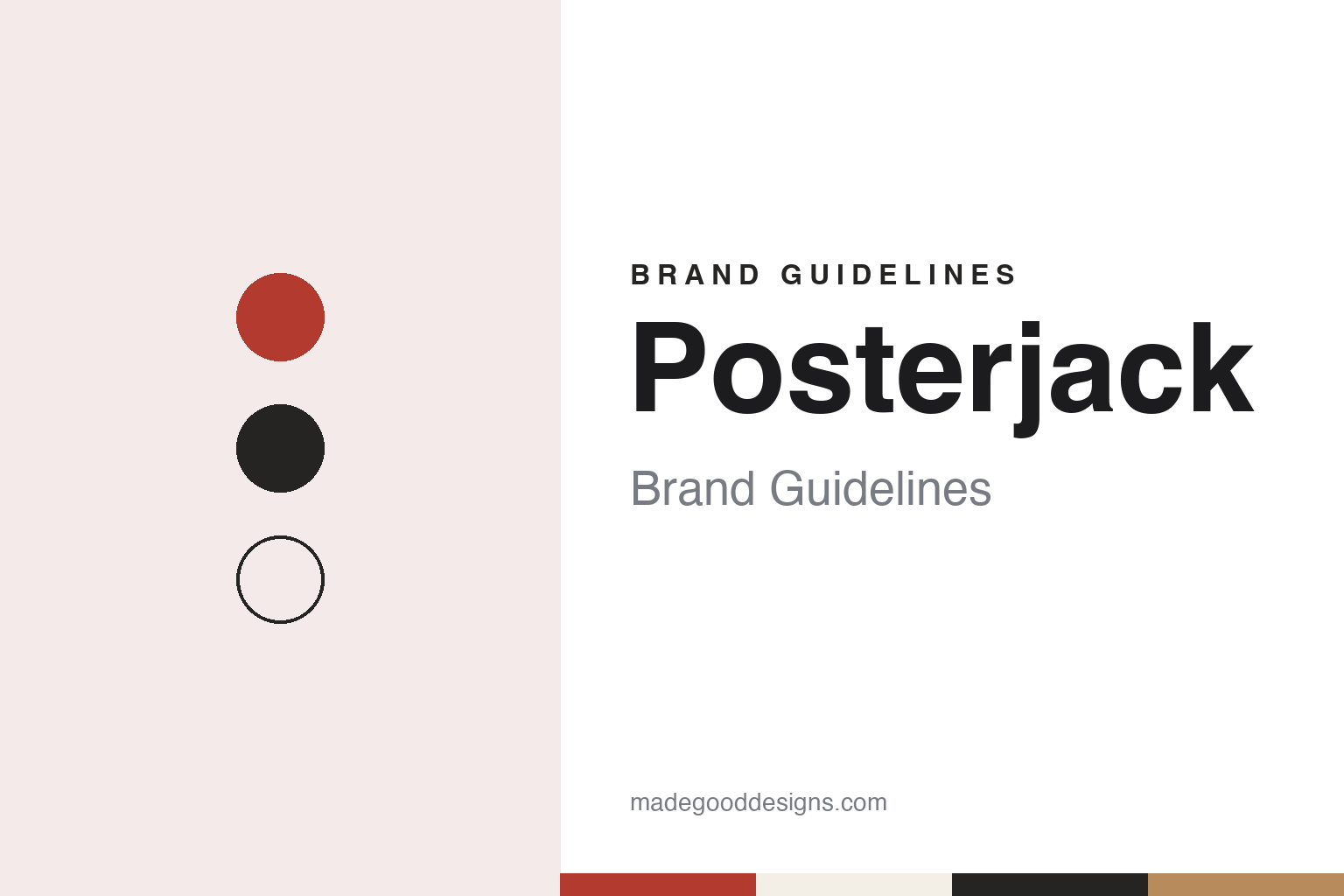
Posterjack Brand Guidelines
A Toronto photo printer that turns phone pictures into wall art.
Aa
Two constants: a maple red, charcoal and linen white palette and a grotesque sans register. Abstract homage — not a Posterjack product or mark; no print, logo or packaging is reproduced.
A Toronto printer
Launched in Toronto in 2009, the company says.
Posterjack is a Toronto photo-printing company that turns customers’ digital photos into prints, wall art, photo books and cards. Its website says it launched in Toronto in 2009 with the aim of turning digital photos into quality prints for Canadians, and the Made in CA directory of Canadian businesses gives the same year and lists it as Canadian-owned. The site is offered in English and French and sells to Canadian customers at posterjack.ca; American customers are sent to a separate Posterjack USA storefront at posterjack.com.
The American side came within a few years. Reviewing an acrylic print in July 2014, the US blog GeekDad described Posterjack as “a Canadian company which recently expanded into the U.S.” and listed framed prints, stretched prints, metal and acrylic among its formats, with peel-and-stick prints as a further option. The reviewer described the ordering as quick: choose a medium and a size, upload the image, add any extras and wait a few days for delivery.
The name has a namesake that is easy to confuse. A separate company, posterjack GmbH of Munich, ran a German-language print-on-demand business under the same name; its founders were Florian Stadler and Johannes Busch. In March 2013 the German start-up site deutsche-startups.de reported that the Spanish print-on-demand firm Hofmann, owned by Realza Capital and Portobello Capital, had acquired a majority stake in that Munich business, which then traded at posterjack.com. That deal concerns the German company, not the Toronto printer in this guide, whose US storefront uses the posterjack.com address today.
Colour
Wall art first, then books and cards.
Posterjack’s range is organised around the wall. Its wall-art menu offers stretched prints, acrylic prints, framed prints and metal prints, the metal in HD, matte and brushed finishes. Alongside them sit gallery boxes, photoboards, wood prints and frameless mounting, each a different way of hanging a photograph without a traditional frame shop.
Loose prints come in satin, glossy, fine art and metallic pearl versions, with peel-and-stick and collage prints as further formats. For books, Posterjack offers layflat, hardcover and softcover photo books, with wedding versions of the layflat and hardcover books; calendars and folded cards complete the paper range. A smaller gift line includes acrylic photo blocks, coasters, metal minis and woodstand prints, and the shop also sells a sample box so that customers can see the materials before ordering.
Size is part of the offer. In February 2019 the Toronto city site blogTO included Posterjack in a round-up of large-format and poster printers, describing it as a popular print shop on Brown’s Line that offers extra-large fine art prints up to 40 by 60 inches, with glossy and peel-and-stick prints available in panoramic sizes up to 40 by 120 inches.
The company publishes its turnaround as average production times. According to its shipping page, posters take one to three business days; stretched, metal and acrylic prints three to five; and photo books and calendars five, before shipping. It sends orders across Canada from Toronto, offers a priority courier option, and says delivery takes longer the further a customer is from the city.
There is no shop counter. The same page says Posterjack is not set up for in-person pick-ups, that its local delivery team delivers orders directly to customers instead, and that every order goes out in what it calls “time-tested, super-tough” packaging; a courier’s rural surcharge applies to remote addresses. Beyond its consumer range, the site runs a custom-art service for businesses, a loyalty programme and a referral scheme for customers who recommend it to friends.
Typography
Photo books, prints and the services behind them.
Photo-book and photo-printing services sell something the customer has already made: the pictures. Their own sites therefore tend to lead with the customer’s photographs rather than with the company. Home pages show open books, framed prints and wall pieces in ordinary rooms, often styled around an occasion such as a wedding, a new baby, a holiday or the end of a year, and the product sits in the frame as a finished keepsake.
The making itself is shown through the tools. Most of these companies offer an online editor and a phone app, and they describe both in plain, step-by-step language: upload, choose a size and cover, arrange the pages, order. Automatic layouts, themes and templates are presented as time-savers, while desktop editors with grids, rulers and finer controls are offered to people who want to place every picture themselves.
Product naming follows the physical object. Ranges are sorted by format, page count, binding and cover — soft cover, hard cover, fabric, leather, lay-flat — and by paper finish, with words such as matte, lustre or gloss doing most of the work. Wall pieces are named by their material, from stretched cotton and acrylic to metal, wood and framed prints, so the label tells the buyer what will hang on the wall.
Behind the consumer brands sit the labs and the owners. Corporate pages explain which group a label belongs to, where its printing sites are and how its brands divide up the countries they serve, while lab-led services describe their printing methods and papers in more detail. For a designer, the useful lessons are in that split: a warm, occasion-led consumer voice on top, and a precise, material-led vocabulary underneath.
Aa
A sturdy grotesque sans for a workshop brand. (Specimen set in Archivo, a sans STAND-IN; NOT the Posterjack logo.)
Posterjack
Crafted in Canada, the company says.
Posterjack presents itself above all as a maker. Its “Our Story” page, under the heading “Crafted in Canada,” says the company prints customers’ photos in its Toronto workshop and has printed them in-house “since day one,” and that it prints more than 270,000 photos a year. The Made in CA directory lists its products as manufactured in Etobicoke, Ontario, and says the company runs a production facility in Toronto. The 2019 blogTO round-up independently places a Posterjack print shop in the city.
The brand voice is patriotic and plain. The site repeats the line “Canada’s Favourite Photo Prints” beside a maple-leaf symbol and describes the business as “Proudly 100% Canadian.” Its shipping and returns page promises to replace a product if there is an issue with it, and to refund the order if a replacement cannot be made to the customer’s satisfaction; customised products cannot otherwise be returned, the page says, because they cannot be reused or resold.
The story page leads with the words “Your Photos Matter” and sets out the aim, in the company’s words, of turning “the photos of your life into artwork you’ll be proud to display in your home.” It names its working stages in the same plain register, from the first proof to a quality check before packing, and invites customers to imagine a beach scene or a road trip on their own wall.
For a design guide, Posterjack shows how a regional printer can build an identity from place — a city, a workshop and a maple leaf — rather than from a single product. Compare Mpix, another photo printer selling online in North America, and Artifact Uprising, a Denver photo-book maker. For this guide we use a maple red, charcoal and linen white with a grotesque sans, an unofficial interpretation; no product or logo is reproduced.
Explore & save
Keep Posterjack’s identity on hand — save it to a board in the Made Good inspiration library.
Posterjack identity set
Pin the Posterjack maple red, charcoal and linen white palette and the grotesque sans register to your own board.