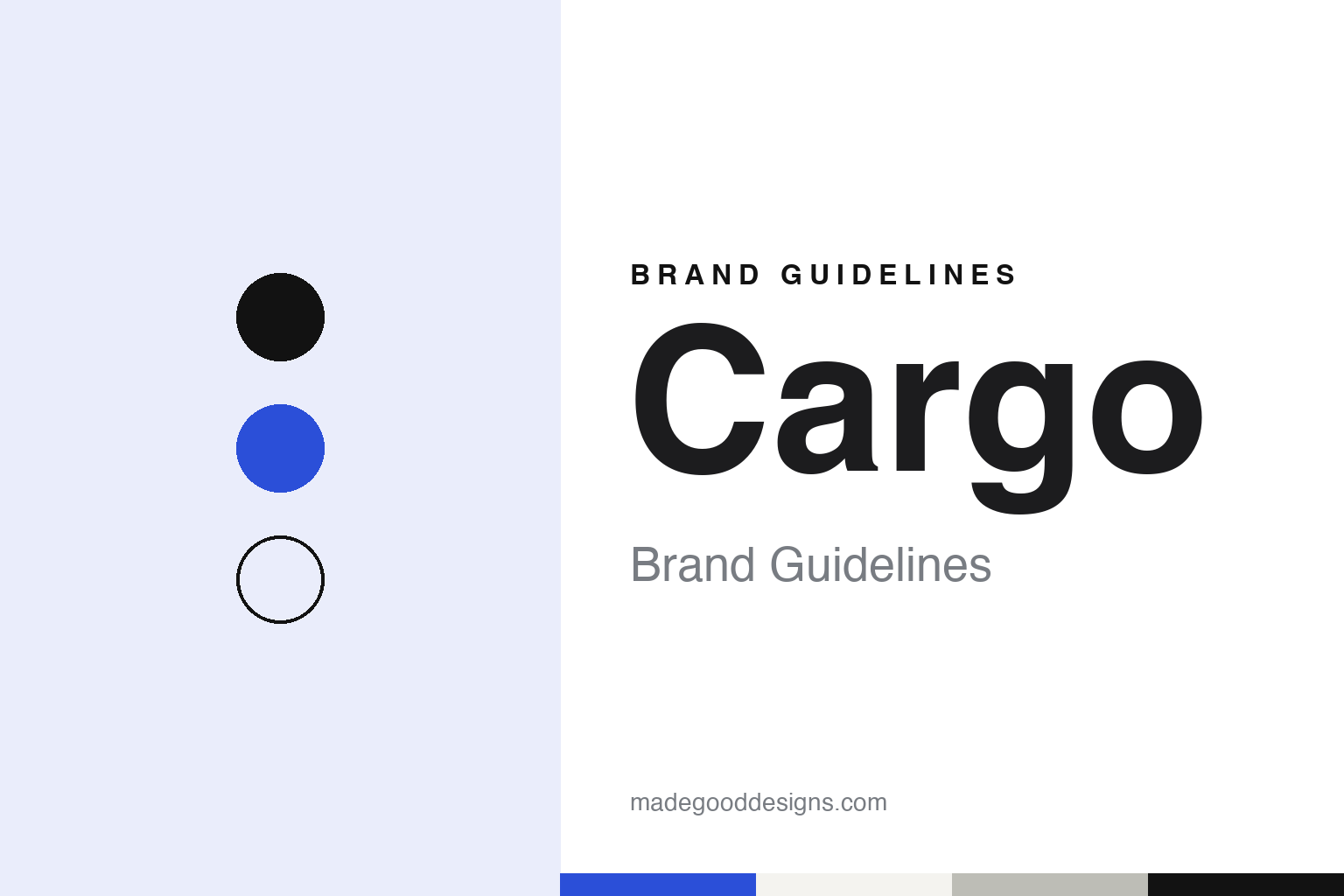
Cargo Brand Guidelines
A SpaceCollective offshoot that made the work the interface.
Aa
Two constants: an ink, gallery white and cobalt palette and a Plain grotesque register. Abstract homage — not a Cargo product or mark; no interface, logo or template is reproduced.
From SpaceCollective
Three people, a community platform and a student archive.
Cargo is a site builder for designers and artists, run from the web address cargo.site; its older address, cargocollective.com, now forwards there. The company’s home page names two interests: “helping creative people secure jobs/clients through showing work and displaying work, generally,” and hosting “a network of peers” whose sites it shows. For years the name carried a second word, Cargo Collective, and the community side of the product explains it.
Its roots lie in an earlier project. In an interview published by Cool Hunting on 22 January 2010, the co-founder Folkert Gorter said he began working with Rene Daalder on SpaceCollective, an online community for sharing ideas and media, in 2005, and that Josh Pangell, responsible for all technology and development, joined shortly after. Finding nothing suitable to build SpaceCollective on, the team wrote its own platform from scratch. SpaceCollective worked closely with universities and students, Gorter said, and from that work came a need for members to publish their work as a personal, ongoing archive; the tool built for it became Cargo. Cool Hunting credited all three as Cargo’s creators.
By January 2010 Cargo was running as a web publishing platform aimed at art directors, photographers, graphic designers and visual artists. It was open by invitation only, Gorter said, to keep the level of creative content high, with plans to let existing members invite others. He described the aim as blurring the line between a portfolio and a blog, so that people would see their websites as “an ongoing feed of creative output.” The company’s current terms of service say they are governed by the laws of California, with disputes going to the courts of Los Angeles.
Colour
“The content is the Cargo.”
Gorter summed up the interface idea in 2010 in a slogan: “the content is the Cargo.” He extended it into a chain — “the work is the interface is the product is the brand is the network is the Cargo” — and gave an example: inside Cargo’s networks a member was represented not by an avatar of their choosing but by an image of their most recently shared work. Sites were built from projects, the counterpart of blog entries, each holding images, text and embedded media, which then appeared on the member’s main page as expandable thumbnails.
Customisation was central from the start. Cool Hunting noted that users could change colours, fonts, borders, margins and layout without much difficulty, and Gorter said each project accepted text, images, embedded media and scripts, while widths and margins were controlled by style sheets. The team was not really made up of engineers, he added, and in a way was designing the system for itself. Members told the company in its forums that they enjoyed learning how the web works by adjusting their sites, he said. The magazine’s examples of sites on the platform included the Office of Feltron and Bruce Mau Design.
Today’s Cargo keeps the focus on the work. Its information page lists the ability to design and publish one or many public sites from a single account — a portfolio, client presentations, idea boards, a profile site or a shop — together with real-time, multi-user editing, a built-in commerce platform for physical or digital goods, and a free connection for one custom domain. The company says it uses one price with no tiers, set “with the budgets of artists and designers in mind.”
The template library is arranged in four groups — Basic, Populated, Graphic and Blank — with the Basic set divided into feed, grid and slideshow layouts, and most templates named by a letter-and-number code rather than a word. Cargo’s fonts page presents typefaces from Dinamo, which it describes as a type foundry based in Berlin.
Typography
How builders present themselves.
Website and portfolio builders present themselves first through their templates. Ucraft’s home page offers more than 120 “designer-made” templates sorted into categories such as business, photography, restaurants and art, and credits each one to a designer on its team; Readymag’s templates, Website Planet reported in May 2026, are grouped into company websites, landing pages, presentations, portfolios, editorials and online stores, and include designs submitted by users.
The editor is the second part of the pitch, and the products differ. Ucraft’s editor works with blocks and elements that snap into a page grid, according to reviews in TechRadar in 2021 and PCMag in 2026, with a separate page of typography, button and layout settings that the company calls Designer Tools. Readymag’s editor is freeform, with elements placed without a rigid grid and detailed type controls such as ligatures, stylistic sets and variable fonts, according to English Wikipedia; Website Planet describes it as layer-based.
Showcase sites made by users do much of the brand’s work. Ucraft keeps a gallery called “Made with U,” and Readymag runs an annual Website of the Year award for projects built on its platform, judged by a jury of designers and art directors, according to English Wikipedia. Plan and feature names follow a similar logic, pairing plain tiers with branded tools: TechRadar listed Ucraft’s paid plans in 2021 as Pro Website, Pro Shop and Unlimited, alongside features such as a logo maker.
Corporate pages on founders and owners vary widely. Ucraft’s about page gives a dated timeline and names its investor, SoftConstruct, but not its founders, while Readymag’s founders and chief executive are named in English Wikipedia and in design-press interviews. This guide sets out what each company says about itself, and what independent dated sources add.
Aa
A plain grotesque — a quiet frame for other people’s work. (Specimen set in Inter Tight, a sans STAND-IN; NOT the Cargo logo.)
Cargo
A builder that steps back.
Cargo’s community pages act as its showcase. A “Sites in Use” section lists members’ websites under headings for graphic design, style, architecture and design, art, photography and shops, each credited to its maker by name, which carries forward the network idea Gorter described in 2010, when he said the system was set up so that it was almost impossible not to learn from other users.
The company also offers free use to students. Its terms say that since May 2024 student and non-profit sites carry a fixed Cargo logo in the bottom-right corner, a change it attributes to promotional codes being used for commercial work. For domain names, the terms name Tucows as the registrar, with Cargo acting as reseller, and they cover sites published on both cargo.site and cargocollective.com.
The brand’s own presentation is spare. The home page sets the name as “Cargo Site Builder” with a registered-trademark sign, followed by two short links, one to make a site and one to explore sites, and a navigation of templates, community and information. The founders’ 2010 phrase about the content being the product is the nearest the company has come, in the sources used here, to a statement of brand.
For a design guide, Cargo shows how a builder can keep its own identity quiet so that its members’ work stands in for the brand. Compare Squarespace, another hosted site builder, and Semplice, a portfolio system. For this guide we use ink, a gallery white and a cobalt blue with a sans, an unofficial interpretation; no product or logo is reproduced.
Explore & save
Keep Cargo’s identity on hand — save it to a board in the Made Good inspiration library.
Cargo identity set
Pin the Cargo ink, gallery white and cobalt palette and the Plain grotesque register to your own board.