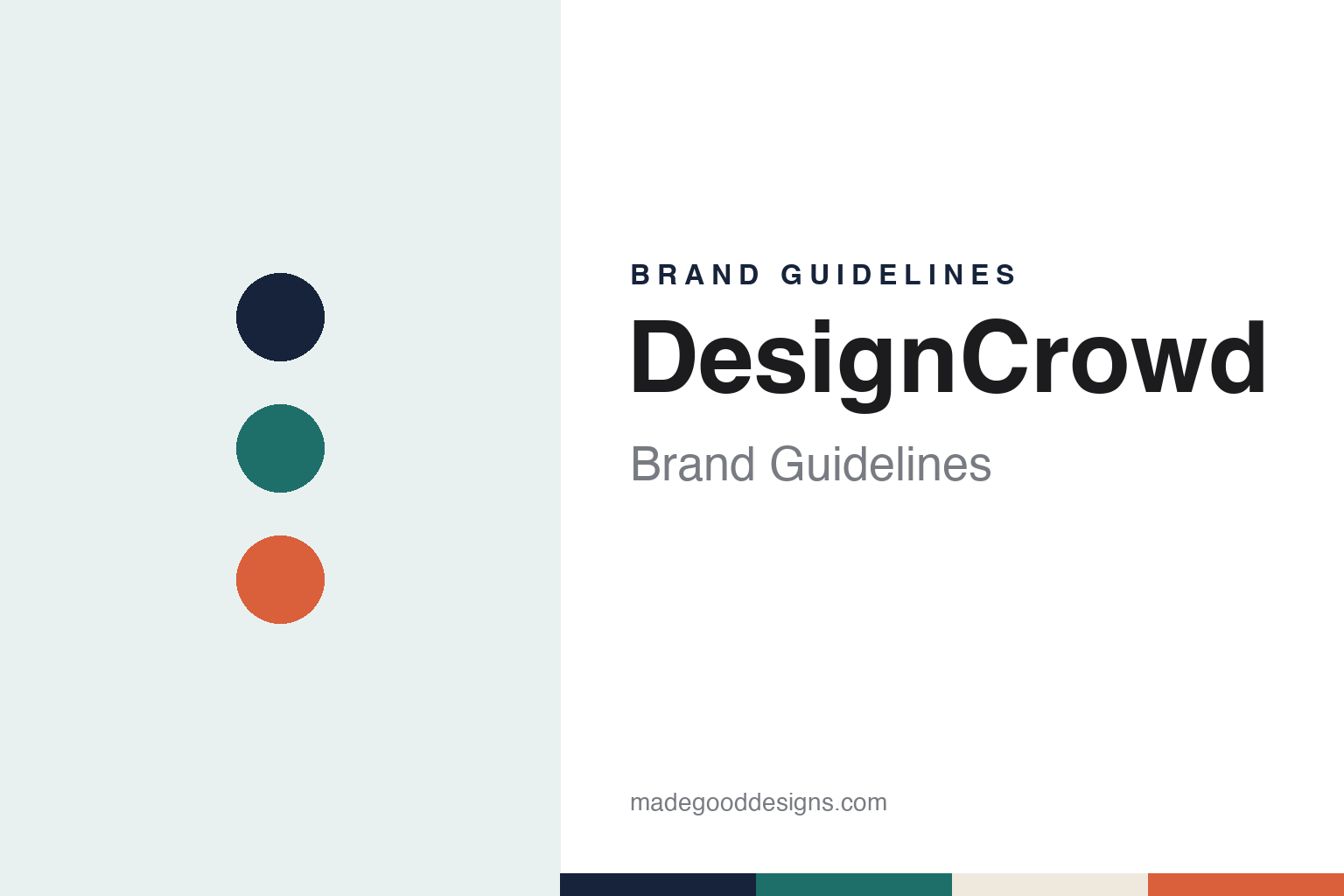
DesignCrowd Brand Guidelines
A Sydney design-contest marketplace that grew sister brands.
Aa
Two constants: an ink, teal and coral palette and a geometric sans register. Abstract homage — not a DesignCrowd asset; no logo, design or contest entry is reproduced.
A Sydney contest site
A project, a deadline and designers from around the world.
DesignCrowd is an online marketplace for logo, graphic, web and print design, run from Sydney. English Wikipedia says the company was founded in 2007 and that Alec Lynch launched the site in January 2008. TechCrunch, reporting in February 2021, also gave 2007 as the founding year and described Lynch as co-founder and chief executive, while a company press release of June 2012 dated the launch to January 2008. The company’s own board page names Lynch as founder and chief executive, and says its first angel investor backed the business in 2009.
The model the company built its name on is the design contest. A business posts a project — a logo, a website, a flyer — with a budget and a deadline, and designers in many countries submit work for it. DesignCrowd’s how-it-works page says a contest can run for three, five or ten days, that designers cannot see one another’s entries, that clients can ask for revisions through feedback, and that the client who picks a winner receives full copyright in the design files. The page tells clients to expect dozens of entries from several designers, and offers the alternative of hiring a single designer directly. When TechCrunch covered the company in December 2011, it summed up the service as a place where anyone could create a project request and set a budget while designers made bids and pitched their work.
Growth came through venture investment and new country sites. English Wikipedia records funding from Starfish Ventures. A company release of June 2012 said the Starfish investment had arrived in late 2011, that DesignCrowd had launched in the United Kingdom about three months earlier, and that it was opening a Canadian site, DesignCrowd.ca, with its head office still in Sydney. The Canadian site offered what the company called local crowdsourcing, letting Canadian businesses run projects with Canadian designers as well as with designers worldwide; the release said more than 1,500 designers from Canada had already registered. English Wikipedia adds an expansion to the Philippines in 2014 and an investment from AirTree Ventures in 2015.
Colour
Brandstack, BrandCrowd and a third name.
The second strand of the business began with an acquisition. In December 2011 DesignCrowd bought Brandstack, a design marketplace that had closed the month before, and relaunched it as BrandCrowd, TechCrunch reported on 20 December that year. Where DesignCrowd ran custom projects, BrandCrowd sold ready-made designs, often logos, that designers offered at set prices. The same report said DesignCrowd would repay the Brandstack designers who had gone unpaid when that site shut, and that the company planned to bring the two services closer together in the new year. English Wikipedia adds that in 2014 DesignCrowd acquired Worth1000, a community design-contest website.
By 2021 BrandCrowd had become the larger part of the story. TechCrunch described it in February 2021 as a do-it-yourself platform launched to complement the crowdsourcing marketplace, and reported that the company buys designs before publishing them in its library, with each logo exclusive to the platform. Lynch told the publication that a small business might commission a custom logo on DesignCrowd and then use it in BrandCrowd’s tools to make business cards, social posts and email signatures. The same report said DesignCrowd was preparing for a possible initial public offering on the Australian Securities Exchange, and named Starfish Ventures and AirTree Ventures as returning backers in its pre-IPO round.
A third name followed in July 2024. According to a company release dated 18 July 2024, the group launched Design.com, a subscription platform for entrepreneurs and small businesses built around a logo maker and a library of templates, together with an AI business-name generator and an AI logo generator, and described itself as a company headquartered in Australia that operates three websites: Design.com, BrandCrowd and DesignCrowd. In November 2026 the DesignCrowd website still links to Design.com from its menus.
Typography
Marketplaces and their interfaces.
Freelance and creative-talent marketplaces describe themselves in a small set of words. DesignCrowd’s about page calls it an online creative marketplace that connects businesses with a global network of designers; English Wikipedia describes Crowdspring as a marketplace for crowdsourced creative services. Category names on these sites are practical rather than poetic: logo and identity, web, print, product and merchandise, art and illustration, with designer directories sorted by type, country and city.
The client’s first screen is usually a brief. When Slate tested Crowdspring in May 2011, posting a job meant filling in a “creative brief” form with set questions about what a logo should communicate. Contest sites then add their own rules on top of the brief. DesignCrowd’s how-it-works page lets a client choose a three-, five- or ten-day deadline, keeps designers from seeing one another’s entries and passes full copyright in the winning files to the client.
Showcase work is presented plainly, as entries and finished projects rather than as campaigns. Slate found that anyone could browse other people’s projects and, in many cases, their submissions, and that the site prompted clients to rate entries on a five-star scale and send feedback. Forbes reported in 2009 that Crowdspring offered larger buyers a Pro option that hid submissions from public view, and that its own logo came through its marketplace.
Corporate pages fill in the rest. DesignCrowd’s about section names its founder and chief executive and has a separate board and investors page listing its venture backers, while dated press releases record new country sites and new brands. This guide sets out what can be checked about each marketplace — who founded it, who owns it and how its interface works — and marks clearly what rests only on the company’s own word.
Aa
A clean geometric sans for a contest marketplace. (Specimen set in Plus Jakarta Sans, a sans STAND-IN; NOT the DesignCrowd logo.)
DesignCrowd
A marketplace, a logo library and a platform.
On its about page, DesignCrowd calls itself an online creative marketplace that helps start-ups, businesses and entrepreneurs connect with a global network of designers, and says it owns and manages BrandCrowd. The site sorts work into broad categories such as logo and identity, web, print, product and merchandise, and art and illustration, and lists designers by type, by country and by city. Its network figures all come from the company, and they changed with each date: over 75,000 designers in the June 2012 release, more than 800,000 in Lynch’s words to TechCrunch in 2021, and more than 1.3 million on the about page in November 2026.
The business remains privately held. Its board page lists directors connected with Starfish Ventures and AirTree Ventures alongside Lynch, and names Right Click Capital, Grand Prix Capital and Tasman Ventures among its investors. The 2012 release placed the head office in Sydney, and the 2024 release describes the group as headquartered in Australia.
For a design guide, DesignCrowd shows how a contest marketplace can split into sister brands — custom work on one site, ready-made logos and templates on others — while keeping the contest as its public face. Compare 99designs and Crowdspring. For this guide we use an ink navy, a deep teal and a coral with a sans, an unofficial interpretation; no product or logo is reproduced.
Explore & save
Keep DesignCrowd’s identity on hand — save it to a board in the Made Good inspiration library.
DesignCrowd identity set
Pin the DesignCrowd ink, teal and coral palette and the geometric sans register to your own board.