Codeable Brand Guidelines
A WordPress-only marketplace built by a client and a freelancer.
Aa
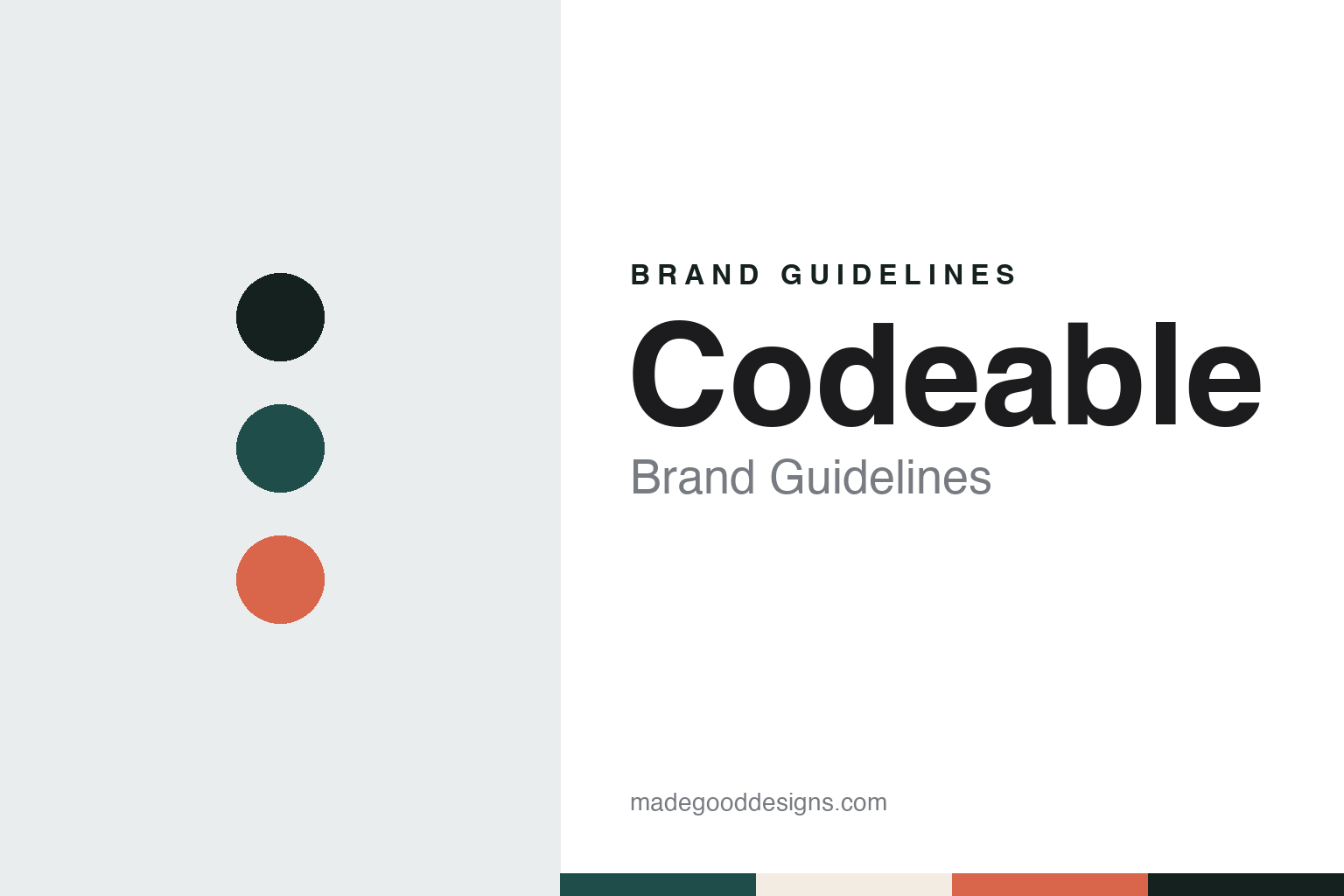
Two constants: a deep teal, sand and coral palette and a friendly geometric sans register. Abstract homage — not a Codeable product or mark; no logo, interface or screen is reproduced.
Client meets freelancer
An agency owner, a remote developer and a shared complaint.
Codeable is a marketplace for one kind of work: WordPress. It began with two people on opposite sides of the freelance trade. In its own account of its history, the company says that in 2010 Per Esbensen was running a development agency in Denmark and often hired freelancers when his own team ran short. One of them was Tomaž Zaman, a remote freelance developer who found work through an online marketplace. The two did a lot of work together.
The trade site Torque, reporting in November 2016 on a question-and-answer session the founders gave to ManageWP, filled in the background. It said the pair met through TYPO3, an enterprise content management system; Esbensen ran an agency specialising in TYPO3 and 3D animation, and Zaman worked as a TYPO3 integrator. They worked on website projects for Scandinavian companies for about two years before starting Codeable.
Both, Codeable says, were frustrated with the way freelance marketplaces worked: Esbensen from the client side and Zaman from the freelancer side. The company lists the problems as it saw them — crowds of freelancers, bidding, a “race to the bottom,” poor work, missed deadlines and unhappy people on both sides. In 2012 the two joined forces, and “a year later Codeable was officially launched,” the company says. A ManageWP article from September 2016 likewise gives the launch year as 2013. The website now headlines “2012 founded.”
From the start the platform was narrow on purpose. Codeable says it began with small customisation tasks for WordPress sites and later widened to larger projects and recurring work, while keeping to the same platform. Its current website calls it “the only WordPress freelancer platform,” a description that is the company’s own.
Colour
No bidding, three estimates and a strict rulebook.
The idea that sets Codeable apart from open marketplaces is how a price is reached. Instead of freelancers bidding against each other, a small number of experts look at a client’s project and each gives an estimate. Torque reported in 2016 that three freelancers estimate what a project should cost and the average is given to the client; ManageWP, writing the same year, described three to five experts per project and “absolutely no bidding.” Zaman told the ManageWP AMA that because the rules about estimating are strict, the three figures are usually close to one another.
The second idea is selection. ManageWP reported in 2016 that about 98% of developers who applied were turned down, and that the entry tests centred on communication rather than coding skill. Zaman was quoted as saying he could read anyone’s code on GitHub, but that what mattered was how a developer communicates. The same article described a 15-page rulebook, which Zaman said collected his own mistakes as a freelancer, and a rule that experts may not promote themselves on the platform. Codeable also turned away a share of the projects clients posted, ManageWP said, for reasons such as poor briefs or unrealistic deadlines.
Codeable’s growth was tied to WooCommerce, the WordPress shop plug-in. ManageWP reported that in the first year of the partnership WooCommerce sent 90% of Codeable’s customers, falling to 40% in the second year and under 5% in the third, as Codeable’s own customer base grew; WooCommerce by then belonged to Automattic. Torque said WooCommerce work was the most common kind on the platform.
The company describes itself in community terms. It says its vetting process was co-created with one of its platform developers, now on staff, that existing experts help assess new candidates, and that experts share knowledge in a dedicated Slack channel and forum and refer clients to one another. It lists in-person meetups and events, including WordCamp Europe in 2018, 2019 and 2023, a gathering in Porto in 2022, and WordCamp Asia and the CloudFest Hackathon in 2024.
Typography
Design and documentation.
Freelance and creative-talent marketplaces describe themselves in a small set of words. DesignCrowd’s about page calls it an online creative marketplace that connects businesses with a global network of designers; English Wikipedia describes Crowdspring as a marketplace for crowdsourced creative services. Category names on these sites are practical rather than poetic: logo and identity, web, print, product and merchandise, art and illustration, with designer directories sorted by type, country and city.
The client’s first screen is usually a brief. When Slate tested Crowdspring in May 2011, posting a job meant filling in a “creative brief” form with set questions about what a logo should communicate. Contest sites then add their own rules on top of the brief. DesignCrowd’s how-it-works page lets a client choose a three-, five- or ten-day deadline, keeps designers from seeing one another’s entries and passes full copyright in the winning files to the client.
Showcase work is presented plainly, as entries and finished projects rather than as campaigns. Slate found that anyone could browse other people’s projects and, in many cases, their submissions, and that the site prompted clients to rate entries on a five-star scale and send feedback. Forbes reported in 2009 that Crowdspring offered larger buyers a Pro option that hid submissions from public view, and that its own logo came through its marketplace.
Corporate pages fill in the rest. DesignCrowd’s about section names its founder and chief executive and has a separate board and investors page listing its venture backers, while dated press releases record new country sites and new brands. This guide sets out what can be checked about each marketplace — who founded it, who owns it and how its interface works — and marks clearly what rests only on the company’s own word.
Aa
A friendly geometric sans for a platform with the slogan “Build with heart.” (Specimen set in DM Sans, a sans STAND-IN; NOT the Codeable logo.)
Codeable
Build with heart, from everywhere.
Codeable has no head office in the usual sense. The company says it is a core team of about 20 people and more than 750 freelancers, all fully distributed, and it signs its pages “Build with heart.” The publisher named in the data on its website is Codeable ApS; ApS is the Danish form of private limited company. Esbensen is listed as co-founder and chief executive on its team page.
The company publishes its own scale figures: more than 700 partners, more than 25,000 customers and more than 300,000 projects, according to its website in November 2026. Its services are now pitched to three groups — business owners, agencies and freelancers — for short-term, recurring and full-time WordPress work, and it runs a partner programme, an affiliate programme and a public directory of its developers. These are Codeable’s figures and descriptions.
The identity is written plainly. The site calls its experts “experts” rather than freelancers or contractors, describes its team as “20 (people, not years old),” and keeps the slogan short. The founders have told their story in several interviews, which the company links from its own history page, including a Mastermind.fm podcast and an interview with Esbensen in Kinsta’s Kingpin series.
For a design guide, Codeable shows how a narrow focus — a single platform, a single kind of client — can carry a brand. Compare Toptal, another vetted network for developers, and Arc, which grew out of a developer mentoring site. For this guide we use deep teal, sand and a warm coral with a sans, an unofficial interpretation; no product or logo is reproduced.
Explore & save
Keep Codeable’s identity on hand — save it to a board in the Made Good inspiration library.
Codeable identity set
Pin the Codeable deep teal, sand and coral palette and the friendly geometric sans register to your own board.