Parkdean Resorts Brand Guidelines
Two caravan park groups, one seaside name.
Aa
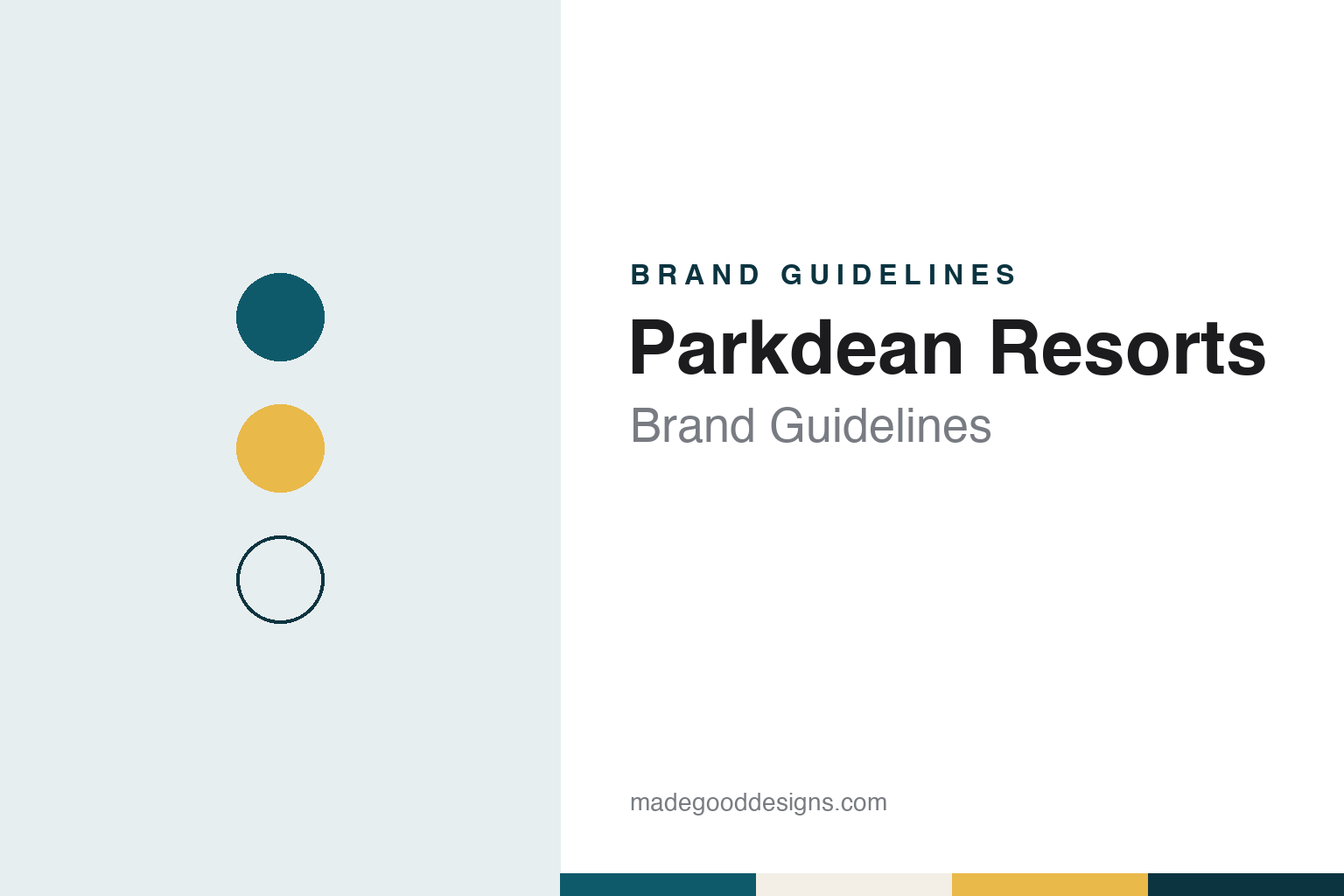
Two constants: a teal, sand and yellow palette and a rounded sans register. Abstract homage — not a Parkdean Resorts asset; no park photograph, mascot or logo is reproduced.
Trecco Bay
One park in South Wales, then a merger.
Parkdean Resorts has two roots. The older of the two businesses that share its name, Parkdean Holidays, began with a single park. WalesOnline reported that Parkdean bought Trecco Bay, the large caravan park at Porthcawl in South Wales, from First Leisure in November 1999, and that the company had been founded with just one site. English Wikipedia describes that purchase as a management buyout. In a statement reported by Chronicle Live in March 2019, co-founder John Waterworth summed up the company’s path as “the initial investment in Trecco Bay in 1999,” a listing on London’s Alternative Investment Market and then a run of acquisitions in what he called “a highly fragmented sector.”
Parkdean Holidays was based in Newcastle upon Tyne, where WalesOnline reported it ran a call centre for bookings. English Wikipedia says the private equity firm Alchemy Partners took an 80 per cent stake in 2006, with the rest held by management, and that in July 2007 Parkdean bought Weststar Holidays and its four parks in South West England. By September 2015, The Guardian reported, Parkdean ran 24 self-catering parks with static caravans, chalets and lodges, mostly in the South West, with a handful in Scotland, two in South Wales and one in Norfolk.
The other root was Park Resorts, based in Hemel Hempstead. English Wikipedia says it was created in 2001, when a management team backed by Close Brothers Private Equity bought twelve Haven parks from Bourne Leisure, and that it later grew through the purchase of GB Holiday Parks and South Lakeland Parks. By 2015 it had 49 parks, mainly in northern England, the Lake District, the Isle of Wight and Scotland, The Guardian reported, and it was owned by the investment firm Electra.
Colour
A merger in 2015 and a Canadian owner in 2017.
On 1 September 2015 The Guardian reported that the two groups would merge to create Britain’s biggest holiday park operator, with 73 sites. Electra was to hold 45 per cent of the new company and Alchemy about a third, with management also holding a stake; the deal still needed clearance from the Competition and Markets Authority, and the name of the combined company had not been decided. Travel Weekly later reported that the company was formed in November 2015.
The new name, Parkdean Resorts, joined the two. English Wikipedia says the business kept trading as “Parkdean Holidays” and “Park Resorts” throughout 2016, with head offices in both Newcastle and Hemel Hempstead, before it launched a new website and rebranded every park under the single Parkdean Resorts name.
Ownership changed again within a year of the merger. In December 2016 Travel Weekly reported that the Canadian buy-out firm Onex had agreed to buy the company from Electra’s manager Epiris; at that point it ran 73 holiday parks across England, Scotland and Wales, sold more than 500,000 holidays and short breaks a year and employed more than 6,000 people in the peak season. Onex announced on 3 March 2017 that it had completed the purchase, with its Onex Partners IV fund and co-investors providing the equity, and called Parkdean Resorts “a leading operator of caravan holiday parks in the United Kingdom.” Onex still lists the company in its portfolio in November 2026.
The leadership changed in 2019. Chronicle Live reported in March that year that John Waterworth, chief executive for about 20 years, would step down that summer, to be succeeded by Steve Richards, then chief executive of Casual Dining Group; Richards spoke at the time of the company’s 67 parks.
Typography
Holiday parks and how they present themselves.
Holiday park and campsite operators sell a place before they sell a stay. Their websites open on photographs of the parks themselves: lodges and cottages among trees, pitches and mobile homes beside water, covered pools and play areas, published by each company as its own pictures of each site. The operators in this guide range from woodland villages built around an indoor pool to campsites with tents, pitches and wooden cabins, and their imagery follows those settings.
Naming does much of the branding work. Center Parcs renamed one of its early Dutch parks after customer research, according to Dutch Wikipedia, and later called its bungalows “cottages” and its pools Aqua Mundo; Landal pairs its own name with a local one, as in Landal Beach Park Texel. Accommodation is sold by type, from a pitch to a lodge, cottage or villa, and those type names carry through from park maps to booking pages.
The booking interface is where the parts meet. On the operators’ own sites a guest picks a park, then dates, party size and an accommodation type, and the site shows what is free. The journey can continue on a phone: parkurlaub.de reported in 2026 that check-in and a digital door key ran through the Landal app. Park maps show the layout of houses, pitches, paths and facilities, and are published by the companies themselves.
Behind the consumer brands sit corporate pages on owners, and these change often. Several of the companies in this guide have been bought and sold by brewers, insurers, listed groups and investment firms, and some share a name with a business they no longer own. This guide records those ownership changes as dated facts from named sources, and treats each company’s description of itself as its own claim.
Aa
A friendly rounded sans for a family seaside brand. (Specimen set in Nunito Sans, a sans STAND-IN; NOT the Parkdean Resorts logo.)
Parkdean Resorts
Parks, pitches and a cast of mascots.
The product is a network of parks rather than a single resort. English Wikipedia lists 65 parks in 2026, from Cornwall, Devon and Dorset through Essex, Norfolk and the Yorkshire coast to Northumberland, with eight in Scotland and five in Wales, Trecco Bay among them. Accommodation, it says, runs from caravans and lodges to cabins, glamping and camping pitches, and the company sells holiday homes to private owners as well as renting out its own. The Guardian noted in 2015 that Parkdean already sold caravans and lodges to owners alongside its holiday lets.
Much of the brand that guests meet on a park is its entertainment. Park Resorts had a group of mascots called Sparky’s Krew — the rabbits Sparky and Sparkle and an aardvark called Naarky — and English Wikipedia says that after the merger they were joined by Parkdean’s Sid the seagull and Lizzie the lizard as the Starland Krew, with Pipsqueak the mouse for younger children. The same article lists partnerships with Bear Grylls Survival Academy, the children’s television brand Milkshake! and Nickelodeon, and gives the head office as Gosforth, in Newcastle.
Both predecessors still show in the company’s map. Parkdean’s Newcastle base and its first park at Porthcawl mark where the business began, while Park Resorts, which The Guardian described in 2015 as twice Parkdean’s size, brought its parks in northern England, the Lake District, the Isle of Wight and Scotland, along with its Hemel Hempstead office.
For a design guide, Parkdean Resorts shows how a merged business can fold two park brands and their mascots into one name across dozens of seaside sites. Compare Haven, whose former parks helped form Park Resorts, and Away Resorts, another UK holiday park operator. For this guide we use a harbour teal, sand and a beach-hut yellow with a rounded sans, an unofficial interpretation; no product or logo is reproduced.
Explore & save
Keep Parkdean Resorts’s identity on hand — save it to a board in the Made Good inspiration library.
Parkdean Resorts identity set
Pin the Parkdean Resorts teal, sand and yellow palette and the rounded sans register to your own board.