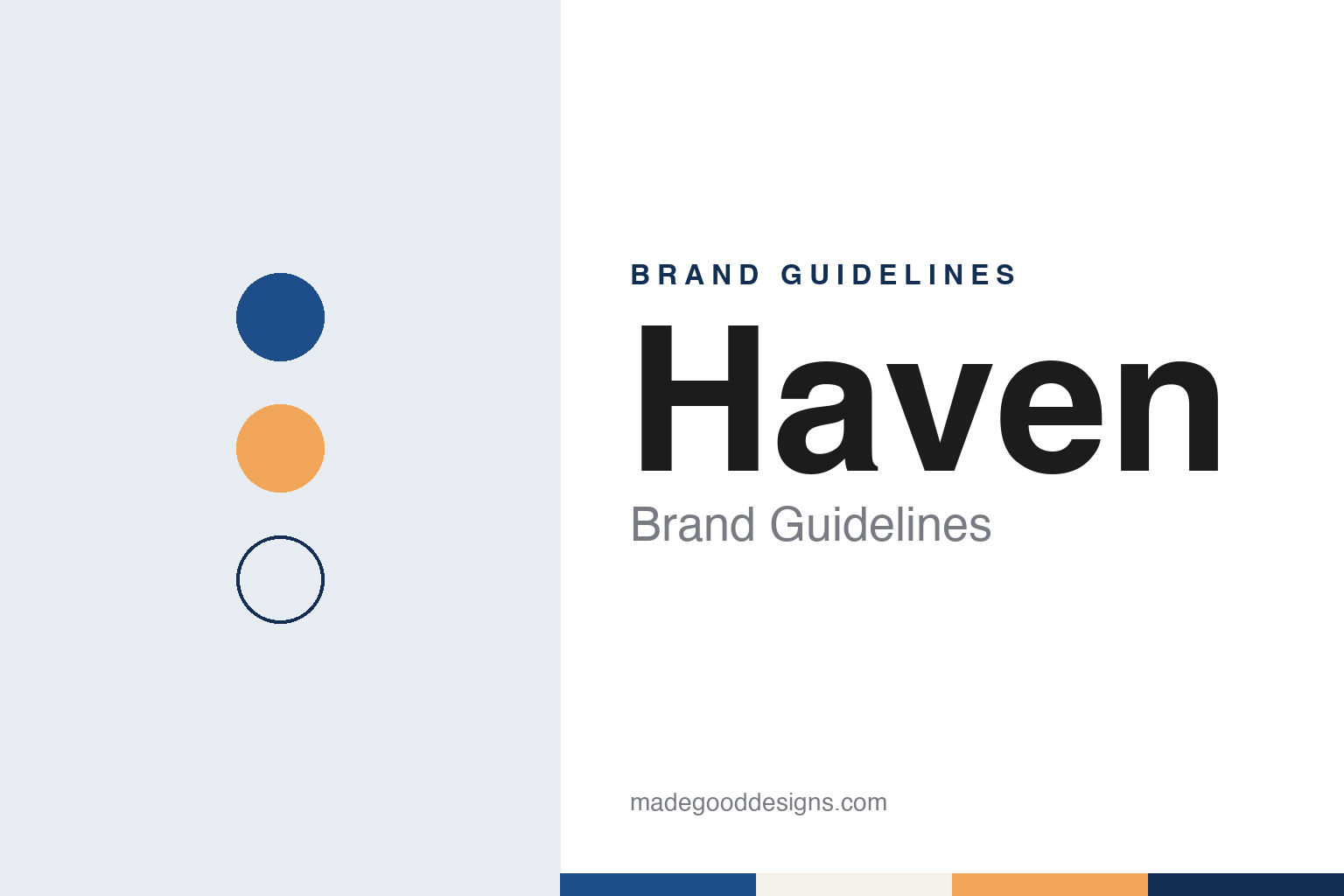
Haven Brand Guidelines
A seaside park name that outlived three owners.
Aa
Two constants: a blue, dune and orange palette and a rounded display sans register. Abstract homage — not a Haven asset; no park photograph, mascot or logo is reproduced.
Leisure Caravan Parks
A company story that runs through Rank.
Haven tells its history through the people who own it today. The company’s corporate history says its story began in 1964, when Leisure Caravan Parks was set up on 1 March by Peter Harris, David Allen, Robert Seaton and John Cook, a group it calls the “Old Boys.” English Wikipedia’s article on Bourne Leisure says Harris, an accountant, and Allen began by buying the Alberta caravan park at Whitstable in Kent, floated Leisure Caravan Parks on the London stock exchange in 1972 and sold it to Rank in 1975, before starting again with a new set of parks under the Bourne Leisure name.
The Haven name itself grew up inside Rank. English Wikipedia says Rank moved the self-catering camps of Warner, the holiday camp business founded in 1932, under the Haven banner, a process complete by 1992, and that by 1996 Haven had 49 parks sorted into three categories. Haven’s own history reaches further back still: it says the Caister holiday camp in Norfolk, which it dates to 1906, is still a Haven park today.
Rank sold its holiday arm in 2000. The Guardian, writing in September 2015, recalled Bourne Leisure’s purchase of Rank’s holiday division in 2000, which included Butlins, the Haven holiday parks and Warner Leisure Hotels. Haven’s history says the purchase also included Haven Europe and the Oasis village, and that Bourne Leisure moved to its head office in Hemel Hempstead.
Colour
Two park brands become one, then a new owner.
Bourne Leisure already ran a second park brand, British Holidays, and the two were combined. Haven says British Holidays “was later fully merged under the Haven brand in 2004.” English Wikipedia adds that Haven took on much of the standard facility naming British Holidays had used since 1997 — FunWorks for entertainment complexes, SplashZone for pools — and that the British Holidays name was dropped completely by the end of the 2007 season. In the same years Bourne sold many smaller parks; English Wikipedia says twelve of them went to the management buyout that became Park Resorts, and that Haven Europe, the continental business, was sold in November 2004 and is now Siblu.
The next change of owner came in 2021. On 1 February that year Travel Weekly reported that the investment firm Blackstone had confirmed an agreement to buy Bourne Leisure, owner of Butlin’s, Haven and Warner Leisure Hotels, and that the Harris, Cook and Allen founding families would co-invest and together keep a “significant minority” stake. The law firm Slaughter and May, which advised Bourne Leisure, says the agreements were signed on 28 January 2021, with funds managed by Blackstone Capital Partners and Blackstone Real Estate Partners as buyers. Travel Weekly described Haven at the time as the largest UK caravan operator, with 38 parks and 2.5 million visitors a year.
The group was later taken apart. English Wikipedia says Bourne Leisure split its main trading companies into separate legal entities in 2025, and Haven says that since 2025 it has “operated as a standalone business.”
Typography
Holiday parks and how they present themselves.
Holiday park and campsite operators sell a place before they sell a stay. Their websites open on photographs of the parks themselves: lodges and cottages among trees, pitches and mobile homes beside water, covered pools and play areas, published by each company as its own pictures of each site. The operators in this guide range from woodland villages built around an indoor pool to campsites with tents, pitches and wooden cabins, and their imagery follows those settings.
Naming does much of the branding work. Center Parcs renamed one of its early Dutch parks after customer research, according to Dutch Wikipedia, and later called its bungalows “cottages” and its pools Aqua Mundo; Landal pairs its own name with a local one, as in Landal Beach Park Texel. Accommodation is sold by type, from a pitch to a lodge, cottage or villa, and those type names carry through from park maps to booking pages.
The booking interface is where the parts meet. On the operators’ own sites a guest picks a park, then dates, party size and an accommodation type, and the site shows what is free. The journey can continue on a phone: parkurlaub.de reported in 2026 that check-in and a digital door key ran through the Landal app. Park maps show the layout of houses, pitches, paths and facilities, and are published by the companies themselves.
Behind the consumer brands sit corporate pages on owners, and these change often. Several of the companies in this guide have been bought and sold by brewers, insurers, listed groups and investment firms, and some share a name with a business they no longer own. This guide records those ownership changes as dated facts from named sources, and treats each company’s description of itself as its own claim.
Aa
A rounded display sans for a seaside family brand. (Specimen set in Fredoka, a sans STAND-IN; NOT the Haven logo.)
Haven
A ribbon, a tiger and a Seaside Squad.
Haven’s identity has long been tied to how its parks are sorted. English Wikipedia says that by 2000 the parks fell into four categories, each with its own colour — red for All Action, blue for Lively, yellow for Leisurely and green for Relaxing — and that those colours formed part of a ribbon logo introduced in 1999, part of which was replaced by the British Holidays logo between 2004 and 2007 as the brands merged.
Its characters carry the brand as much as any mark. Haven says Rory the Tiger, introduced in 1988, was its first mascot; English Wikipedia lists him as part of today’s Seaside Squad, alongside Annie the Elephant, George the Gorilla and Jaz Bear, and says the squad was renamed and redesigned for shows from October 2022. The same article says the entertainers once called Havenmates, known for jackets patterned like striped deckchairs, became Funstars after the Bourne Leisure purchase.
The parks are mostly on the coast. Haven’s press office said in September 2026 that it ran 39 parks in England, Scotland and Wales, each with an indoor pool, a supermarket and a pub-restaurant, and that Seal Bay Resort at Selsey in West Sussex, bought by Blackstone, would trade under its own name for the rest of 2026 before joining the Haven brand for the 2027 season as its 40th park. Haven’s history lists park purchases at Skegness in 2022 and at Mablethorpe in 2024, an agreement with the pub company J D Wetherspoon in 2024, and a first Burger King franchise at Haggerston Castle in 2005.
For a design guide, Haven shows how a park name can outlast its owners, absorbing a sister brand and a cast of characters along the way. Compare Parkdean Resorts, built partly from former Haven parks, and Siblu, the former Haven Europe. For this guide we use a coast blue, a dune tone and a sunset orange with a rounded sans, an unofficial interpretation; no product or logo is reproduced.
Explore & save
Keep Haven’s identity on hand — save it to a board in the Made Good inspiration library.
Haven identity set
Pin the Haven blue, dune and orange palette and the rounded display sans register to your own board.