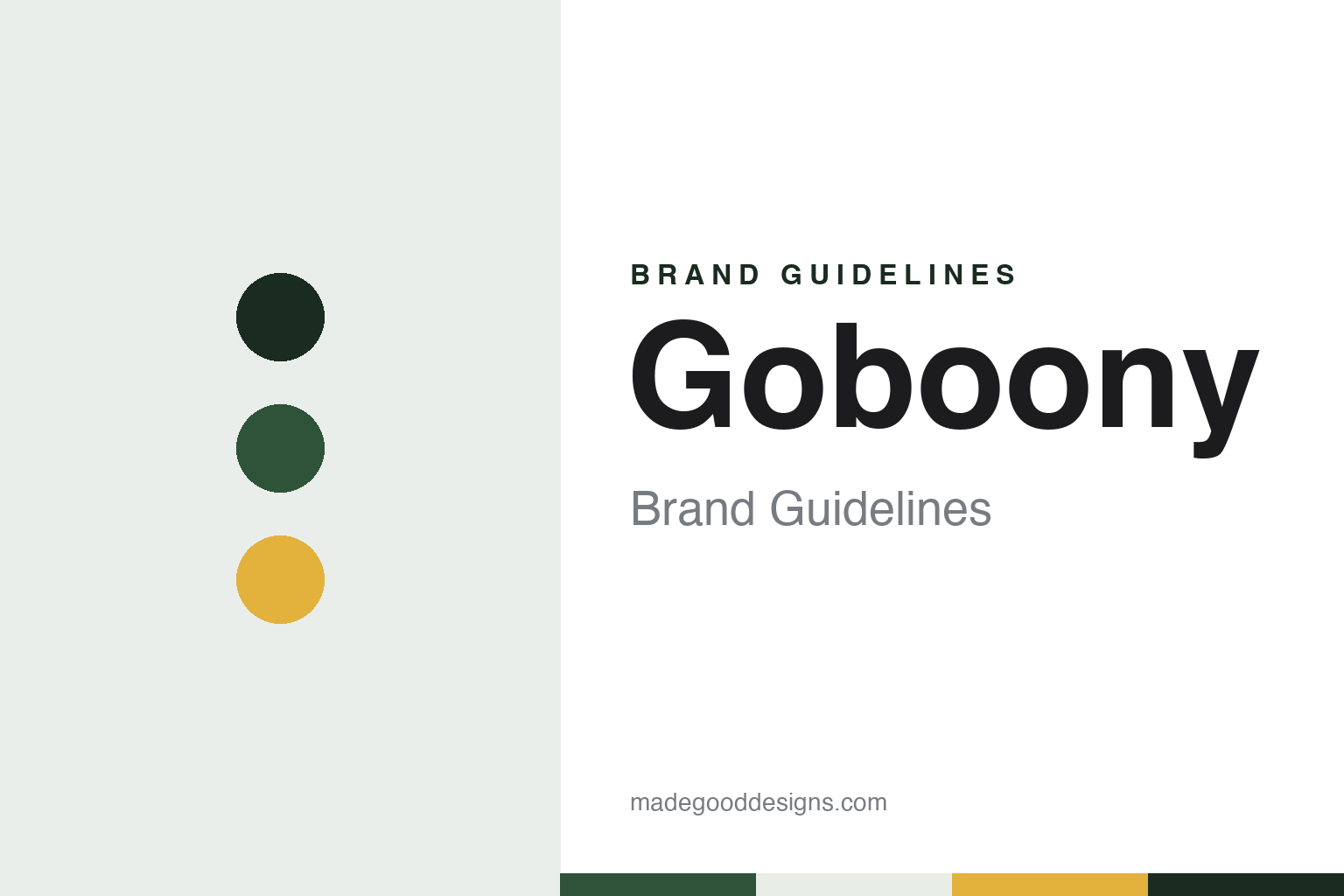
Goboony Brand Guidelines
The Utrecht platform named for the boonies.
Aa
Two constants: a forest green, mist and sunflower palette and a geometric sans register. Abstract homage — not a Goboony product or mark; no vehicle, logo or app screen is reproduced.
Utrecht, 2015
Two Dutch travellers who met on a New Zealand road.
Goboony is a Dutch peer-to-peer platform on which private owners, and some rental firms, rent out motorhomes and campervans to travellers. It was founded in Utrecht by Mark de Vos and Foppe Mijnlieff. Silicon Canals reported in March 2016 that the two had started the platform ten months earlier, which places the launch in 2015, the founding year the company itself gave when it announced its merger with Yescapa in 2023.
The founders met in New Zealand in 2011, when both were touring the country by motorhome in opposite directions, the company says, and Silicon Canals reported at the launch that the idea for Goboony came from that meeting on the road. Both were already entrepreneurs: De Vos advised small and medium-sized businesses, and Mijnlieff worked in business development through his own venture firm, the same report said. The name comes from New Zealand too. The company says it derives from “boonies,” a term there for beautiful, untouched places, and that Goboony helps people get to them by motorhome.
The model borrowed openly from home-sharing. Silicon Canals wrote at the launch that Airbnb was plainly the inspiration, in layout and feel as well as in concept, and quoted De Vos: where a house can be let only a few weeks a year, a motorhome is needed by its owner only a few weeks a year, leaving far more time to earn from it. Goboony offered a searchable database of vehicles, live availability, verified owners and reviews from both renters and owners, and handled payments itself, so that renters did not have to send money directly to a stranger. At the time it had about 150 motorhomes listed, a few of them from rental companies, and all of them Dutch.
Colour
From 150 Dutch vans to a European platform.
Growth followed quickly. In March 2016 Silicon Canals reported that Goboony had closed its first investment round, from a strategic partner and three informal investors, and had 190 motorhomes listed, which the site said made it the largest provider of rental motorhomes in the Netherlands, ahead of the rival platform Camptoo. The plan then was to roll out to Italy, Germany, England and France within eighteen months, and in time to New Zealand, where the founders had met.
Camptoo, which Silicon Canals reported had started in The Hague at almost the same time as Goboony, later became part of Goboony’s story in a different way. Goboony says Camptoo declared bankruptcy on 26 October 2022, and that its administrator agreed to direct Camptoo’s users to Goboony; Goboony said it would not take over Camptoo’s business or its debts, and offered Camptoo owners help moving their listings over, reviews included. When the company announced its merger in 2023, it described this as Goboony acquiring assets from Camptoo, which had been active in the United Kingdom, the Netherlands and Belgium.
Goboony now trades in English as well as Dutch, with sites including goboony.co.uk. On its about page the company says Europe’s motorhomes typically stand still for 48 weeks a year, and that sharing them lets owners earn from vehicles they already have while travellers set their own pace. It also says it was the first platform to welcome electric campervans for hire and that it now lists the largest number of electric motorhomes in Europe; those are its own claims.
Inside the company, KVK, the business site of the Dutch Chamber of Commerce, reported in September 2024 that Goboony had a team of 85, mostly aged between 20 and 35, and that co-owner De Vos described the company’s motto as “share the freedom.” Freedom, he told KVK, was the company’s most important value at work too: staff plan their own time off with colleagues and team leaders rather than counting days.
Typography
Peer-to-peer and fleet rental.
Campervan and motorhome rental is sold with pictures of the open road, but two different kinds of business sit behind those pictures. Some companies own and run fleets of their own vehicles from depots; others are marketplaces, on which private owners list their own caravans, campervans and motorhomes and the platform handles the booking and the cover. Camplify, launched in Newcastle, New South Wales, in 2015, and PaulCamper, launched in Berlin in 2013, are marketplaces of the second kind, and since December 2022 both have belonged to the same group listed in Australia.
This guide looks first at the vehicle as each company publishes it: in a company livery or paint scheme, photographed against a landscape, or listed as an owner’s own van in that owner’s own photographs. Where a company describes its vans, its colours or its paintwork, the guide gives that as the company’s own account, with the date of the source.
Names come next. Rental firms give names to their vehicle ranges and models, and marketplaces give names to their memberships and cover products: Camplify sells a premium membership called Club Camplify and member cover under the name MyWay, while PaulCamper says it built its rental cover together with Allianz. Bookings are made online, and some companies also offer an app, as Camplify does on its website; this guide describes such apps plainly, from what the companies say about them.
Finally, there are the owners. Some names in this category belong to larger groups, and corporate pages, annual reports and stock-exchange filings show who owns what and since when. This guide follows those documents and dated press reports, gives fleet, depot and country counts only as a dated source states them, and treats the colours and typefaces shown here as an unofficial interpretation rather than official brand values.
Aa
A geometric sans for a name taken from New Zealand slang. (Specimen set in Poppins, a sans STAND-IN; NOT the Goboony logo.)
Goboony
A merger with Yescapa in 2023.
On 25 August 2023 Goboony announced a merger with Yescapa, the Bordeaux peer-to-peer platform founded in 2012, Tech.eu reported the same day. The companies said they had been in close contact since 2018. A new holding company became the ruling structure for both brands; the four co-founders — Mark de Vos and Foppe Mijnlieff of Goboony, Benoît Panel and Adrien Pinson of Yescapa — stayed with the group, and Sergio Branco, whose earlier roles included Homeaway, then part of Expedia, became group chief executive. The deal was paired with a funding round led by iXO Private Equity together with existing shareholders, which the adviser Cambon Partners names as No Such Ventures and MAIF Avenir.
The companies said the combined platform had about 30,000 vehicles in some 10,000 European cities and served around 350,000 travellers a year. They set out a multi-year plan for shared management, finance and data work, with a single technical platform to be built over time. Both names stayed in use, and Goboony’s about page still gives Utrecht as its base.
For a design guide, Goboony shows how a name drawn from a traveller’s slang word can carry a platform from a handful of Dutch vans to a European merger. Compare Yescapa, its French partner in the 2023 merger, and PaulCamper, another peer-to-peer motorhome platform. For this guide we use a forest green, a pale mist and a sunflower yellow with a geometric sans, an unofficial interpretation; no product or logo is reproduced.
Explore & save
Keep Goboony’s identity on hand — save it to a board in the Made Good inspiration library.
Goboony identity set
Pin the forest green, mist and sunflower palette and the geometric sans register to your own board.