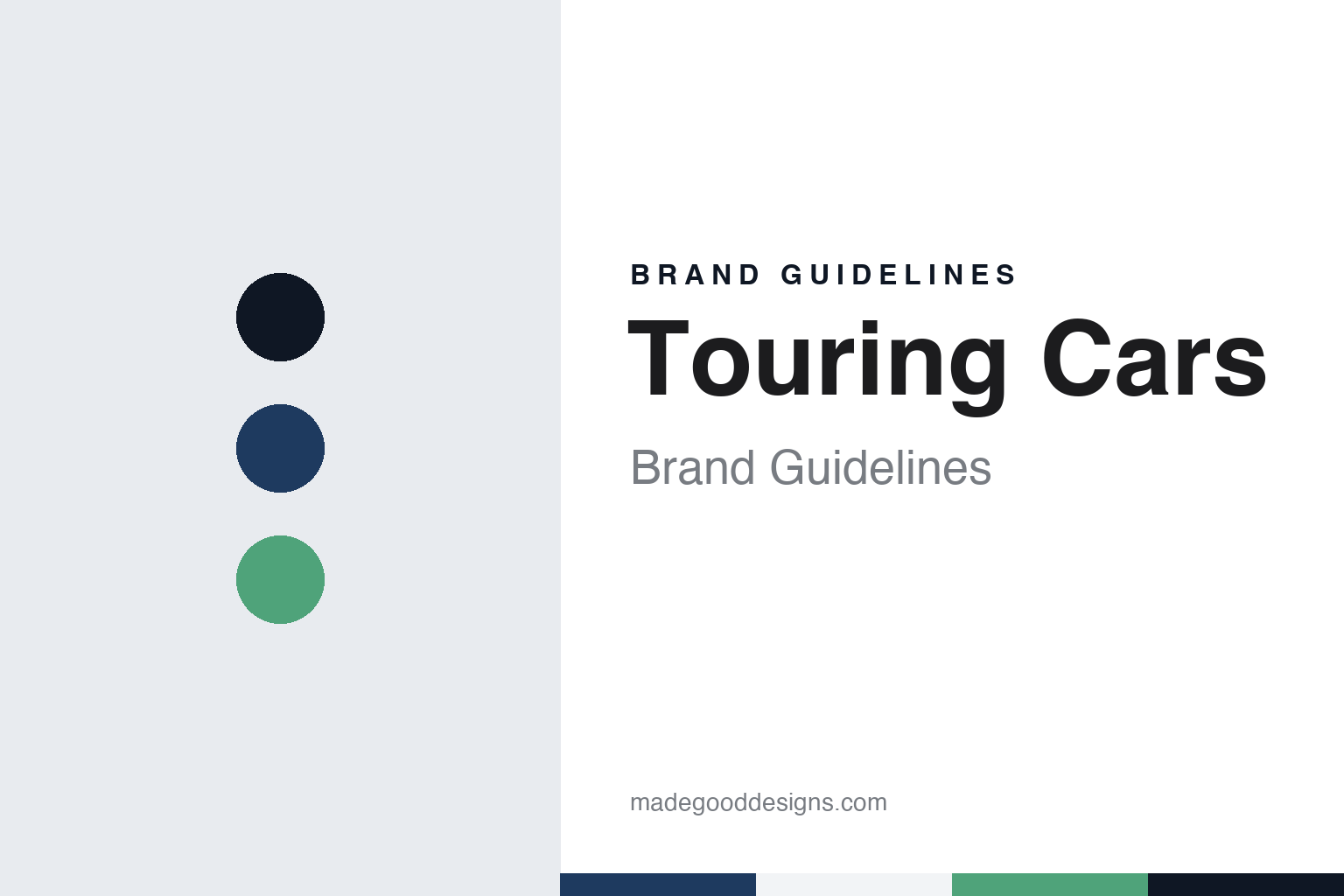
Touring Cars Brand Guidelines
Finland’s 1982 motorhome rental firm and its franchise chain.
Aa
Two constants: a fjord blue, polar night and aurora green palette and a soft serif register. Abstract homage — not a Touring Cars vehicle or mark; no livery, logo or photograph is reproduced.
Northern Stars
One motorhome and a film shoot.
Touring Cars is a Finnish motorhome rental company founded in 1982. The Finnish motoring magazine Moottori described it in September 2024 as a Finnish family company founded that year and specialising in renting out motorhomes. The company’s own history names its founder as Hannu Kekäläinen, who, it says, had seen the popularity of motorhomes on a trip to Florida, then commissioned a workshop to build five motorhomes and kept one of them for himself.
According to the same history, the business began under the name Northern Stars, when that vehicle, found in Kuopio in eastern Finland, was rented as a dressing room for the actor Lee Marvin during the filming of Gorky Park, which was partly shot in Helsinki. The company says that single rental showed Kekäläinen there was a market for renting motorhomes, at a time when such vehicles were rare in Finland.
Expansion abroad started early. The company says its first cooperation in Sweden began in 1985, around Stockholm, and that it entered Norway in 1989. Tanja Saarnio, who joined to help run motorhome tours in Karelia, became part owner and managing director in 1991 and sole owner in 1995, the company says; that year it also started a customer magazine called Key To Freedom, a phrase the brand still uses. The company says it chose at that point to invest in a better-equipped fleet and to put customer service at the centre of the business. In the 1990s it began a reinvestment programme in which private buyers purchase a motorhome and rent it back through Touring Cars. In 2002, the company says, it created its first staff training programme and quality handbook. In 2003 it bought the business of its Swedish partner, and in 2004 it opened offices in Kuopio, Pori and Oulu. By 2009, the company says, it ran 125 motorhomes and had started operations in Iceland.
Colour
From Nordic chain to franchise network.
The company describes the years after its 30th anniversary in 2012 as a new strategy. It says it became a franchise business in 2013, with the German motorhome maker Hobby as its factory partner, after a period of direct imports from Hymer that began in 2005. A franchise agreement in Reykjavik followed in 2014. Estonia, the United Kingdom and Spain joined in 2017, and Barcelona and Riga in 2018, the year Veijo Tiitinen became managing director. The company says its network had grown past 20 rental stations by 2020 but shrank to nine that year, when it sold rental fleet and rebuilt its franchise model to give partners financial and fleet-management support.
Moottori gave a snapshot in September 2024. Touring Cars then operated in Finland, Sweden, Norway, Iceland, the United Kingdom, Estonia and Latvia, partly on a franchise basis, the magazine reported, with about 80 per cent of its rental motorhomes owned by the company and about 20 per cent owned by private investors whose vehicles it rents out and maintains. It added that the fleet used vehicles from several motorhome makers, with many four-wheel-drive models in Iceland, and that the company was looking for partners to open stations in northern Germany, Scotland and Malmö.
By November 2026 the company’s own pages listed 10 rental stations in eight countries: Finland, Sweden, Norway, Estonia, the Netherlands, Spain, Iceland and England. It says Amsterdam and Madrid opened in 2026, that local entrepreneurs run its European stations, and that vehicle sales and maintenance are handled locally in Finland, Norway, Estonia and England.
Typography
Design and documentation.
Campervan and motorhome rental is sold with pictures of the open road, but two different kinds of business sit behind those pictures. Some companies own and run fleets of their own vehicles from depots; others are marketplaces, on which private owners list their own caravans, campervans and motorhomes and the platform handles the booking and the cover. Camplify, launched in Newcastle, New South Wales, in 2015, and PaulCamper, launched in Berlin in 2013, are marketplaces of the second kind, and since December 2022 both have belonged to the same group listed in Australia.
This guide looks first at the vehicle as each company publishes it: in a company livery or paint scheme, photographed against a landscape, or listed as an owner’s own van in that owner’s own photographs. Where a company describes its vans, its colours or its paintwork, the guide gives that as the company’s own account, with the date of the source.
Names come next. Rental firms give names to their vehicle ranges and models, and marketplaces give names to their memberships and cover products: Camplify sells a premium membership called Club Camplify and member cover under the name MyWay, while PaulCamper says it built its rental cover together with Allianz. Bookings are made online, and some companies also offer an app, as Camplify does on its website; this guide describes such apps plainly, from what the companies say about them.
Finally, there are the owners. Some names in this category belong to larger groups, and corporate pages, annual reports and stock-exchange filings show who owns what and since when. This guide follows those documents and dated press reports, gives fleet, depot and country counts only as a dated source states them, and treats the colours and typefaces shown here as an unofficial interpretation rather than official brand values.
Aa
A soft serif for a company that sells the feeling rather than the vehicle. (Specimen set in Fraunces, a serif STAND-IN; NOT the Touring Cars logo.)
Touring Cars
Key to Freedom, Good Feelings.
The brand rests on two phrases. “Key to Freedom” names the company’s standard rental concept, and “Good Feelings” is the slogan the company says grew from its founder’s view that the real product is the freedom a motorhome brings rather than the vehicle itself. The rental range is sorted by size and use instead of by a maker’s model names: in November 2026 it ran from an Urban Van for two adults and a child to Large motorhomes for five and six, with a four-wheel-drive van and Luxury layouts in between. The home page promises a “five-star hotel room on wheels” and German-built vehicles, with free airport transfers and unlimited mileage.
The company says its headquarters and international sales office are in Vantaa, near Helsinki, that it employs about 60 to 100 people a season and that it works with more than 140 sales partners. It describes itself as a family business owned by Tanja Saarnio, an owner since 1991, and Elle Tick, an owner since 2021. On 29 September 2026 the company announced that its board had appointed Lauri Hellén as Group CEO from 1 October 2026, with Veijo Tiitinen moving to lead Touring Cars Norway AS and Jarkko Koskenmäki taking on the development of the franchise network. Alongside the rental offer, the company’s pages recruit franchisees and sales partners and describe business-to-business rentals.
For a design guide, Touring Cars shows how a rental firm can lead with a promise and a feeling rather than with its vehicles, using one concept name across stations run by local partners. Compare McRent, a German rental network, and Roadsurfer. For this guide we use fjord blue, polar night and aurora green with a soft serif, an unofficial interpretation; no product or logo is reproduced.
Explore & save
Keep Touring Cars’s identity on hand — save it to a board in the Made Good inspiration library.
Touring Cars identity set
Pin the Touring Cars fjord blue, polar night and aurora green palette and the soft serif register to your own board.