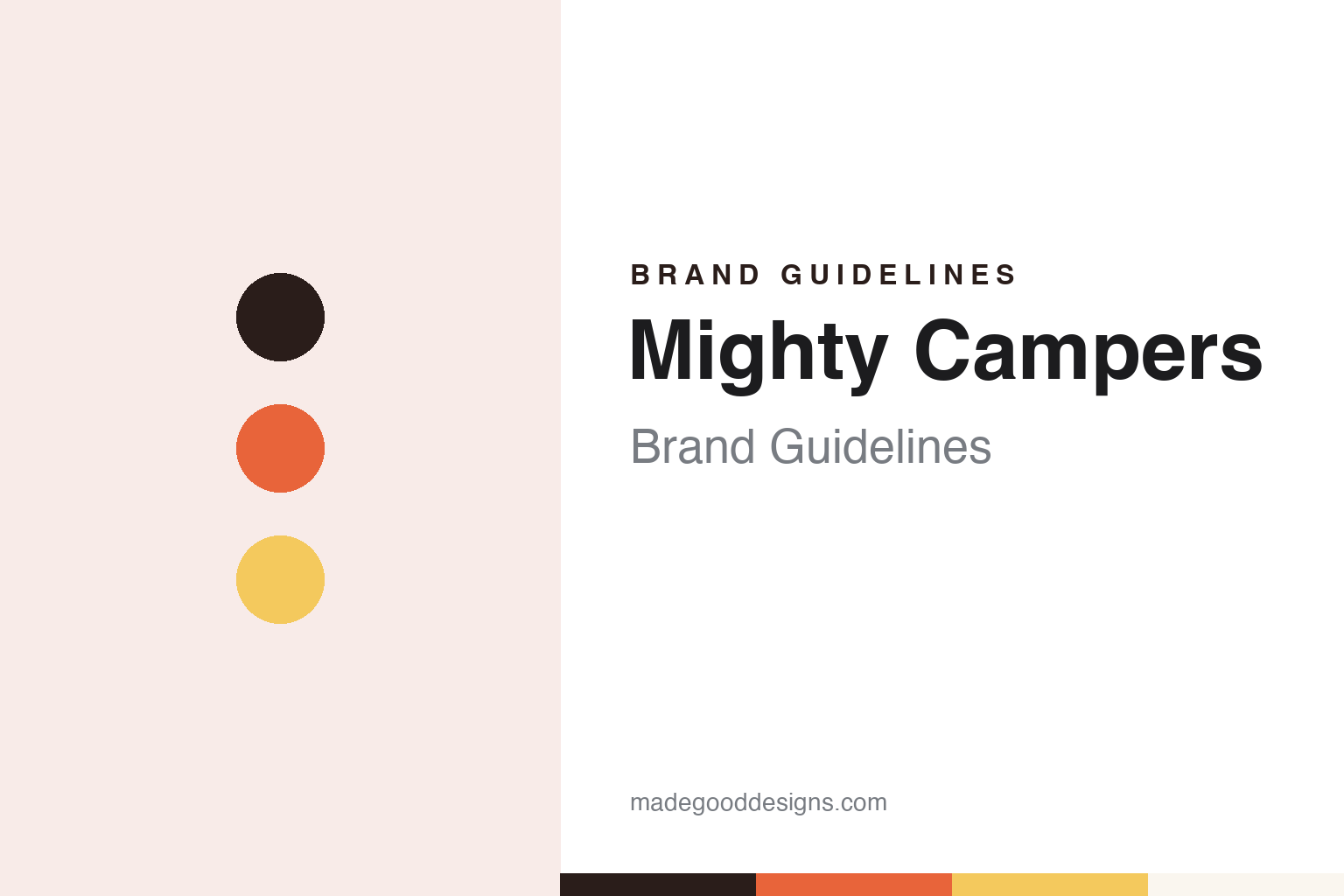
Mighty Campers Brand Guidelines
A value brand with a loud name, a hammock in the first van and a ladder of sister brands.
Aa
Two constants: a campfire char, ember and sunset orange palette and a Heavy grotesque register. Abstract homage — not a Mighty Campers or thl product or mark; no vehicle, livery or logo is reproduced.
A value brand
thl’s third step, launched in 2012.
Mighty Campers is the value campervan brand of Tourism Holdings Limited, the Auckland company that writes its name in lower case as thl. English Wikipedia describes thl as a New Zealand tourism company that began as a scenic helicopter business, The Helicopter Line, and has been listed on the New Zealand stock exchange since 1986. By the early 2010s its rental arm already ran two main campervan brands, Maui and Britz, alongside smaller budget names.
Mighty was built out of those budget names. English Wikipedia says that in mid-2012 the Backpacker and Explore More campervan brands were combined and relaunched as Mighty, aimed at lower-cost and youth travellers. thl announced the launch in a press release dated 19 June 2012, calling Mighty “an exciting new value brand” for Australia and New Zealand, offering both cars and campers. Bookings opened on 25 June 2012, the release said, from nine branches around Australia and four in New Zealand; a week later the trade newsletter e-Travel Blackboard reported the launch with nine Australian branches and three in New Zealand, at Auckland, Christchurch and Queenstown.
The pitch was value without the youth-only label. thl said the brand had been shaped by “months of field research” and by travel-industry feedback, and Kate Meldrum, its general manager of marketing and customer experience, said customers wanted “value-centric brands that appeal to a wide audience and go beyond the youth market”. She described Mighty as “as relevant as it is vibrant and fun”, and tied it to childhood memories of camping trips and the wish to explore.
Colour
From the Jackpot to the Big Six.
The first hero product was a van called the Mighty Jackpot. thl’s 2012 release said the Jackpot was “built on the foundation of camping ‘ceremony’ and task accomplishment”, a space “that does only a few things, and does them well”. Its design team listed what mattered to the Mighty traveller: an easy pull-down double bed, a hammock for an extra passenger, a quick change between sleeping, socialising and eating, a real dining space, plenty of storage and a pin board for maps and tickets. The launch fleet ran from sleepervans for two to campervans for four.
The naming habit has stayed. Mighty’s website now lists models such as the two-berth Highball, the Double Down, the Deuce and the six-berth Big Six, along with a four-wheel drive in Australia and a four-berth model called the Fortune in New Zealand. It says customers can pick up from 13 locations across Australia and New Zealand: Adelaide, Alice Springs, Brisbane, Broome, Cairns, Darwin, Hobart, Melbourne, Perth and Sydney in Australia, and Auckland, Christchurch and Queenstown in New Zealand. The same site also offers motorhome rentals in the United States through the wider group.
The brand’s promises are built around price and help on the road. Mighty’s website offers a Price Match Promise, unlimited-kilometre options and Qantas Points, and points travellers to 24-hour phone support, how-to videos and the thl Roadtrip App. It says each camper comes with bedding, linen and kitchen essentials, and describes the range as “simple, smart, and ready for adventure”, from “the basics done brilliantly to the total package at a tight price”. It also leans on its parent’s history, saying the brand is backed by “over 40 years” of experience in campervan rental.
Typography
Campervan rental in Australia and New Zealand.
Campervan and motorhome rental is sold with pictures of the open road, but two different kinds of business sit behind those pictures. Some companies own and run fleets of their own vehicles from depots; others are marketplaces, on which private owners list their own caravans, campervans and motorhomes and the platform handles the booking and the cover. Camplify, launched in Newcastle, New South Wales, in 2015, and PaulCamper, launched in Berlin in 2013, are marketplaces of the second kind, and since December 2022 both have belonged to the same group listed in Australia.
This guide looks first at the vehicle as each company publishes it: in a company livery or paint scheme, photographed against a landscape, or listed as an owner’s own van in that owner’s own photographs. Where a company describes its vans, its colours or its paintwork, the guide gives that as the company’s own account, with the date of the source.
Names come next. Rental firms give names to their vehicle ranges and models, and marketplaces give names to their memberships and cover products: Camplify sells a premium membership called Club Camplify and member cover under the name MyWay, while PaulCamper says it built its rental cover together with Allianz. Bookings are made online, and some companies also offer an app, as Camplify does on its website; this guide describes such apps plainly, from what the companies say about them.
Finally, there are the owners. Some names in this category belong to larger groups, and corporate pages, annual reports and stock-exchange filings show who owns what and since when. This guide follows those documents and dated press reports, gives fleet, depot and country counts only as a dated source states them, and treats the colours and typefaces shown here as an unofficial interpretation rather than official brand values.
Aa
A heavy grotesque — a loud name for a value brand. (Specimen set in Archivo Black, a sans STAND-IN; NOT the Mighty Campers logo.)
Mighty Campers
One brand on a ladder of four.
Mighty’s place in thl has moved as the group has grown. English Wikipedia records that thl’s New Zealand rentals merged with two other campervan companies, United and KEA, with effect from 1 November 2012, a few months after Mighty’s launch. A decade later the group crossed the Tasman again: RNZ reported on 1 December 2022 that thl had completed its merger with the Australian rental company Apollo Tourism & Leisure, through a scheme approved by the Supreme Court of Queensland.
The group now sets out its Australian and New Zealand brands as a ladder. Its page on Mighty’s website describes maui as its “signature motorhomes”, Apollo as “great value, dependable”, Britz as “built for adventure”, and Mighty as “Fun, affordable, and ideal for backpackers, young explorers or those seeking real value”. The same page calls thl “the global leader in RV travel”, a description the company gives of itself; English Wikipedia, citing Stuff in 2023, lists rental operations in New Zealand, Australia, the United States, Canada, the United Kingdom and Ireland.
The tone stays loud and informal throughout. The name is a single word, the vans carry short names such as Highball and Double Down, and the website signs off with lines such as “Adventure is calling, and it’s Mighty” and an invitation to “Join the Mighty Movement”.
For a design guide, Mighty Campers shows how a large group can give its budget tier a voice of its own rather than a cut-down version of its premium brand. Compare Britz, the thl brand it sits beside, and Maui, the group’s top step. For this guide we use a campfire char, an ember and a sunset orange with a heavy sans, an unofficial interpretation; no product or logo is reproduced.
Explore & save
Keep Mighty Campers’s identity on hand — save it to a board in the Made Good inspiration library.
Mighty Campers identity set
Pin the Mighty Campers campfire char, ember and sunset orange palette and the Heavy grotesque register to your own board.