Travellers Autobarn Brand Guidelines
A backpacker car dealer from Sydney that became a campervan hire network.
Aa
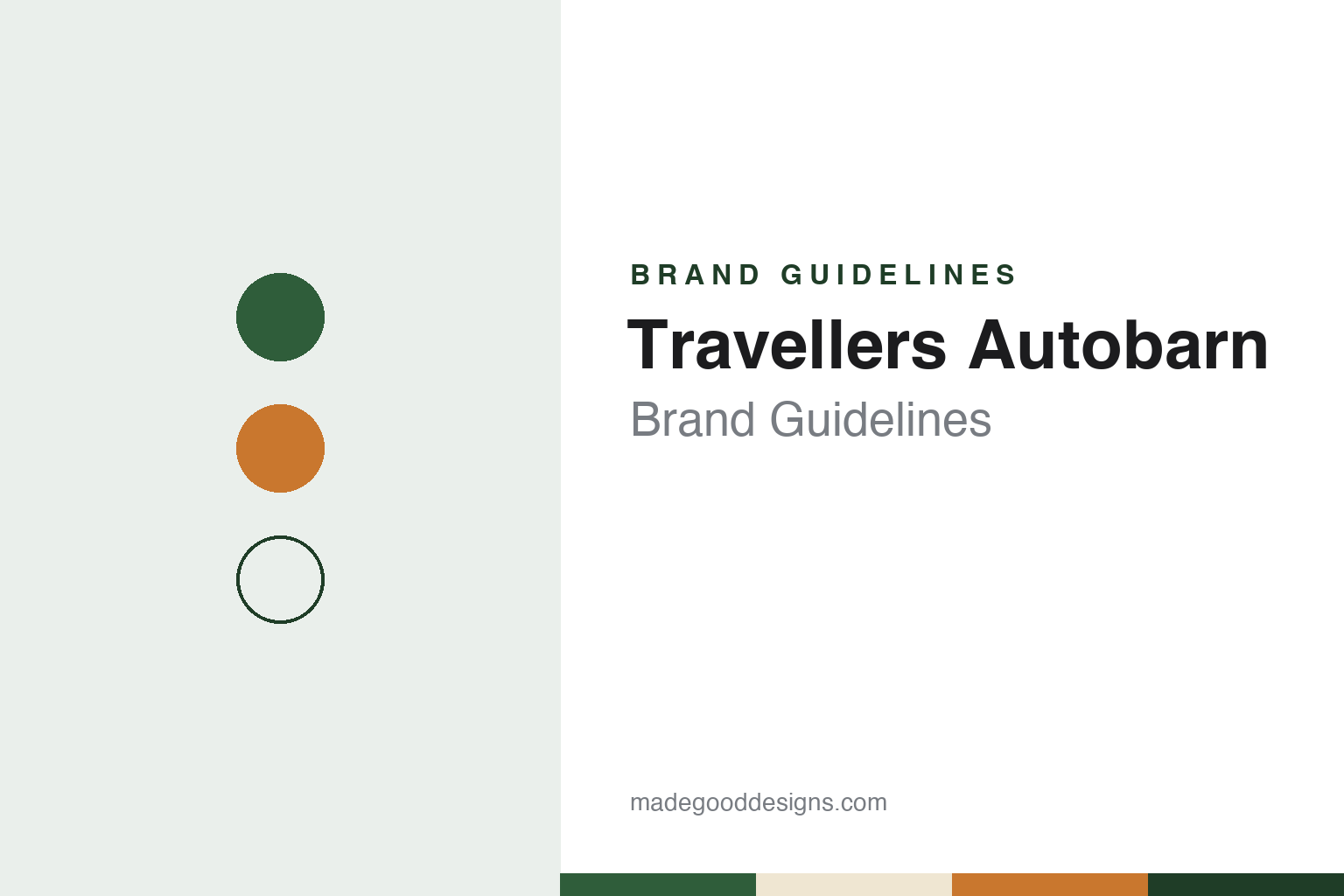
Two constants: a gum-leaf green, ochre and sand palette and a sturdy grotesque register. Abstract homage — not a Travellers Autobarn vehicle, livery or mark; no logo or van graphic is reproduced.
Sydney, 1993
Ex-backpackers selling cars to backpackers.
Travellers Autobarn says it opened in Sydney in late 1993. Its own history describes a city where several dealers were already selling cars to backpackers, but where those businesses were “car dealerships first and foremost.” The founders, the company says, were ex-backpackers themselves, and they set out to offer the service they would have wanted on their own trips. The company does not name them on its history page, and the business has no Wikipedia entry in English, so its early years are told mainly in its own words.
The idea was practical. For many visitors, the company argues, a car or a van is the only realistic way to see a country the size of Australia, whether the trip lasts a week, a month or a year. So Travellers Autobarn did two things at once from the start: it sold used cars and campervans to travellers, and it rented them out. It still does both. Its website splits into “Rent Campervans” and “Buy a Camper,” with a sales stock list, a “Try Before you Buy” offer and what it calls a Guaranteed Buyback, a fixed, written promise to buy a vehicle back at the end of a trip. The company says it is the only business in Australia that offers one; that is its own claim.
Growth followed the backpacker trail. The company lists its branches by year: Sydney in 1993, Cairns in 1999, Brisbane and Melbourne in 2002, and Darwin and Perth in 2005. It says all its branches sit “in the heart of backpacker areas.” Today the Sydney branch is listed by Destination NSW’s official visitor site at Banksmeadow, south of the city, and the company and that listing both describe six hire locations across Australia, with one-way trips between them. The booking form adds a Byron Bay–Ballina option to the six branches.
Colour
From station wagons to the Hi-5.
Travellers Autobarn’s range runs from plain cars to vans that sleep a family, and each type has its own short name. On its Australian hire pages in November 2026 the company listed a Station Wagon; the X-Wagon, based on the Nissan X-Trail; the Budgie Van; the Chubby Camper, a two-berth van; the Hi-Top, for two or three people; the Kuga, which it calls its most popular model; and the Hi-5, which it calls its largest camper, seating and sleeping up to five. Each model card gives seats, berths and the years of its fit-out, a plain, spec-sheet way of presenting the fleet rather than lifestyle copy.
The company presents the vans as its own work. In a profile carried by the magazine Outdoor Japan in its September 2023 issue, Travellers Autobarn described itself as a camper van rental company that had been “creating high-quality, custom-built camper vans for 20 years,” and said its vans offer two metres of standing height inside, so that travellers can stand up to dress or cook with the bed in place. Those are the company’s descriptions of its own vehicles.
The audience is stated openly. The company says its customers are backpackers and budget travellers, and its history page argues that for most Australians, from students to families and retirees, the only way to see the country is by car. Its hire pages stress unlimited kilometres, roadside assistance and access to free campsites, and its website runs a large section of road-trip itineraries, free-camping guides and budget-travel tips alongside the booking engine. The site is also published in French and German.
The vehicle sales side keeps the original business alive. Alongside the campervan stock list, the company still sells cars to travellers who want to own a vehicle for a long trip and sell it back at the end, the model it says it began with in 1993.
Typography
How hire brands present themselves.
Campervan and motorhome rental is sold with pictures of the open road, but two different kinds of business sit behind those pictures. Some companies own and run fleets of their own vehicles from depots; others are marketplaces, on which private owners list their own caravans, campervans and motorhomes and the platform handles the booking and the cover. Camplify, launched in Newcastle, New South Wales, in 2015, and PaulCamper, launched in Berlin in 2013, are marketplaces of the second kind, and since December 2022 both have belonged to the same group listed in Australia.
This guide looks first at the vehicle as each company publishes it: in a company livery or paint scheme, photographed against a landscape, or listed as an owner’s own van in that owner’s own photographs. Where a company describes its vans, its colours or its paintwork, the guide gives that as the company’s own account, with the date of the source.
Names come next. Rental firms give names to their vehicle ranges and models, and marketplaces give names to their memberships and cover products: Camplify sells a premium membership called Club Camplify and member cover under the name MyWay, while PaulCamper says it built its rental cover together with Allianz. Bookings are made online, and some companies also offer an app, as Camplify does on its website; this guide describes such apps plainly, from what the companies say about them.
Finally, there are the owners. Some names in this category belong to larger groups, and corporate pages, annual reports and stock-exchange filings show who owns what and since when. This guide follows those documents and dated press reports, gives fleet, depot and country counts only as a dated source states them, and treats the colours and typefaces shown here as an unofficial interpretation rather than official brand values.
Aa
A sturdy grotesque for a practical, spec-sheet brand. (Specimen set in Archivo, a sans STAND-IN; NOT the Travellers Autobarn logo.)
Travellers Autobarn
From Sydney to Tokyo.
After a decade of growth inside Australia, Travellers Autobarn went abroad. The company says it opened in New Zealand in 2016, with branches in Auckland and Christchurch; in the United States in 2019, in Los Angeles, Las Vegas and San Francisco; and in Tokyo in 2023. The New Zealand business has had outside coverage: the travel guide NZ Pocket Guide, in a review of the Kuga campervan last updated in September 2022, called Travellers Autobarn one of the most prominent campervan brands on New Zealand’s roads, described the New Zealand Kuga as a Toyota Hiace with automatic transmission, and listed depots in Auckland, Hamilton, Christchurch and Queenstown. The Japan launch is the one with a dated outside record: Outdoor Japan’s September 2023 issue carried the company’s announcement that its vans were available “from this year” in Tokyo, alongside Australia, New Zealand and the US. Its website now offers a destination switch between Australia, New Zealand, the United States and Japan.
Ownership is private. In its profile on the Adventure.Travel directory, the company describes itself as owned and operated by an Australian family as majority shareholder, with a minority stake held by the Diethelm Keller Group, a Swiss investment company; it also says it employs more than fifty staff, with its head office in Sydney. Australia’s business register lists a Travellers Autobarn Holdings company in New South Wales, registered in September 2024.
The name needs care. Travellers Autobarn is a separate business from Autobarn, the Australian car-accessories retail chain, and the two are unrelated.
For a design guide, Travellers Autobarn shows how a budget brand can build a recognisable system from plain parts: short, memorable van names, model cards that read like spec sheets, and a long library of road-trip itineraries that does most of the storytelling. Compare JUCY, another campervan hire brand in Australia and New Zealand, and Spaceships, which also hires compact campers in Australia and New Zealand. For this guide we use a gum-leaf green, an ochre and a dry sand with a sans, an unofficial interpretation; no product or logo is reproduced.
Explore & save
Keep Travellers Autobarn’s identity on hand — save it to a board in the Made Good inspiration library.
Travellers Autobarn identity set
Pin the Travellers Autobarn green, ochre and sand palette and the sturdy grotesque register to your own board.