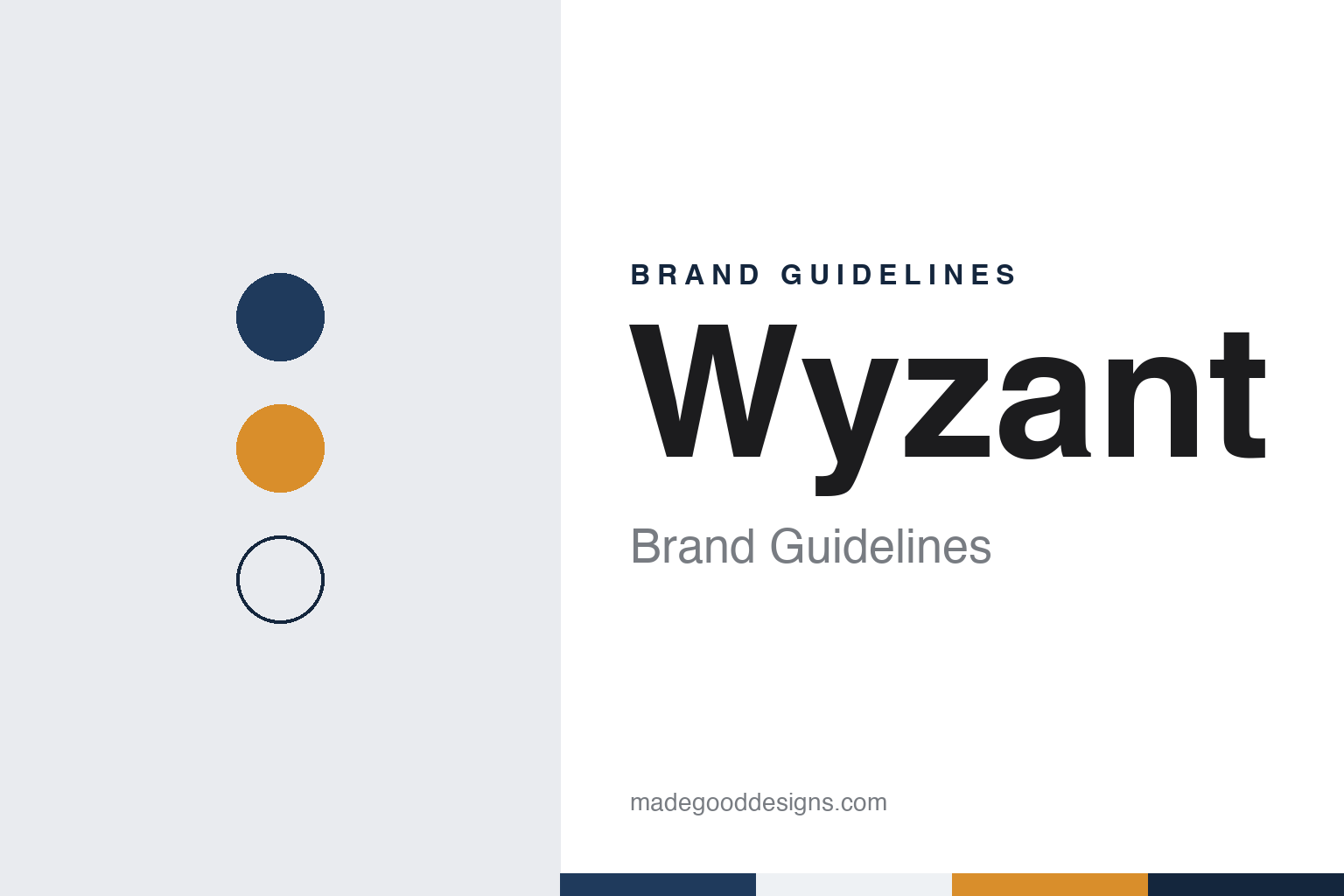
Wyzant Brand Guidelines
A Chicago tutoring marketplace named for a wise ant.
Aa
Two constants: a Wyzant ink navy and amber palette and a Rounded sans register. Abstract homage — not a Wyzant product or mark; no logo, mascot or interface is reproduced.
A Wise Ant
A tutoring marketplace begun in 2005.
Wyzant is an online marketplace for hiring tutors, based in Chicago. It was founded in 2005 by Andrew Geant and Mike Weishuhn, according to TechCrunch, which reported in December 2013 that the pair started on college campuses in and around Washington, D.C., advertising the service with fliers and on Craigslist, and then grew it market by market. Geant was co-founder and chief executive in 2013, and he still held the chief executive role when the company’s sale was announced in 2021.
The name is a pun. It is pronounced “wise ant,” the Las Vegas Sun explained in June 2014, and the logo of the time featured an ant wearing glasses. Press coverage in 2013 and early 2014 wrote the name WyzAnt, with a capital A that put the ant inside the word itself; by the time of the 2021 announcement the company wrote it Wyzant.
For its first eight years the business ran without outside investors, TechCrunch reported. In December 2013 it took its first outside capital, a Series A round led by Accel Partners, and said it planned to hire about 50 people, mostly in Chicago, and to launch its first native mobile apps in the first half of 2014. In January 2014 TechCrunch reported that Wyzant was buying the remaining assets of Tutorspree, a tutoring start-up that had launched from Y Combinator in 2011 and closed in 2013; the deal was strictly an asset purchase, giving Wyzant Tutorspree’s customers, domain and technology.
Colour
Profiles, ratings and a share of each lesson.
The model was a local marketplace rather than a chain of centres. TechCrunch compared it in 2013 with Yelp: students searched for tutors near them and filtered the results by price, rating and distance, and each result showed a photo and a short résumé-style profile with star ratings and student feedback. At that point the company counted more than 500,000 tutors and over one million students, with tutoring in more than 240 subjects and over 850,000 tutor ratings and reviews, TechCrunch reported. Wyzant earned its income by taking a share of each lesson on a sliding scale, and offered tutors profiles, payment processing and basic tools for scheduling and managing clients. Rather than specialise in one exam or subject, it took a broad approach, from school subjects to college courses and from test preparation to arithmetic, and it planned to expand a “Resources” section of question-and-answer forums, lesson plans, videos and blog posts, TechCrunch wrote.
The Las Vegas Sun described the same structure in 2014 as “part Facebook, part Yelp.” It gave a different tutor figure, more than 73,000 tutors teaching some 240 subjects to more than a million students, and explained that families could book and pay tutors through the site rather than in cash, and could request a criminal background check on a tutor, with the date of the latest check shown on the profile. In 2013 the platform was still built around in-person lessons, and video lessons were in development, TechCrunch reported; the Sun noted that tutors still met students at libraries and homes, and that the company planned features to let tutors teach entirely online.
By 2021 lessons could take place online, through video chat and an interactive whiteboard, or in person in cities including New York, Washington, D.C., Dallas, Chicago, Miami and San Francisco, according to the acquisition announcement published by eSchool News. The same announcement gave Wyzant’s network as more than 65,000 tutors, in subjects ranging from English and physics to coding, LSAT preparation and music, and described lessons as pay-as-you-go, with no pre-paid packages. It also carried the company’s promise that a first hour with a new tutor is free if the student is not happy with it. IXL, for its part, described itself in the same text as a platform used by 11 million students.
Typography
Tutoring brands and their interfaces.
Tutoring brands sell something hard to picture: time with a teacher and steady practice. So they make it visible in other ways. The centre front is the first of them. Explore Learning says it opened its first centre in 2001 right beside the entrance of a supermarket in Chelmsford, so that parents could leave a child to work while they shopped; Kip McGrath says it began in 1976 in a family garage in Maitland, New South Wales, before growing into a franchise of locally run centres.
The second is the screen. Many of these companies now present their teaching through their own software, and give it a name of its own. Explore Learning calls its adaptive platform Compass and fills it with avatars and named characters; Kip McGrath calls its learning management system KipLearn and points parents to a portal for progress reports and bookings. Programme names, reward schemes and four-step “how it works” sequences do much of the explaining on their websites.
The third is the corporate page. A tutoring brand is often a network rather than a single business: franchisees run centres under one name while the company supplies curriculum, training and systems, as Kip McGrath’s 2026 shareholder documents describe. Ownership pages matter too. Explore Learning has been backed by Graphite Capital since a 2012 buyout, according to the trade title Unquote, and Kip McGrath, listed in Australia, became the subject of a takeover by Crimson Consulting in 2026.
This guide sets out what can be checked about each brand — who founded it, who owns it, how many centres it reports and where — and marks clearly what rests only on the company’s own word. Centre and student numbers are given as each source states them, with dates, because they change from year to year.
Aa
A rounded sans — for a name that hides a wise ant. (Specimen set in Nunito Sans, a sans STAND-IN; NOT the Wyzant logo.)
Wyzant
Part of IXL Learning since 2021.
In February 2021 IXL Learning, the San Mateo, California, company behind the IXL practice platform for schools, announced an agreement to acquire Wyzant. The announcement, published by eSchool News on 8 February 2021, said the acquisition would be finalised during the first quarter of 2021, and the law firm Latham & Watkins, which advised IXL, reported the same month that IXL had announced it had acquired Wyzant. The announcement placed Wyzant after earlier IXL purchases: ABCya in 2018, Education.com in 2019 and Vocabulary.com in 2020. In it, Geant spoke of a “shared mission of making personalized learning accessible for everyone.” English Wikipedia also gives 2021 for the acquisition and lists Chicago as Wyzant’s headquarters.
The brand’s story runs from a bootstrapped marketplace that took a single venture round and bought a smaller rival’s assets to a business inside a larger education group. Its identity has always rested on the pun in its name: a wise ant, once spelled with a capital A and drawn wearing glasses.
For a design guide, Wyzant shows how a marketplace can turn a pun into a mark and let tutor profiles, photos and star ratings carry the product. Compare Varsity Tutors, another American tutoring platform, and Preply, a marketplace for online tutors. For this guide we use an ink navy and an amber with a rounded sans, an unofficial interpretation; no product or logo is reproduced.
Explore & save
Keep Wyzant’s identity on hand — save it to a board in the Made Good inspiration library.
Wyzant identity set
Pin the Wyzant ink navy and amber palette and the Rounded sans register to your own board.