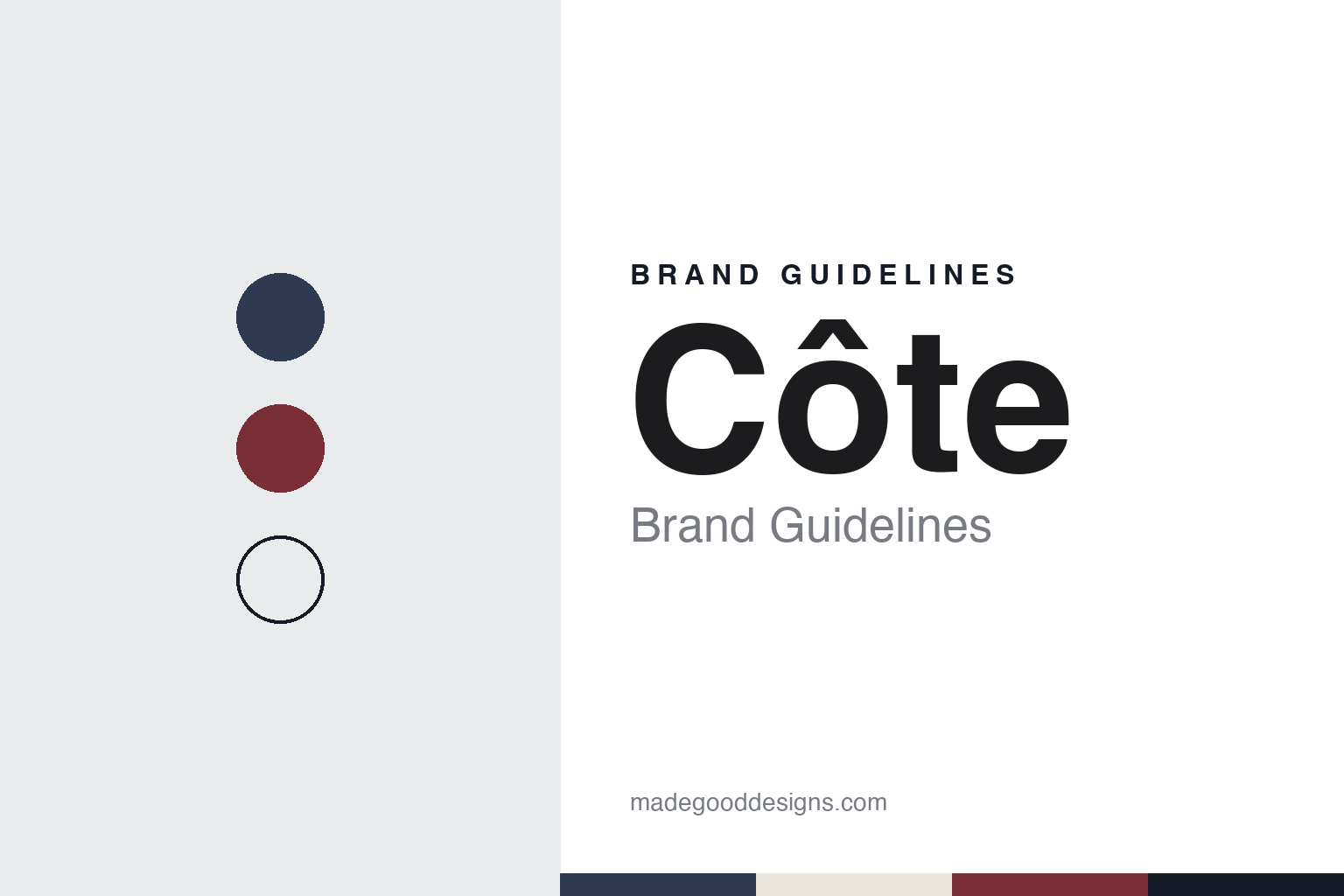
Côte Brand Guidelines
The Wimbledon brasserie chain that put steak frites on the British high street.
Aa
Two constants: an ink blue, zinc and Bordeaux palette and a brasserie serif register. Abstract homage — not a Côte product or mark; no menu, logo or shop front is reproduced.
Wimbledon
Four restaurateurs and a French brasserie for the high street.
Côte began in Wimbledon, in south-west London, in 2007. English Wikipedia and the trade title MCA name the same four founders: the restaurateur Richard Caring, Andy Bassadone, Chris Benians and Nick Fiddler. The chain originally traded as Côte Brasserie; English Wikipedia gives the trading name today as Côte, set in capitals in its logotype, and the company as Côte Restaurants Group Limited.
The idea was a French-style brasserie for British high streets and market towns rather than a single Paris-style landmark. Bassadone and Benians had come from the Italian chain Strada, Restaurant Online reported in a 2014 profile, and in the late 2000s they were rolling out Côte in partnership with Caring. The same team went on to back Bill’s, the Sussex café chain, in 2008.
Growth was quick. MCA wrote in October 2025 that the chain had 45 sites when the private equity firm CBPE bought it in 2013. Restaurant Online, writing in January 2014, described Côte as a former stablemate of Bill’s that Caring had recently sold to CBPE. Two years later, in 2015, it changed hands again, to BC Partners, by which point MCA counted 65 restaurants. The group also ran two smaller formats, Jackson & Rye and Limeyard, which MCA says were later discontinued, while Côte itself grew to close to 100 sites before 2020. The Caterer put the figure at 98 restaurants in October 2020.
Colour
Convivialité, terroir and a brasserie card.
Côte presents itself through French vocabulary rather than through a founder story. Its own philosophy page leans on two words: convivialité, which it glosses as feasting with others, and terroir, the link between a taste and a place. The company says it cooks seasonally, buys from farming families in France and built its own butchery, with a Himalayan salt drying room for its beef.
The menu reads like a brasserie card. In September 2025, MCA reported, Côte ran a weekday offer built on five of its standing dishes, one per day, running from steak frites on Monday through beef bourguignon on Thursday to moules frites on Friday. The dish names stay in French or in the half-French register of the British brasserie, and the format repeats from site to site.
Kitchen leadership became part of how the chain describes itself. In 2022 Côte appointed Steve Allen, who had run the kitchen at Gordon Ramsay’s restaurant at Claridge’s, as executive chef, MCA wrote, and it noted that the menu changes with the seasons rather than with passing trends. The company names him on its own site as its executive chef.
The chain also sells Côte at Home: boxed meals, including a chateaubriand sharing box, plus cheese and charcuterie boxes delivered to the door. MCA described this as an offer more often associated with independent fine-dining restaurants than with high-street chains. After 2020 the new owners began an estate-wide refurbishment programme, the same report says.
Typography
Dining rooms, menus and owners.
Britain’s Italian restaurant chains tend to tell their stories through a room and an oven. Pizza Express traces itself to a single pizzeria on Wardour Street in Soho, opened in 1965 with an oven brought from Italy, according to accounts in MCA and Restaurant Online in 2018. Franco Manca, which began in Brixton Market in 2008, says its founders built their own oven there before opening anywhere else.
Menus and naming are usually plain. Dishes are listed by ingredient and region rather than by invented brand names, and some chains publish where those ingredients come from: Franco Manca’s pages run through its flour, tomatoes, cheeses and coffee one by one. Restaurant names lean on a founder, a place or a simple description; Franco Manca, the company says, means “Franco is missing,” after the man who ran the market pizzeria before it.
The corporate pages tell a second story, about owners. Many of these chains have passed between founders, stock-market listings and investment firms. In 2014 City A.M. noted that the private equity firm Cinven’s Gondola group ran Pizza Express alongside Zizzi and ASK Italian; Franco Manca was bought by the listed group Fulham Shore in 2015, and Fulham Shore by the Tokyo-listed Toridoll in 2023.
Restructurings are part of that record too. Company voluntary arrangements, which let a business close restaurants and reset its leases with creditors’ approval, were used by Pizza Express in 2020 and announced by Franco Manca’s owner in 2026, according to trade press reports. Each guide in this series sets out what can be checked about a chain, who founded it, who owns it and what has changed, and marks what rests on the company’s own word.
Aa
A brasserie serif — the register of a French menu card. (Specimen set in Playfair Display, a serif STAND-IN; NOT the Côte logo.)
Côte
Administration in 2020, a new owner in 2025.
In 2020 Côte went into administration. The Caterer reported in October 2020 that Partners Group, the private equity firm that was already a lender to the business, had bought it out of administration; the three Limeyard and Jackson & Rye sites closed, and 94 of the 98 restaurants stayed open. MCA dates the deal to September 2020. Partners Group installed Jane Holbrook, a former chief executive of Wagamama, as executive chair. Speaking to MCA in 2021, she said the brand had “lost its way” and set out plans to make it “more relevant”; the refurbishment programme and the 2022 kitchen appointment followed. She left in June 2025, MCA reported, after Emma Dinnis had joined from Sofology as chief executive in March 2025.
Partners Group appointed the advisory firm Interpath in the summer of 2025 to look for new investors, MCA reported, and the sale that followed was presented as a solvent transaction. On 3 October 2025, The Caterer reported, Côte was sold to the Karali Group, a family-owned franchise business led by Salim and Karim Janmohamed, for an undisclosed sum. Karali runs Taco Bell restaurants in the UK and holds the UK and Ireland master franchise for Marugame Udon, whose nine existing restaurants in London and Reading it took over, and its other recent purchases included the doughnut chain Crosstown, bought out of a pre-pack administration in June 2024, MCA wrote; The Caterer described Côte as an addition to its portfolio of hospitality brands. The Caterer put the estate at around 70 UK restaurants at the time of the sale.
The ownership line is long for a chain less than twenty years old: four founders, then CBPE, BC Partners, Partners Group and the Karali Group. Through each change the name, the French dish names and the high-street brasserie format stayed in place, while the estate grew to nearly a hundred restaurants and then shrank back to about seventy.
For a design guide, Côte shows how a British chain can borrow a whole national dining culture, its words, its dishes and its brasserie rooms, and keep that register steady through five sets of owners. Compare Bill’s, backed by the same founders from 2008, and Carluccio’s, another European-themed chain on British high streets. For this guide we use ink blue, zinc grey and a Bordeaux red with a serif, an unofficial interpretation; no product or logo is reproduced.
Explore & save
Keep Côte’s identity on hand — save it to a board in the Made Good inspiration library.
Côte identity set
Pin the Côte ink blue, zinc and Bordeaux palette and the brasserie serif register to your own board.