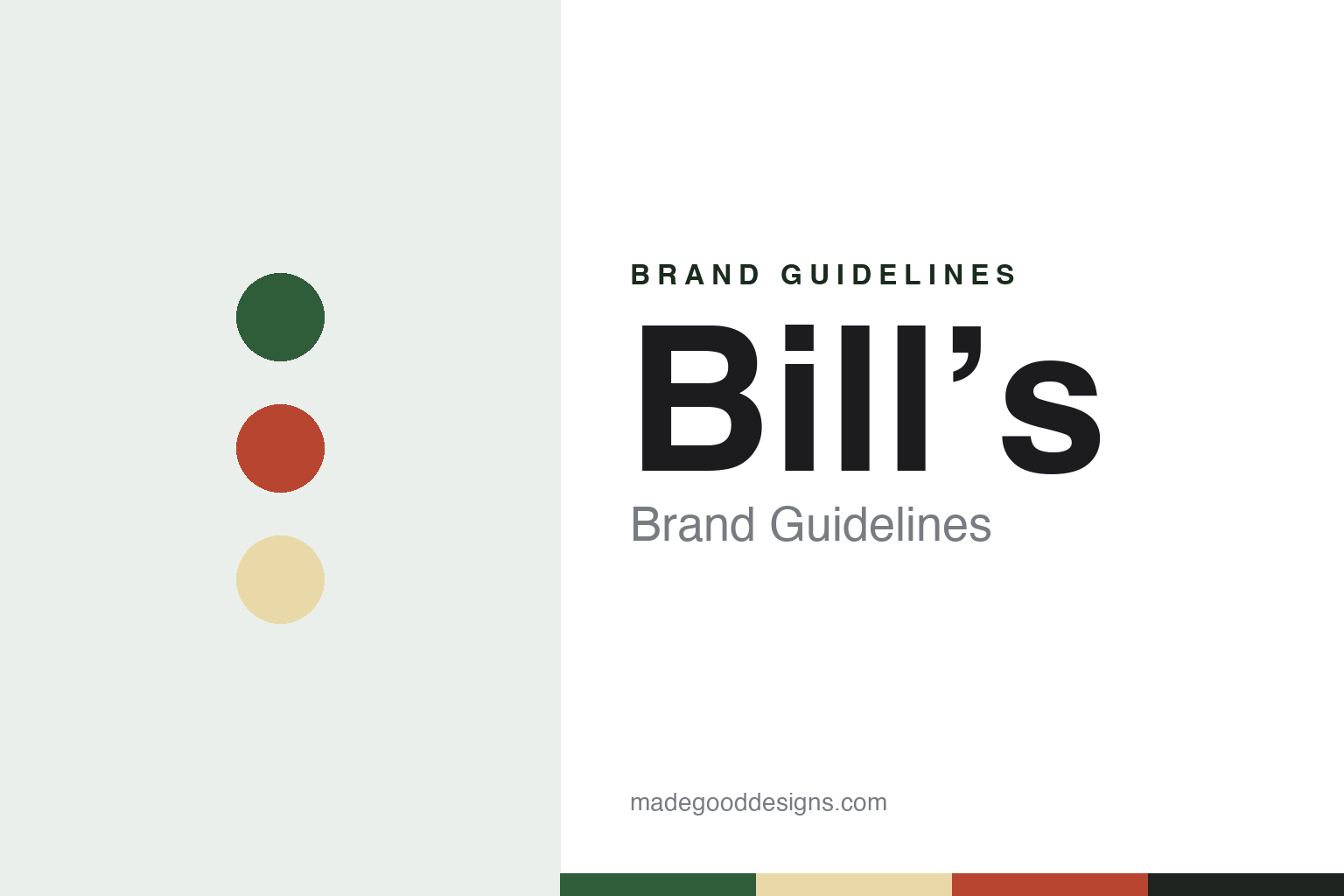
Bill’s Brand Guidelines
The Lewes greengrocer that became an all-day restaurant chain.
Aa
Two constants: a greengrocer green, raffia and chilli red palette and a market sans register. Abstract homage — not a Bill’s product or mark; no menu, logo or shop front is reproduced.
Lewes
A greengrocery that added a café.
Bill’s began as a greengrocery. Bill Collison ran a fruit and vegetable shop by the river in Lewes, East Sussex, and, in his own words to Restaurant Online in 2020, ran it as just a greengrocer until 2000. A 2014 profile in the same title says the shop reopened in early 2001 as Bill’s Produce Store and Café, a more upmarket greengrocer with a café attached. English Wikipedia and The Caterer (2024) also give 2001 as the founding year; Brighton and Hove News gave 2004 in a 2017 report, so the sources differ on the date.
Collison hired the chef Andy Pellegrino, who cooked from the produce on the shop floor. Restaurant Online described the early menu, with homemade granola, bright salads and fruit smoothies, as closer to the American West Coast than to southern England. A second Bill’s opened in central Brighton in 2005, on North Road according to Brighton and Hove News, and it too sold fruit and vegetables alongside the café.
Collison has said the business that followed came out of those two shops. In the 2020 interview he described getting up at three in the morning to set out the produce and help with the cooking before the doors opened at seven, and said that people who came to look at the Lewes shop included Chris Benians, one of the people behind Strada and Côte. That visit led to an early-morning meeting with Richard Caring at the Lewes shop, and then a visit to the Brighton site.
Colour
Raffia, dried chillies and blackboards.
The look of Bill’s is built from its greengrocer past. In its 2014 profile, Restaurant Online described fruit and vegetables placed on the tables as decoration and wheelbarrow displays of fruit outside some branches. Inside, skeins of raffia hung from the ceilings, dried chillies decorated the light fittings and hand-written blackboards covered the walls. Collison worked with contractors during each fit-out to keep the same bright look, the magazine reported, and one of the managing directors joked that nothing in the displays should be moved.
The shelves themselves were part of the design. The original Lewes and Brighton sites kept a greengrocery section, while newer branches dropped fresh produce for packaged goods: olive oil in tins, English honey, violet pastilles and teas. Each table carried a “Bag of Bill’s” leaflet, a tick-box list that let diners add shop items to the bill and collect them on the way out.
The rooms change with the hour. Bill’s serves from breakfast through to the evening, and Restaurant Online described how, after dark, the lights go down, paper napkins give way to red-and-white check cloth napkins and vintage candelabras go on the tables. The main menu then changed every two to three months, standardised across the chain.
Collison stayed involved in this side of the business after the 2008 sale. Brighton and Hove News reported in 2017 that he still held a stake and led the creative design of new restaurants. In 2020 he told Restaurant Online that the group had tried new looks in three test restaurants, with more comfortable chairs and better tableware, to make Bill’s an evening destination, and had refurbished about half the estate; he singled out the Manchester Spinningfields restaurant, set inside what he called a glass box. He described Bill’s in the same interview as “a sort of anti-chain restaurant” that takes an individual approach to each site, and said the aim of the refits had been to “glam it up a bit” while keeping breakfast at the centre of the offer.
Typography
Dining rooms, menus and owners.
Britain’s Italian restaurant chains tend to tell their stories through a room and an oven. Pizza Express traces itself to a single pizzeria on Wardour Street in Soho, opened in 1965 with an oven brought from Italy, according to accounts in MCA and Restaurant Online in 2018. Franco Manca, which began in Brixton Market in 2008, says its founders built their own oven there before opening anywhere else.
Menus and naming are usually plain. Dishes are listed by ingredient and region rather than by invented brand names, and some chains publish where those ingredients come from: Franco Manca’s pages run through its flour, tomatoes, cheeses and coffee one by one. Restaurant names lean on a founder, a place or a simple description; Franco Manca, the company says, means “Franco is missing,” after the man who ran the market pizzeria before it.
The corporate pages tell a second story, about owners. Many of these chains have passed between founders, stock-market listings and investment firms. In 2014 City A.M. noted that the private equity firm Cinven’s Gondola group ran Pizza Express alongside Zizzi and ASK Italian; Franco Manca was bought by the listed group Fulham Shore in 2015, and Fulham Shore by the Tokyo-listed Toridoll in 2023.
Restructurings are part of that record too. Company voluntary arrangements, which let a business close restaurants and reset its leases with creditors’ approval, were used by Pizza Express in 2020 and announced by Franco Manca’s owner in 2026, according to trade press reports. Each guide in this series sets out what can be checked about a chain, who founded it, who owns it and what has changed, and marks what rests on the company’s own word.
Aa
A market sans — the register of a chalked price board, set clean. (Specimen set in Archivo, a sans STAND-IN; NOT the Bill’s logo.)
Bill’s
Richard Caring’s backing, from two shops to a national chain.
In 2008 the business was bought by Richard Caring with Andy Bassadone and Chris Benians, who were then rolling out Côte together, Restaurant Online reported in 2014. English Wikipedia describes the deal as Caring taking a major shareholding when Bill’s had two restaurants, and Brighton and Hove News wrote in 2017 that Collison had sold most of his stake but kept a share.
The roll-out started slowly and then sped up. By January 2014 Bill’s had 29 sites, 14 of them in London, with branches as far apart as Exeter, Cardiff and Cambridge, and Manchester planned as its move into the north of England. By 2020 Restaurant Online called the estate 80-strong. The Caterer reported in September 2024 that Caring had grown the chain to more than 80 restaurants, that the group had closed more than 20 underperforming sites after 2020 and invested in refurbishments, and that Bill’s then had over 40 restaurants across the UK.
The same 2024 report described a return to expansion. Bill’s had tested a smaller café bar format in Newbury and St Albans, with part of the core menu plus sharing plates, cakes and pastries, and had appointed the property firm Savills to look for sites, with new restaurants in Milton Keynes and in Street, Somerset, before Christmas 2024.
For a design guide, Bill’s shows how a single shop’s furniture, its crates, raffia, chillies and chalkboards, can become a repeatable interior for dozens of restaurants without losing the sense of where it started. Compare Côte, founded by the same backers, and Pret A Manger, another British food chain built around a shop format. For this guide we use greengrocer green, raffia and a chilli red with a sans, an unofficial interpretation; no product or logo is reproduced.
Explore & save
Keep Bill’s’s identity on hand — save it to a board in the Made Good inspiration library.
Bill’s identity set
Pin the Bill’s greengrocer green, raffia and chilli red palette and the market sans register to your own board.