Pepco Brand Guidelines
Poundstretcher Poland, a 2004 name and the violet logo of 2021.
Aa
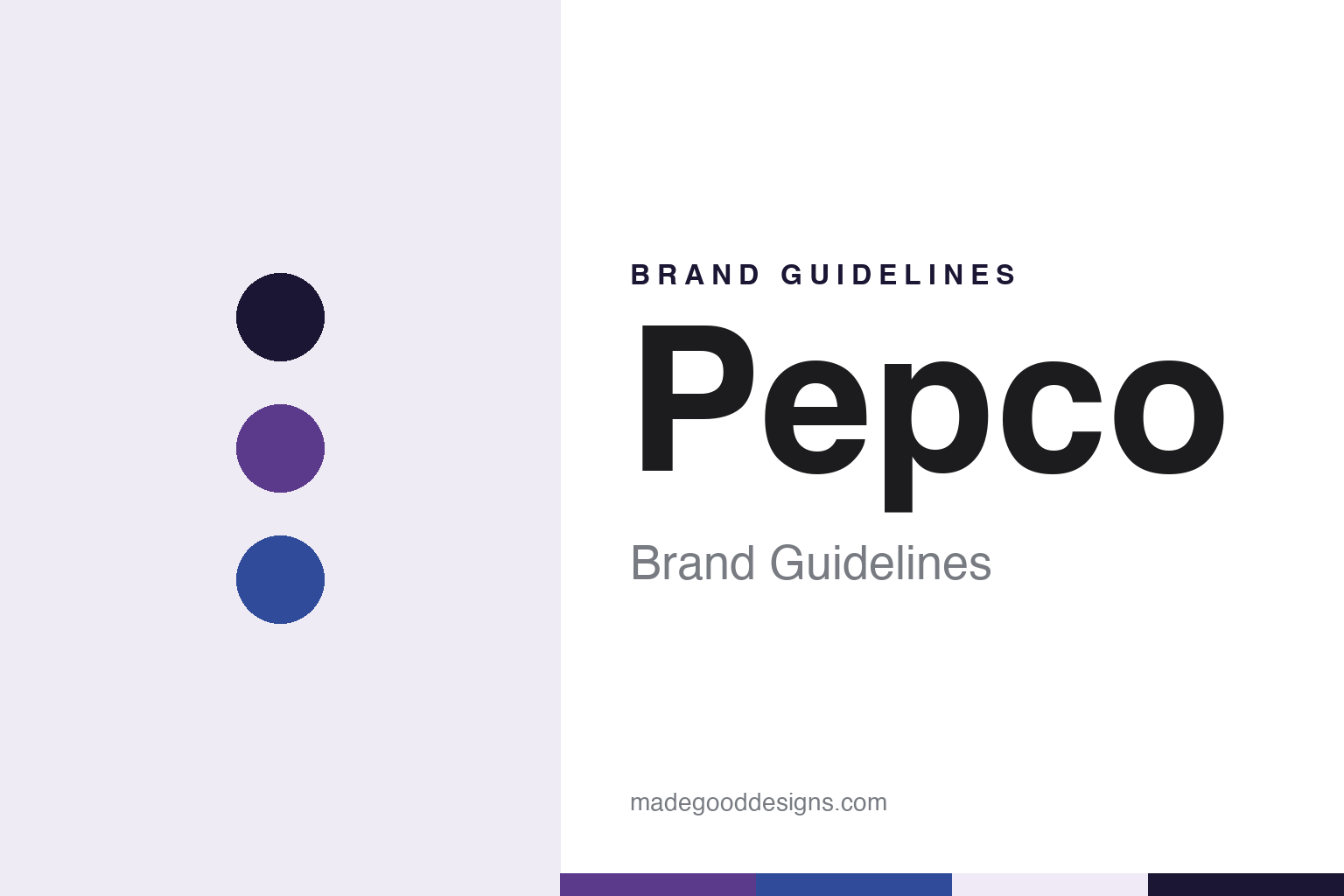
Two constants: a violet and deep blue palette and a Rounded geometric sans register. Abstract homage — not a Pepco product or mark; no sign, label or logo is reproduced.
Poundstretcher Poland
A British chain’s Polish arm.
Pepco did not start under its own name. English and Polish Wikipedia both say the business began at the end of 1999 as the Polish arm of the British retailer Brown & Jackson, which opened Poundstretcher shops in Poland. After weak results the Polish business was sold in 2002 to the South African company Tradegro, and it passed to Pepkor, also South African, in 2004. Polish Wikipedia says that was when the logo and the company name were changed to Pepco.
Pepco Group’s own timeline tells the same story with slightly different dates: it says Pepkor acquired 14 former Poundstretcher stores in 2003 and launched the Pepco brand in Poland the following year, and that the first 14 Pepco shops opened in 2004. The timeline marks the 100th store in 2007, the 500th in 2014, the 1,000th in 2016 and the 2,000th in 2020.
Expansion outside Poland came in steps. Polish Wikipedia lists the Czech Republic and Slovakia in 2013, Romania and Hungary in 2015, Croatia, Slovenia and Lithuania in 2017, Latvia and Estonia in 2018, Bulgaria in 2019, Italy and Serbia in 2020, Spain and Austria in 2021, and Germany and Greece in 2022. The company adds Portugal and Bosnia and Herzegovina in 2023, its 4,000th store, opened in Madrid, in 2025, and North Macedonia in 2026, which it counts as its 19th market. Its brand page says the shops sit mostly in small and medium-sized towns, range from about 350 to 700 square metres and sell clothing for the whole family alongside household goods and toys.
Colour
Violet replaces four colours.
The clearest design record is a logo change in 2021. Polish Wikipedia notes that Pepco changed its logotype that year, and the Polish business site Bankier.pl described the change in November 2021. Pepco, it reported, had dropped the blue, yellow, red and white of its earlier mark in favour of shades of violet and blue, with the name set in a simpler typeface. The new logo was already up at 50 new locations across Europe.
Bankier.pl quoted the company, by way of the trade site Wiadomości Handlowe, as saying it refreshes the look of its stores and its customer communication every few years, that the full rebrand would reach existing stores gradually, and that every new store opened from October 2021 carried the new branding. The rebrand was to cover the logo, the appearance of the shops and all of the company’s communication with customers. The same report noted that Pepco had started selling online through Polish marketplaces such as Allegro and Empik.
The name has also travelled inside other shops. For several years Pepco’s parent owned the British chain Poundland and the Dealz stores, and Retail Gazette listed Dealz and the Pep&Co clothing fascia among the group’s brands when it reported the Warsaw listing in May 2021. English Wikipedia says that since 2023 Poundland and Dealz have been phasing out Pep&Co products in favour of Pepco-branded ranges, marketed in the UK as available only at Poundland.
The group website names Pepco as its primary brand. The group’s office is listed in London, while its own country table puts Poland at the top, with 1,397 Pepco stores, ahead of 500 in Romania and 321 in Czechia.
Typography
Design and documentation.
Discount and variety retailers tend to put their offer into the name itself. Some chains take a price as their name, as Poundland did in 1990 and 99p Stores did after it; others use initials, a family name or a short invented word. When a chain built on a single price begins to sell items above it, the name stays on the fascia while the range changes behind it, and advertising rules can then limit what the shop is allowed to say about its prices.
The fascia carries most of the identity. A shop sign on a high street or retail park usually pairs the name with a short strapline, such as B&M’s “Big Brands, Big Savings,” described by The Grocer in 2020. Inside, the same name and colours tend to repeat on aisle headers, shelf tickets, seasonal end displays and carrier bags, so that a shopper sees one consistent mark from the car park to the till.
Own-label naming is a quieter part of the system. Variety chains often sell well-known brands alongside goods under their own labels, and some suppliers prefer their products to appear under a retailer’s name rather than their own. Formats are named in the same plain way: a home store, a local convenience shop, an express branch, each a variation on the parent name rather than a separate brand.
The corporate side is published separately. Listed or formerly listed chains keep investor pages with dated histories of founders, owners, acquisitions and listings, and those pages, read alongside independent press, are a dependable guide to who owns a fascia at any given time. In this sector ownership changes often, through buyouts, listings, sales and administrations, and the guides in this series give those changes with their dates.
Aa
A rounded geometric sans — for a simpler violet and blue name. (Specimen set in Lexend, a sans STAND-IN; NOT the Pepco logo.)
Pepco
A listing, then a narrower group.
The group’s shares began trading on the Warsaw Stock Exchange on 26 May 2021 under the ticker PCO. Retail Gazette reported that day that the offer left about a fifth of the shares in free float, and that the South African group Steinhoff, then the majority shareholder, kept a stake of 78.9 percent. By October 2026 the majority holder was IBEX, which the company said held 59.8 percent of the voting rights after selling part of its stake that month.
Since 2025 the group has narrowed itself to the Pepco chain. The Grocer reported in June 2025 that Pepco had completed the sale of Poundland to the investment firm Gordon Brothers for a nominal sum, said it wanted to focus on its higher-margin clothing and general merchandise business, and agreed to keep providing services such as clothing procurement for a transition period. In July 2026 ESM Magazine reported that the group had completed the sale of Dealz Poland to an affiliate of Modella Capital, after clearance from the Polish competition authority; the deal had been announced on 3 June.
Germany has needed a restructuring. FashionUnited reported in July 2025 that Pepco Germany GmbH, which had entered the country in 2022 and then ran 64 stores, mostly in the east, had filed for self-administration proceedings at the Berlin-Charlottenburg court on 21 July. In February 2026 the same publication reported that creditors had approved an insolvency plan on 14 January, that the store count had been cut from 64 to 36, and that the proceedings would end on 28 February 2026, with the German business continuing to trade.
For a design guide, Pepco shows how a chain born under a borrowed British name can build its own identity, then simplify it, swapping four primary colours for violet and blue across thousands of shops. Compare it with Poundland, the British chain it once owned, or the German discount chain TEDi. For this guide we use shopfront violet, deep blue and lilac mist with a sans, an unofficial interpretation; no product or logo is reproduced.
Explore & save
Keep Pepco’s identity on hand — save it to a board in the Made Good inspiration library.
Pepco identity set
Pin the Pepco violet and deep blue palette and the Rounded geometric sans register to your own board.