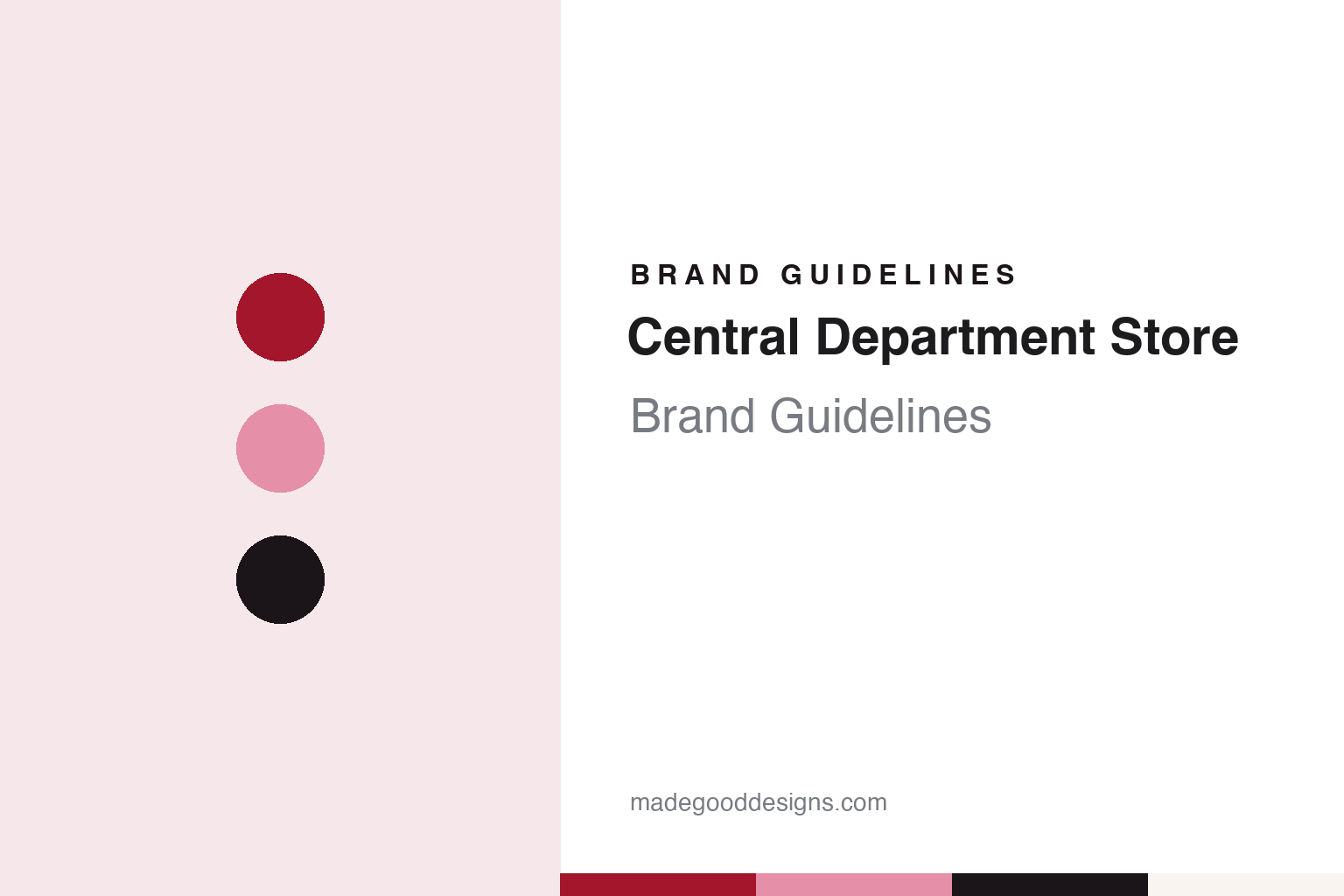
Central Department Store Brand Guidelines
From a 1947 Bangkok shophouse to a listed department store group.
Aa
Two constants: a red, pink and ink palette and a clean retail sans register. Abstract homage — not a Central Department Store asset; no logo, bag or fascia is reproduced.
A shophouse in Si Phraya
Books, magazines and an English name.
Central Department Store grew out of a family shop in Bangkok. Central Group’s own timeline dates the first Central business to 1947, when Tiang Chirathivat and his eldest son Samrit opened a small shophouse selling local and international books and magazines alongside general goods. Thai Wikipedia places that shop in a two-storey, single-unit shophouse at the mouth of Captain Bush Lane in the Si Phraya district, now Soi Charoen Krung 30, and describes it as a continuation of Tiang’s earlier grocery, Keng Seng Lee, in Bang Khun Thian. English Wikipedia says Tiang had come to Bangkok from Hainan Island in 1925 and first set up shop in Thon Buri, across the Chao Phraya River.
The name came early. Thai Wikipedia says Tiang had wanted a Chinese name meaning “middle” or “centre,” while Samrit preferred the English word Central, for a place at the centre of goods and services. In 1950, according to the company, the business was set up as Central Trading and added imported goods such as ready-made clothes and cosmetics; Thai Wikipedia dates its move to a three-unit shophouse in the Surawong area to 5 July 1950.
The department store itself followed in 1956. Central Group’s timeline, English Wikipedia and Thai Wikipedia all give that year for the opening of the original Central Department Store in the Wang Burapa district of Phra Nakhon, in old Bangkok. Thai Wikipedia says Tiang opened it with three of his sons, Samrit, Wanchai and Suthiporn, and that further branches followed at Ratchaprasong in 1964 and Silom in 1968.
Colour
Chidlom, Ladprao and a retail group.
The store that came to stand for the name opened at Chidlom. The company dates Central Chidlom to 1974 and calls it its flagship today; English Wikipedia gives 1973 and describes it as built around a “one stop shopping” idea, with everything a customer needed under one roof. Thai Wikipedia, which also gives 1974, lists the next steps: a branch at Lad Ya, on the Thon Buri side, in 1981, and Central Ladprao in 1983. Ladprao sat inside CentralPlaza Ladprao, the opening shopping centre of the group’s property arm, which English Wikipedia says was founded in 1980 and is now the listed Central Pattana. In 1992 the chain went upcountry with a store at Kad Suan Kaew in Chiang Mai, which the company describes as its earliest Central Department Store outside Bangkok.
A retail group grew around the stores. Central Group’s timeline says Central Retail Corporation was incorporated in 1990 to hold the retail businesses, that it bought the Robinson department store chain in 1995, and that it launched Tops supermarkets in 1996 and The1Card loyalty programme in 2006. Abroad, English Wikipedia says, Central opened a department store in the east wing of the Grand Indonesia mall in Jakarta in 2014, in space previously used by Harvey Nichols, and ran a second Jakarta store at Neo Soho from 2016 to 2019.
Central Retail went public in 2020. The Nation reported on 19 February 2020 that the Stock Exchange of Thailand had announced that trading in Central Retail Corporation shares would begin the next day, and described the company as running stores in Thailand, Italy and Vietnam. Thai Wikipedia says the listing took the place of Robinson’s, whose shares were bought through a tender offer and withdrawn from the exchange. The wider Central Group, which English Wikipedia describes as still privately owned by the Chirathivat family as of 2025, also holds European department stores bought with the KaDeWe Group and the Selfridges Group.
Typography
How the category presents itself.
Department stores and hypermarkets in Thailand, Malaysia and Indonesia are usually met inside a larger building. Many sit as anchor tenants in shopping malls, so the store name appears twice: on the fascia above the entrance and again on the mall directory, the car-park signs and the shopping bags carried through the concourse. Some groups also run the malls themselves, which lets one family of names cover both the centre and the store inside it.
The calendar shapes much of what customers see. Retailers in the region publish their own campaigns around Chinese New Year, Hari Raya, Songkran, Deepavali, Christmas and year-end sales, and the store name is often paired with a seasonal theme for a few weeks before returning to its everyday colours. Shopping bags, price tags and in-store signs carry the same palette, so a chain’s colours can be read from across a mall.
Own-label ranges and loyalty programmes extend the name beyond the fascia. Several groups publish house brands for groceries, clothing or homeware, and many describe member cards and apps that collect points across the group’s stores. Store naming is usually plain: a chain name followed by the mall or district, so that a branch is known by its location as much as by its owner.
Corporate pages fill in the rest. Most of these companies set out their founders, founding dates, parent groups and stock-exchange listings on their own investor or corporate sites, and the national business press records acquisitions, renamings and closures as they happen. The guides in this set draw on those dated records and describe each name as its owner and the press present it.
Aa
A clean retail sans for store signs and bags. (Specimen set in Manrope, a sans STAND-IN; NOT the Central Department Store logo.)
Central Department Store
Red and pink bags, and a pink flagship.
In 2020, after the Robinson takeover was complete, Central Department Store took over the running of the Robinson stores, Thai Wikipedia says. The Bangkok Post reported on 19 June 2020 that Central Retail had begun realigning the Central and Robinson department store names to suit the customers at each location, starting at the Megabangna complex. Several former Robinson stores now trade as Central, among them Central Bangrak on Charoen Krung Road, which the Thai business site Brand Inside reported in November 2024 had taken down its Robinson signs.
The flagship was rebuilt in the same period. The Nation reported in December 2024 that the renovated Central Chidlom held its grand opening on 12 December, after its first major renovation in 50 years, under a “City Store” idea and the line “The Store of Bangkok.” It described a store of 60,000 square metres with about 500 luxury brands, a co-working lounge for customers and a shop-in-shop area for shoes, and said the branch used a Chidlom pink colour scheme that set it apart from other Central stores, which typically use red and pink shopping bags. The same report said Central Department Store Group then ran 76 department stores: 29 Central branches and 47 Robinson branches.
For a design guide, Central Department Store shows how a family shop’s English name became a group identity carried across stores, malls and a listed company. Compare Robinson, the department store chain Central bought in 1995, and Tops, the supermarket chain from the same retail group. For this guide we use a deep red, a soft pink and an ink with a sans, an unofficial interpretation; no product or logo is reproduced.
Explore & save
Keep Central Department Store’s identity on hand — save it to a board in the Made Good inspiration library.
Central Department Store identity set
Pin the red, pink and ink palette and the clean retail sans register to your own board.