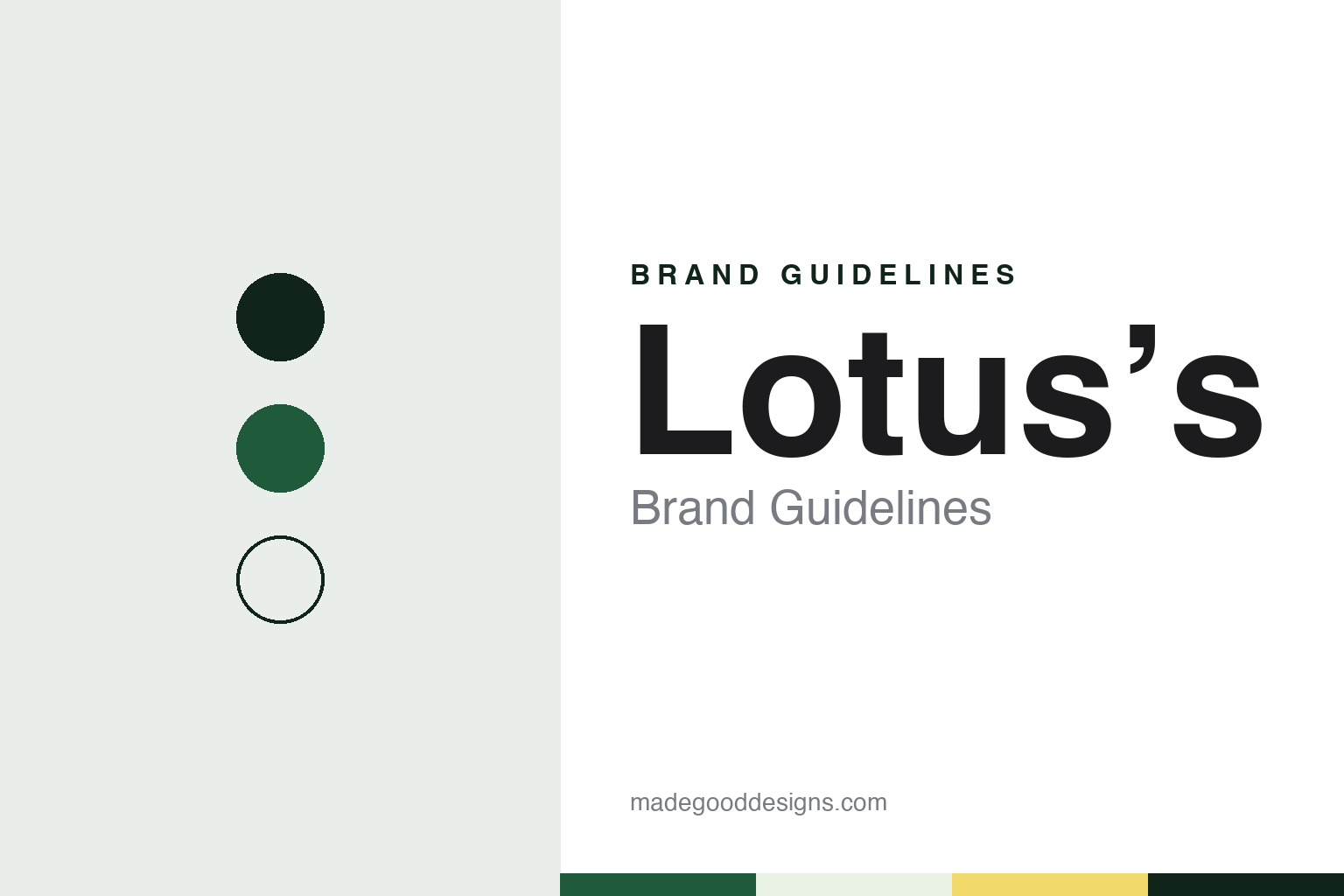
Lotus’s Brand Guidelines
CP Group’s 1994 supercenter, the Tesco Lotus years and the smart “S”.
Aa
Two constants: a deep green and soft yellow palette and a Rounded sans register. Abstract homage — not a Lotus’s product or mark; no store sign, logo or pack is reproduced.
Lotus Supercenter
A CP Group hypermarket that opened at Seacon Square in 1994.
Lotus’s began as Lotus Supercenter, a hypermarket chain set up in 1994 by Thailand’s Charoen Pokphand (CP) Group. English Wikipedia says its first outlet opened at Seacon Square, a large indoor shopping mall in the Prawet district of eastern Bangkok that itself opened in 1994, so the hypermarket and the mall arrived together. CP Group itself is far older: English Wikipedia traces the Bangkok conglomerate to a seed shop that two brothers opened in the city’s Chinatown in 1921, which grew over the following decades into animal feed, farming, food processing and, later, retail.
The chain changed hands four years after it opened. In 1998 the British grocer Tesco bought a stake, and the business became Tesco Lotus; English Wikipedia says CP Group sold most of its remaining shares in 2003. For the next two decades the stores carried the Tesco name in front of the older Lotus one.
Under Tesco the chain ran several formats, which English Wikipedia lists as Extra, Hypermarket, Department Store, Talad and Express. The larger formats sold fresh food, prepared food and groceries alongside electrical goods, clothing, toys, stationery and household goods. Talad, the Thai word for market, was a grocery-led supermarket, and Express was a small convenience format. Many of the products on the shelves were Tesco own-label lines, and the bigger stores were often set inside malls with food courts, other shops and large car parks.
English Wikipedia says online shopping arrived in April 2013, and that by early 2018 the chain’s retail floor space stood at about 1.4 million square metres. As of December 2019 it counted 1,967 stores in Thailand under the Tesco Lotus name: about 1,600 Tesco Lotus Express shops and around 400 stores in the hypermarket, Talad and department-store formats. Tesco also ran a separate business in Malaysia, which would later be renamed under the same brand.
Colour
From Tesco Lotus back to CP Group.
On 9 March 2020 CP Group submitted the winning bid to buy back Tesco’s Thai business together with Tesco’s operations in Malaysia, English Wikipedia says. Because CP already ran the 7-Eleven convenience chain in Thailand and the Makro cash-and-carry business, the purchase needed the approval of Thailand’s Trade Competition Commission. English Wikipedia says the sale was approved in Malaysia in November 2020 and in Thailand in December 2020, ending more than two decades of Tesco ownership.
The Tesco name then came down. In February 2021 the Bangkok Post reported that CP Group had dropped the Tesco brand in Thailand after completing the purchase, and that the Ramintra store in Bangkok was the first large-format branch to be transformed throughout. English Wikipedia dates the rebranding of the acquired stores from February 2021, when the Tesco corporate branding was replaced with that of Lotus’s.
The new name kept the word Thai shoppers already used and added a possessive. The company has said that the drop pin in the new logo marks Lotus’s as a one-stop destination and that the final “s” stands for “smart”, which it links to technology, efficiency and sustainability; English Wikipedia describes the refreshed look as aimed at younger shoppers. Those readings are the company’s own.
Malaysia followed within weeks. On 31 March 2021 the New Straits Times reported that Lotuss Stores (Malaysia) had launched its first flagship store in Kepong, Kuala Lumpur, the first of 62 stores in the country to be transformed after CP Group acquired Tesco’s Malaysian business the previous December. The president of Lotus’s Malaysia told the paper that customers would see stores progressively rebranded “with the Lotus’s green and yellow”. English Wikipedia gives a slightly different figure, 64 rebranded former Tesco outlets in Malaysia.
Typography
Hypermarkets and supermarkets.
Department stores and hypermarkets in Thailand, Malaysia and Indonesia are usually met inside a larger building. Many sit as anchor tenants in shopping malls, so the store name appears twice: on the fascia above the entrance and again on the mall directory, the car-park signs and the shopping bags carried through the concourse. Some groups also run the malls themselves, which lets one family of names cover both the centre and the store inside it.
The calendar shapes much of what customers see. Retailers in the region publish their own campaigns around Chinese New Year, Hari Raya, Songkran, Deepavali, Christmas and year-end sales, and the store name is often paired with a seasonal theme for a few weeks before returning to its everyday colours. Shopping bags, price tags and in-store signs carry the same palette, so a chain’s colours can be read from across a mall.
Own-label ranges and loyalty programmes extend the name beyond the fascia. Several groups publish house brands for groceries, clothing or homeware, and many describe member cards and apps that collect points across the group’s stores. Store naming is usually plain: a chain name followed by the mall or district, so that a branch is known by its location as much as by its owner.
Corporate pages fill in the rest. Most of these companies set out their founders, founding dates, parent groups and stock-exchange listings on their own investor or corporate sites, and the national business press records acquisitions, renamings and closures as they happen. The guides in this set draw on those dated records and describe each name as its owner and the press present it.
Aa
A rounded sans for a friendly store name. (Specimen set in Nunito, a sans STAND-IN; NOT the Lotus’s logo.)
Lotus’s
A store brand inside CP Axtra.
The company behind the stores has since been reorganised. Siam Makro, the CP-controlled company that runs the Makro wholesale stores, officially changed its name to CP Axtra Public Company Limited on 15 June 2023, the Thai news agency InfoQuest reported. The agency said the new name reflected a business spanning wholesale under Makro, retail under Lotus’s and the leasing of shopping-mall space, and that both store brands stayed in use.
A further step followed in 2024. In October 2024 the law firm Linklaters, which advised CP Axtra, announced the completion of a group restructuring that amalgamated CP Axtra with its wholly owned subsidiary Ek-Chai Distribution System, the company that ran the Lotus’s retail business. The restructuring brought the Makro wholesale and Lotus’s retail operations together in one company listed on the Stock Exchange of Thailand. The brand on the shop front stayed Lotus’s.
The name has had three forms in three decades: Lotus Supercenter from 1994, Tesco Lotus from 1998 and Lotus’s from 2021. The changes of 1998 and 2021 each followed a change of owner, and each kept the word Lotus. Lotus’s is a different business from the Lotus car maker, the Lotus Biscoff biscuit and the software house Lotus Development, which share only the word.
For a design guide, Lotus’s shows how a retailer can keep a local name through two changes of owner and swap only the parts around it. Compare Big C, another Thai hypermarket chain, and Tops, the supermarket chain of Central Retail. For this guide we use a deep green, a leaf green and a soft yellow with a rounded sans, an unofficial interpretation; no product or logo is reproduced.
Explore & save
Keep Lotus’s’s identity on hand — save it to a board in the Made Good inspiration library.
Lotus’s identity set
Pin the deep green and soft yellow palette and the Rounded sans register to your own board.
Source & notes
Frequently Asked Questions
What font can I use to match the Lotus’s look?
This guide describes Lotus’s’ type as “A rounded sans for a friendly store name”. Its type specimen is set in Nunito from Google Fonts as a stand-in; Nunito is not Lotus’s’ own lettering.
What colours are in the Lotus’s palette?
This guide’s Lotus’s palette is Deep green #1F5A3A, Ink #10241A, Soft yellow #F2D96B, Leaf green #5E9E5A and Paper #F7F8F3. The tones are the guide’s own unofficial interpretation, not official Lotus’s hex codes.
When was Lotus’s founded?
Lotus’s was founded in 1994 (as Lotus Supercenter), in Bangkok, Thailand.
Who founded Lotus’s?
Lotus’s was founded by Charoen Pokphand (CP) Group in 1994 (as Lotus Supercenter).