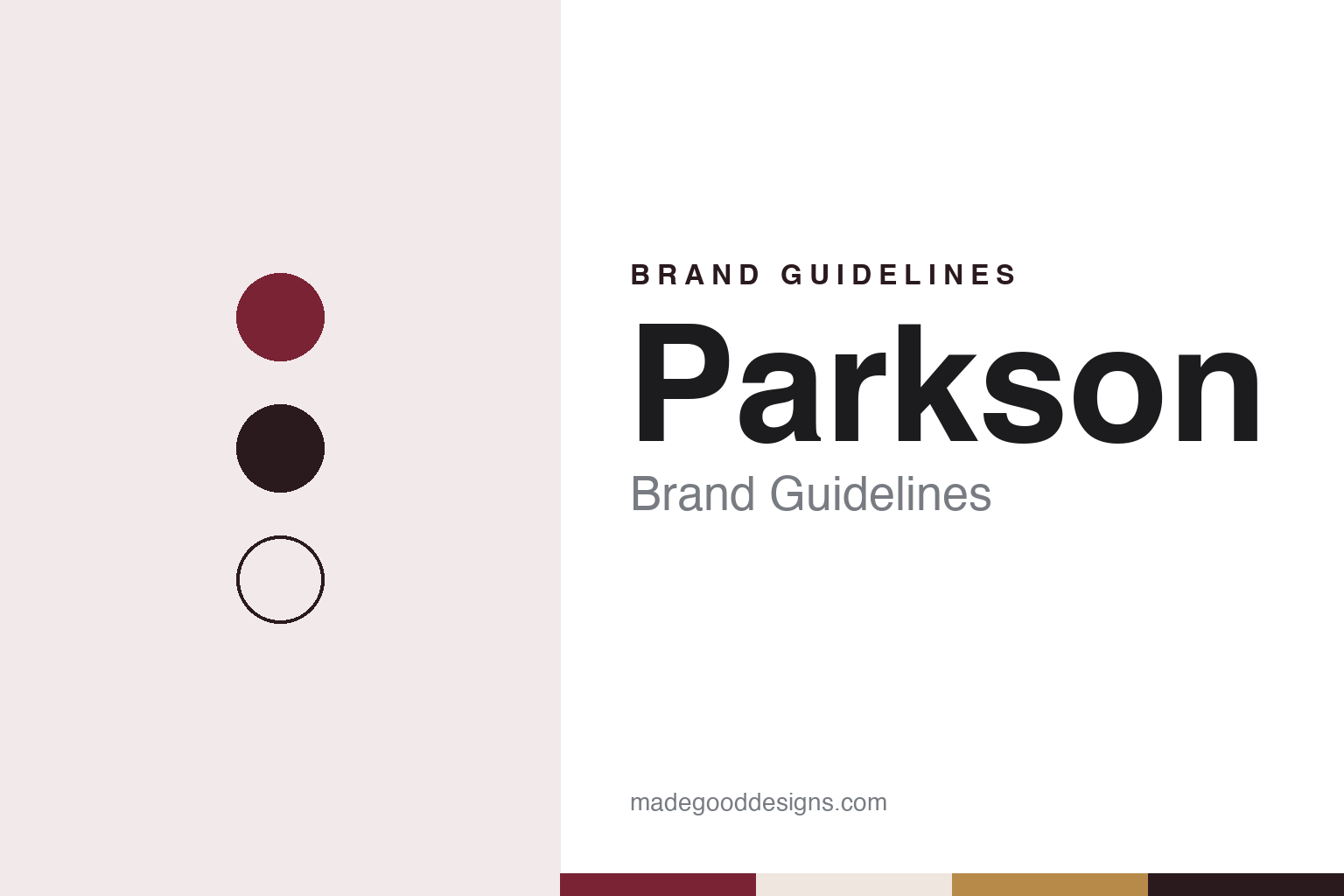
Parkson Brand Guidelines
The 1987 Kuala Lumpur department store that went to China.
Aa
Two constants: a mulberry, cream and brass palette and a geometric sans register. Abstract homage — not a Parkson asset; no logo, fascia or store photograph is reproduced.
Parkson Grand
A department store in a Kuala Lumpur shopping centre.
Parkson began in Kuala Lumpur in 1987. English Wikipedia says the chain was created by William Cheng and opened its first store that year at Sungei Wang Plaza, under the name Parkson Grand. The listed company behind it today is Parkson Holdings Berhad, which English Wikipedia describes as a subsidiary of the Lion Group, the Malaysian group controlled by the Cheng family. Its Chinese name, written 百盛, is romanised as Bǎishèng in Mandarin.
The company’s Malaysian website is organised by departments, brands, exclusives, new arrivals, store locations and promotions, with a Parkson Card and the BonusLink card listed as its loyalty schemes.
The original site did not last. English Wikipedia records that Parkson closed its Sungei Wang Plaza and Maju Junction stores in 2018, saying the customer base at both locations had changed; a store in Puchong closed in late 2019 after about eighteen months, the MyTown Shopping Centre branch closed in February 2020, and two more stores closed in 2021. English Wikipedia gives the Malaysian count as 37 stores as of 2025, four of them in Kuala Lumpur.
Parkson is also, English Wikipedia says, a member of the Intercontinental Group of Department Stores. Its stores sit inside shopping centres rather than in buildings of their own, and its Malaysian website lists two malls it runs itself, Maju Junction and M Square, each with a supermarket and a food park.
Colour
Beijing in 1994, and a long run in China.
The bigger story is China. English Wikipedia dates Parkson’s entry to 1994, with a store on Fuxingmen Road in Beijing, followed by Qingdao in 1998 and, in May 2013, a fourth store in Chongqing at Chongqing Fortune Mall. The Chinese business sits in Parkson Retail Group Ltd, which is listed in Hong Kong; The Edge Malaysia reported in August 2025 that Parkson Holdings owned 54.97% of it.
The same Edge report said that, as of 31 December 2024, Parkson operated 41 department stores in 27 Chinese cities, down from 43 a year earlier, which its 2024 annual report put down to an ongoing review of each store’s performance. It also reported that Parkson Retail Group had signed an agreement on 7 August 2025 to end early its tenancy at the China National Arts and Crafts Museum in Beijing, a site it had traded from since 1994, with effect from 1 January 2026.
Not every move in China was a retreat. The Star reported in January 2025 that a Parkson unit in Liupanshui, in Guizhou province, had signed a new ten-year tenancy for its department store in the Baolong International Building, where the company said it had run a store since 2012.
English Wikipedia lists a run of closures alongside the openings: five Chinese stores in 2016, and stores in Beijing’s Changying Street, Hefei and Zhengzhou in 2017. In 2012 the group bought the Qingdao Shopping Mall, and English Wikipedia gives a total of 44 locations in China as of 2025.
Typography
How the region’s big stores present themselves.
Department stores and hypermarkets in Thailand, Malaysia and Indonesia are usually met inside a larger building. Many sit as anchor tenants in shopping malls, so the store name appears twice: on the fascia above the entrance and again on the mall directory, the car-park signs and the shopping bags carried through the concourse. Some groups also run the malls themselves, which lets one family of names cover both the centre and the store inside it.
The calendar shapes much of what customers see. Retailers in the region publish their own campaigns around Chinese New Year, Hari Raya, Songkran, Deepavali, Christmas and year-end sales, and the store name is often paired with a seasonal theme for a few weeks before returning to its everyday colours. Shopping bags, price tags and in-store signs carry the same palette, so a chain’s colours can be read from across a mall.
Own-label ranges and loyalty programmes extend the name beyond the fascia. Several groups publish house brands for groceries, clothing or homeware, and many describe member cards and apps that collect points across the group’s stores. Store naming is usually plain: a chain name followed by the mall or district, so that a branch is known by its location as much as by its owner.
Corporate pages fill in the rest. Most of these companies set out their founders, founding dates, parent groups and stock-exchange listings on their own investor or corporate sites, and the national business press records acquisitions, renamings and closures as they happen. The guides in this set draw on those dated records and describe each name as its owner and the press present it.
Aa
A geometric sans for a mall-anchor register. (Specimen set in Jost, a sans STAND-IN; NOT the Parkson logo.)
Parkson
Vietnam, Indonesia, Myanmar and Laos.
Outside Malaysia and China, Parkson’s record is one of arrivals and exits. English Wikipedia says the chain entered Vietnam on 29 June 2005 with a store in Saigontourist Plaza on Lê Thánh Tôn Street in Ho Chi Minh City, later adding Parkson Hùng Vương Plaza in the city’s Chợ Lớn district in 2007, Parkson Landmark 72 in Hanoi in 2011 and stores in Da Nang and Haiphong, before closing most of them between 2015 and 2018. The Saigontourist Plaza flagship reopened in July 2020 after a renovation that added a shopping mall to the building. Inside Retail Asia reported on 28 April 2023 that Parkson Vietnam, an indirect wholly owned subsidiary of the Singapore-listed Parkson Retail Asia, had filed for voluntary bankruptcy with the City People’s Court in Ho Chi Minh City after eighteen years in the market, with one place of business left in the city. English Wikipedia says that last store closed in 2023.
In Indonesia, English Wikipedia says Parkson bought PT Tozy Sentosa, operator of Centro Department Store, in 2011. Centro had opened its first store at Plaza Semanggi in Jakarta in November 2003, and English Wikipedia says the company’s website placed Centro in the middle-class segment and Parkson in the upper-middle. The group opened Parkson-branded stores in Medan in November 2013, at Lippo Mall Puri in Jakarta in 2014 and at Hartono Mall in Yogyakarta in 2015. The operator was declared bankrupt by a court on 17 May 2021. In Myanmar a single store opened in May 2013 at FMI Centre in Yangon, moved to Junction Square in 2017 and later closed. A 41.8% stake in Sri Lanka’s Odel, bought in 2012, was sold to Softlogic in 2014, and a Parkson-branded shopping mall opened in Vientiane, Laos, in February 2020, though English Wikipedia says no Parkson department store trades there.
For a design guide, Parkson shows how one short wordmark can travel across very different markets, from Kuala Lumpur malls to Chinese city centres, and how a brand’s map can shrink as well as grow. Compare it with AEON, another mall anchor in Malaysia, and with Central Department Store in Thailand. For this guide we use a mulberry red, an ink plum, a shopfront cream and a brass tone with a geometric sans, an unofficial interpretation; no product or logo is reproduced.
Explore & save
Keep Parkson’s identity on hand — save it to a board in the Made Good inspiration library.
Parkson identity set
Pin the Parkson mulberry, cream and brass palette and the geometric sans register to your own board.
Source & notes
Frequently Asked Questions
What font can I use to match the Parkson look?
This guide describes Parkson’s type as “A geometric sans for a mall-anchor register”. Its type specimen is set in Jost from Google Fonts as a stand-in; Jost is not Parkson’s own lettering.
What colours are in the Parkson palette?
This guide’s Parkson palette is Mulberry red #7A2335, Ink plum #2A1A1E, Shopfront cream #EFE6DF, Brass #B88A4A and Paper #F8F6F3. The tones are the guide’s own unofficial interpretation, not official Parkson hex codes.
When was Parkson founded?
Parkson was founded in 1987 (Parkson Grand, Sungei Wang Plaza), in Kuala Lumpur, Malaysia.
Who founded Parkson?
Parkson was founded by William Cheng in 1987 (Parkson Grand, Sungei Wang Plaza).
Who owns Parkson?
Parkson today: Parkson Holdings Berhad, part of the Lion Group.