Othaim Brand Guidelines
A 1956 Riyadh food trader that became a grocery network.
Aa
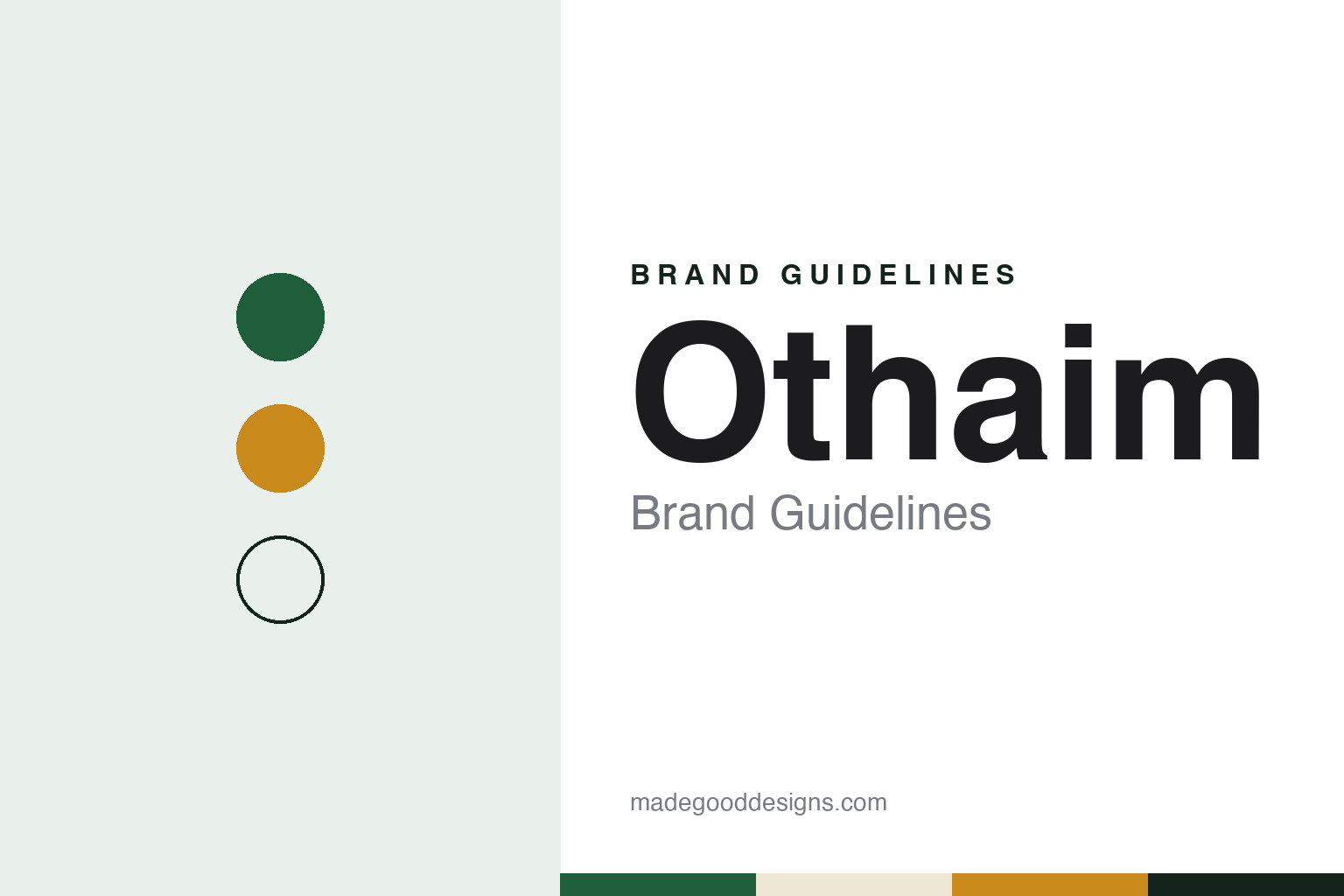
Two constants: a green, sand and saffron palette and a Market sans register. Abstract homage — not an Othaim product or mark; no logo, fascia or pack is reproduced.
Al Batha, 1956
A foodstuffs trader in the old commercial heart of Riyadh.
Othaim is the store name of Abdullah Al Othaim Markets Company, a grocery retailer based in Riyadh and listed on the Saudi stock exchange. In Arabic the company is أسواق عبدالله العثيم, and in English it usually shortens the name to “Al Othaim” or “Othaim Markets.” It traces its story to 1956, when Saleh Al Othaim opened a foodstuffs business, the Saleh Al Othaim Trading Establishment, in Hillat Al Qusman, in the Al Batha commercial district of Riyadh, according to the company’s own history pages.
In 1980, the company says, Abdullah Al Othaim Markets was set up to carry that business on, opening centres for both wholesale and retail sales. It dates its real turning point to 1990, when it had 14 stores and applied what it calls a “consumer wholesale” system across all of them: shops for households, run on wholesale lines. Central warehouses for dry and chilled goods followed in 1992, along with a larger delivery fleet, and in 2004 the company launched its loyalty programme, Iktissab.
English Wikipedia’s article on the chairman, Abdullah Al Othaim, adds the corporate shape behind the stores. It says the Al Othaim establishment was converted into a limited-liability company in 2000 and later separated into three businesses: the markets company, which sells food at retail; a real-estate company that develops and runs shopping centres under the Othaim Mall name; and Al Othaim Holding, the main shareholder in the other two. English Wikipedia names Abdullah Al Othaim as chairman of both the holding company and the markets company.
The markets company was listed on Tadawul, the Saudi exchange, in 2008, its website says. That listing is the reason so much of its later story can be followed year by year: the company publishes quarterly investor presentations, and the Saudi financial press reports them.
Colour
From 14 stores in 1990 to 470 branches in 2025.
The network grew quickly after 2015. In May 2025 the Saudi financial news site Argaam, drawing on the company’s first-quarter investor presentation, set out the branch count year by year: 159 branches in Saudi Arabia and 12 in Egypt in 2016; 250 and 44 in 2020; 408 and 57 in 2024; and, by the end of March 2025, 411 in Saudi Arabia and 59 in Egypt, or 470 in all.
The same Argaam report broke the Saudi network into formats. Of the 411 branches at the end of the first quarter of 2025, 309 were supermarkets, 83 were smaller “corner” stores, 12 were wholesale branches and 7 were hypermarkets. On Argaam’s figures, the corner format rose from 44 Saudi branches in 2020 to 83 in 2024.
The company’s own timeline marks the milestones along the way: its first store in Egypt in 2016, its 300th store in Saudi Arabia in 2022, and, in 2024, both its 400th Saudi branch and the first Al Othaim Cash & Carry. In November 2025 Argaam reported the chief executive telling the Saudi channel Al Ekhbariya that 115 new stores had opened between 2023 and 2025, taking the Saudi total past 400.
Online, the company promotes its own shopping app, Speedi. In October 2025 Gulf News reported a partnership under which Amazon.sa customers in selected areas could order groceries and household goods from Al Othaim Markets, starting in Riyadh and Jeddah; in Riyadh, the paper said, the range sits in the “Fresh” section of the Amazon app. Argaam’s November 2025 report also described the company as holding a 68% stake in Mueen, a recruitment and manpower subsidiary.
Own-label goods carry names of their own. The company lists Rex, Haley and Zood as brands sold only in its stores, and says Zood covers both its in-store bakeries and a fresh range of fruit, vegetables and meat.
Typography
How Gulf grocers present themselves.
Gulf hypermarket, grocery and electronics retailers are mostly seen from the car park. A hypermarket façade carries one short name in large letters, often in both Latin and Arabic script, and the same name is repeated on trolleys, shelf labels, carrier bags and the delivery app. Many chains run more than one size of store, from a large hypermarket in a mall to a smaller neighbourhood branch, and they often give each size its own version of the name rather than a new one.
The retail calendar shapes how these brands appear through the year. Ramadan and Eid, national-day celebrations and the start of the school term bring seasonal campaigns, special displays and printed or digital offer leaflets, and the companies publish these on their own websites, apps and social channels. Own-label ranges sit beside international brands on the shelves, with their own packaging under the retailer’s name or a separate label.
Not every chain in this group sells food. Bookshop chains combine stationery, school supplies and books with gadget aisles, and electronics retailers fill their stores with phones, laptops, televisions and home appliances. Their store fascias tend to follow the same pattern as the grocers: one name, read from a distance, often in two scripts.
Behind the shopfront, the corporate side is published separately. Listed retailers post annual reports, results and board details on their investor pages and through the Saudi Exchange (Tadawul), the Abu Dhabi Securities Exchange or the Dubai Financial Market, while family-owned and group-owned chains describe their founders, owners and history on corporate “about us” pages. This guide uses those pages and dated press reports, and marks clearly what rests on a company’s own account.
Aa
A clear, upright sans with Arabic and Latin forms. (Specimen set in Cairo, a sans STAND-IN; NOT the Othaim logo.)
Othaim
A family trading name over many formats.
The Othaim name now covers several kinds of shop. The same company runs neighbourhood supermarkets, small corner stores, a handful of hypermarkets, wholesale branches and, since 2024, a cash-and-carry format, and it sells online through its own app and, since October 2025, through Amazon’s Saudi site. Across all of them the name stays the same: “Al Othaim,” with “Markets” or “Cash & Carry” added to say what kind of shop it is.
Shoppers will also see the name on Othaim Mall, the shopping centres found in several Saudi cities. English Wikipedia places those malls in a separate real-estate company within the same group, not in the listed grocery company, so a mall and a market that share the name are run by different businesses.
The company’s loyalty scheme has its own name. Iktissab, launched in 2004, is the card and programme under which customers collect rewards, and the company website gives it a place of its own in the main menu, next to offers and the branch finder. Its own-label lines — Rex, Haley and Zood — sit under the store name rather than replacing it.
Egypt is the company’s only market outside Saudi Arabia. It opened there in 2016, and by March 2025 it had 59 branches in the country, according to Argaam. In Saudi Arabia the company’s website says its branches reach more than 100 cities and governorates.
No logo history, typeface or official colour reference is documented in the sources used for this guide, so the palette and specimen here are our own.
For a design guide, Othaim shows how a single trading name can stretch across supermarkets, corner shops, wholesale branches and an app without changing its form. Compare Panda, another Riyadh grocery chain, and Lulu, the Abu Dhabi hypermarket group. For this guide we use a date-palm green, a warm sand and a saffron with a sans, an unofficial interpretation; no product or logo is reproduced.
Explore & save
Keep Othaim’s identity on hand — save it to a board in the Made Good inspiration library.
Othaim identity set
Pin the Othaim green, sand and saffron palette and the Market sans register to your own board.