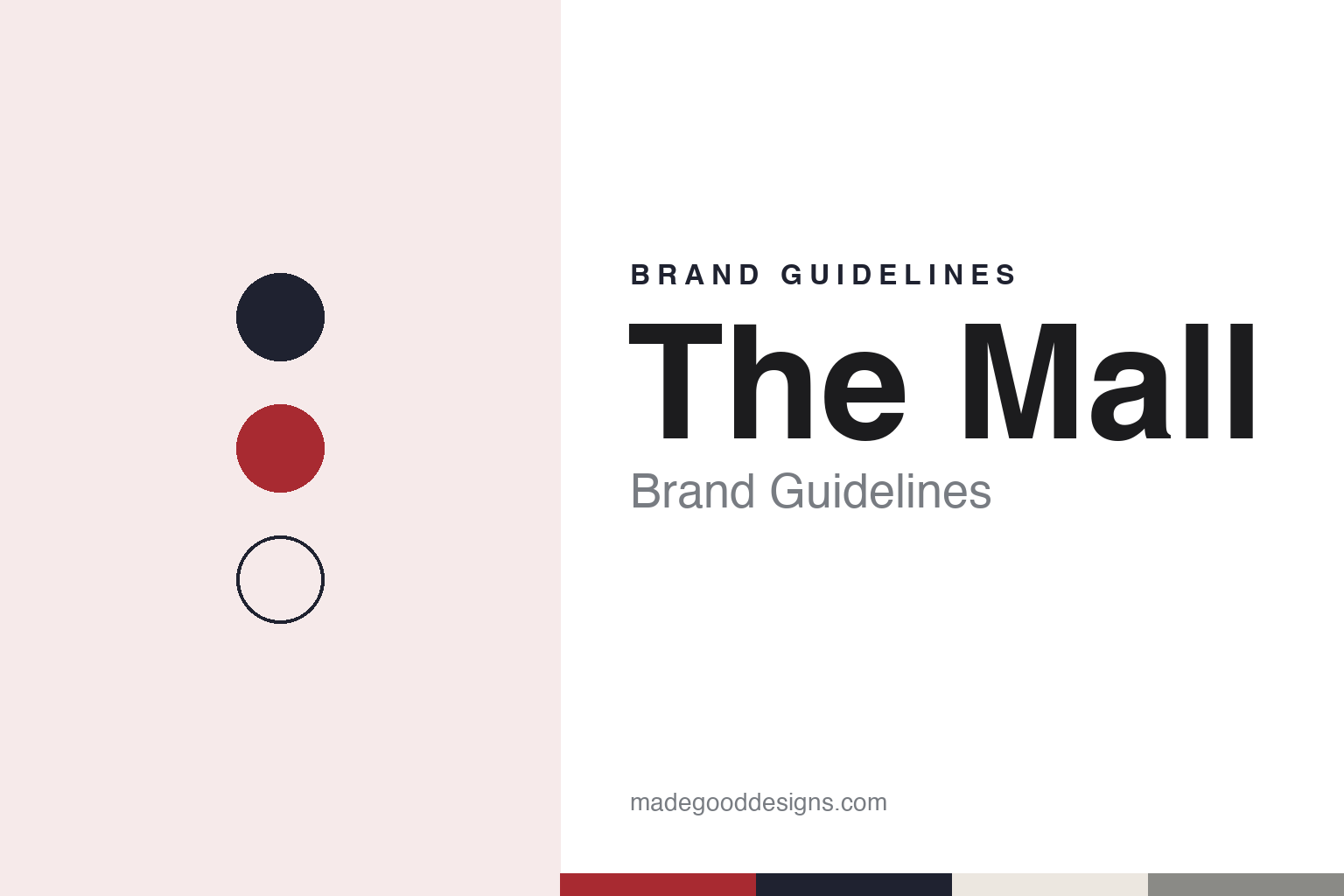
The Mall Brand Guidelines
A Ratchadamri Road store of 1981 that became a Bangkok retail group.
Aa
Two constants: a lifestore red, Sukhumvit ink and arcade stone palette and a shop-sign sans register. Abstract homage — not a The Mall product or mark; no logo, sign or shopping bag is reproduced.
Ratchadamri, 1981
A first store near Ratchaprasong.
The Mall Group dates its retail business to 25 June 1981, when it opened its first store on Ratchadamri Road, close to the Ratchaprasong shopping district of Bangkok. English Wikipedia says the store had 400 employees when it opened. Thai Wikipedia, which gives the company’s Thai name as บริษัท เดอะมอลล์ กรุ๊ป จำกัด, says this first branch, The Mall Ratchadamri, closed in 1988 after running at a loss, and that by then the company had opened a second branch on Ramkhamhaeng Road, followed by The Mall 3 and The Mall 4 in the same part of the city.
The name was a plain English word, and the company used it on branch after branch, adding only the district. Thai Wikipedia lists The Mall Tha Phra in 1989, The Mall Ngamwongwan in 1991, and The Mall Bangkae and The Mall Bangkapi, which opened on the same day in 1994. It describes those two as large branches, each with a water park and a convention hall inside. A branch in Nakhon Ratchasima followed in 2000. Thai Wikipedia describes the business from the start as both shopping centres and department stores, and the one word covered each of them.
The group is privately held. English Wikipedia describes The Mall Group as a subsidiary of Lukrak Supachai Company Limited, owned 65 per cent by the Umpujh family and 35 per cent by the Phataraprasit family, and names Supaluck Umpujh as its chair. The same source says the group had about 13,000 employees as of 2018 and has been a member of the International Association of Department Stores since 2009.
Colour
Emporium, Siam Paragon and the EM District.
In the late 1990s the group moved up-market along Sukhumvit Road. Thai Wikipedia says The Emporium opened on 27 July 1997 as the group’s first upscale shopping centre, during the Asian financial crisis of that year, and that after the Nakhon Ratchasima opening in 2000 the group stopped launching new projects for about six years. In 2002, the same source says, The Mall Group and Central Group both bid to run the former World Trade Center complex in central Bangkok; Central’s offer was higher, and The Mall Group instead joined Siam Piwat to build Siam Paragon, which opened in 2005. English Wikipedia counts Siam Paragon among the group’s centres.
The Sukhumvit plan grew into a district. Thai Wikipedia says that in 2013 the group held an event announcing a large renovation of Emporium and two extensions under the name EM District, and that EmQuartier opened on 29 May 2015 and Emsphere on 1 December 2023. Each of the three names begins with the letters “Em”.
Outside Bangkok, Thai Wikipedia says the group opened Bluport, its second shopping centre in the provinces, on 1 October 2016; English Wikipedia places it at Hua Hin. Inside the centres the group runs its own specialty shops. English Wikipedia says it operates Gourmet Market supermarkets in its own centres and in others such as Terminal 21 Asok and The Promenade. Thai Wikipedia also lists Beauty Hall, Sports Mall, BTrend and Power Mall, and a fashion import unit, M Curated, which carries the Japanese label Beams.
Typography
Department stores and hypermarkets.
Department stores and hypermarkets in Thailand, Malaysia and Indonesia are usually met inside a larger building. Many sit as anchor tenants in shopping malls, so the store name appears twice: on the fascia above the entrance and again on the mall directory, the car-park signs and the shopping bags carried through the concourse. Some groups also run the malls themselves, which lets one family of names cover both the centre and the store inside it.
The calendar shapes much of what customers see. Retailers in the region publish their own campaigns around Chinese New Year, Hari Raya, Songkran, Deepavali, Christmas and year-end sales, and the store name is often paired with a seasonal theme for a few weeks before returning to its everyday colours. Shopping bags, price tags and in-store signs carry the same palette, so a chain’s colours can be read from across a mall.
Own-label ranges and loyalty programmes extend the name beyond the fascia. Several groups publish house brands for groceries, clothing or homeware, and many describe member cards and apps that collect points across the group’s stores. Store naming is usually plain: a chain name followed by the mall or district, so that a branch is known by its location as much as by its owner.
Corporate pages fill in the rest. Most of these companies set out their founders, founding dates, parent groups and stock-exchange listings on their own investor or corporate sites, and the national business press records acquisitions, renamings and closures as they happen. The guides in this set draw on those dated records and describe each name as its owner and the press present it.
Aa
A plain shop-sign sans for a one-word store name. (Specimen set in Plus Jakarta Sans, a sans STAND-IN; NOT The Mall logo.)
The Mall Lifestore
A red “M” for a new name.
After almost four decades, the group changed the name over its doors. The trade site Brand Buffet reported on 12 November 2020 that The Mall Group was rebranding its shopping centres as The Mall Lifestore, starting with The Mall Ngamwongwan, and that the chair presented the change as marking the group’s fourth decade. The report described the new corporate identity in some detail: the old mark, a red “M” drawn as a curled ribbon, was replaced by a simpler, sturdier letter M, set beside the word LIFESTORE in a handwritten script, and the company said it kept red as the identity’s colour. Brand Buffet said the new logo was to be used at each branch as it was refitted, and quoted the executive vice-president as saying the Ngamwongwan building had been refitted under a “Green House” design idea, with display mannequins handmade in Thailand.
The refits then went branch by branch. Thai Wikipedia, which shortens the new name to M Lifestore, says Ngamwongwan was converted in 2020 and Tha Phra the following year, then Bangkapi in 2023 and Bangkae the year after.
Seasonal campaigns tie the two families together. Positioning Magazine reported on 7 November 2026 that the group had launched its year-end campaign, The Mall Group The Great Happy New Year 2027, on 6 November 2026 across every The Mall Lifestore branch, Emporium, EmQuartier, Emsphere and Paragon Department Store, built around the British characters Mr. Men and Little Miss. The magazine said the previous year’s campaign had used Monchhichi, and that the group’s marketing chief described character campaigns as a method it had used for more than ten years because they work across languages and generations, with exclusive character merchandise as part of each campaign.
The result is a group with two naming systems side by side: The Mall Lifestore for the suburban branches, and the Em family of names for the Sukhumvit centres, with Siam Paragon held with a partner. Gourmet Market runs through both.
For a design guide, The Mall shows how a plain English word can carry a store chain for decades and then be reduced to a single red letter without losing the place names its shoppers know. Compare Central Department Store, the department store of the Central Group that won the 2002 bid for the World Trade Center site, and Big C, the Bangkok hypermarket chain that sells inside the group’s Bluport centre. For this guide we use a lifestore red, a Sukhumvit ink and an arcade stone with a sans, an unofficial interpretation; no product or logo is reproduced.
Explore & save
Keep The Mall’s identity on hand — save it to a board in the Made Good inspiration library.
The Mall identity set
Pin The Mall lifestore red, Sukhumvit ink and arcade stone palette and the shop-sign sans register to your own board.