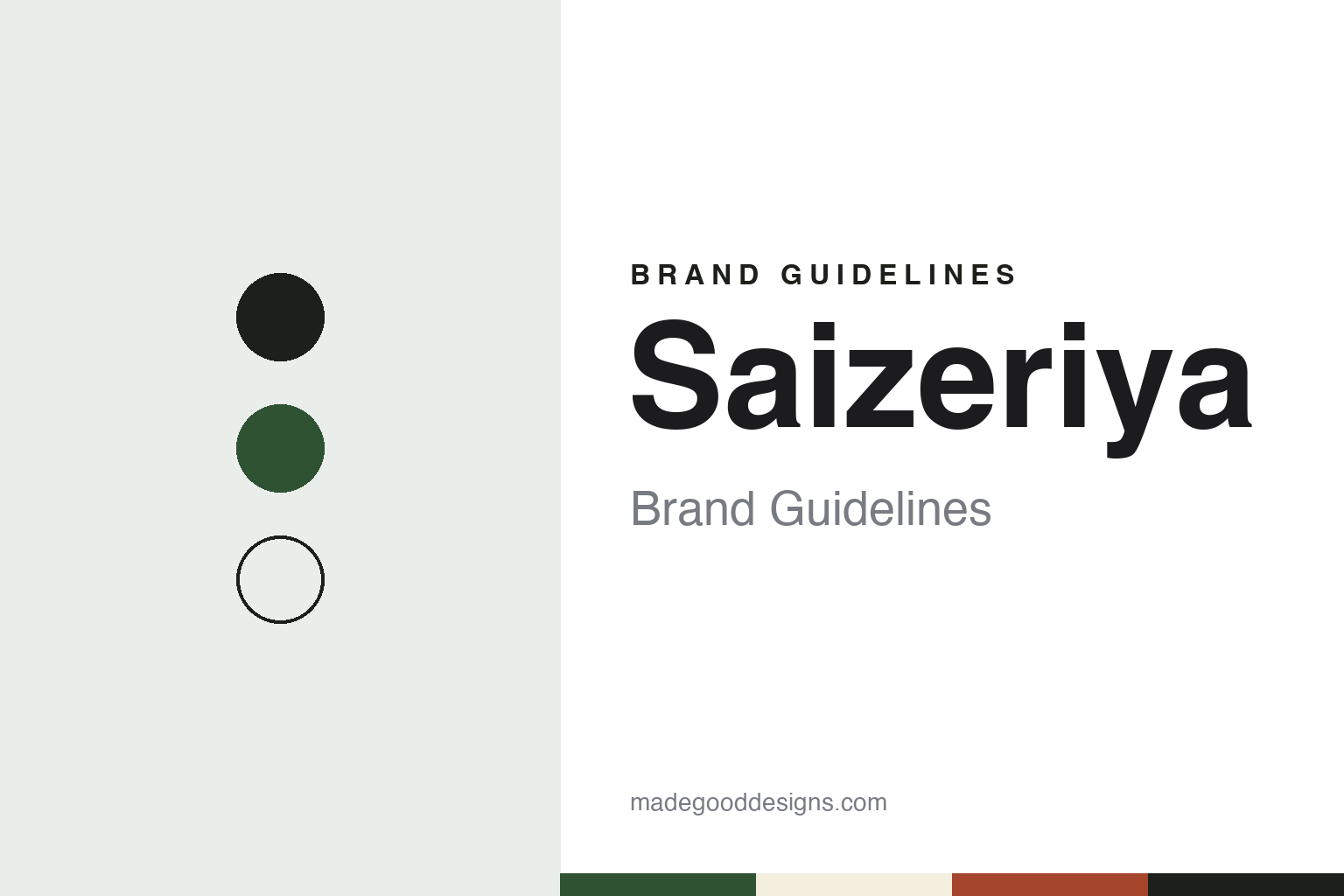
Saizeriya Brand Guidelines
The Ichikawa Italian chain with Renaissance art on its walls.
Aa
Two constants: a Saizeriya green, cream and terracotta palette and a fresco serif register. Abstract homage — not a Saizeriya product or mark; no dish, painting or logo is reproduced.
Motoyawata
A shop near a station in Chiba.
Saizeriya began as a single restaurant in Ichikawa, in Chiba Prefecture, near Motoyawata station. Japanese Wikipedia says its founder, Yasuhiko Shōgaki, then a student at the Tokyo University of Science, took over a former fruit parlour that already carried the name Saizeriya and opened it as a Western-style restaurant in 1967; the company timeline in both the Japanese and English Wikipedias dates his private business to April 1968. Unseen Japan reported in December 2024 that the restaurant started as a yōshoku, or Western food, restaurant in 1967 before becoming an Italian one.
The switch to Italian food is the part of the story both Wikipedias tell at length. Japanese Wikipedia says Shōgaki travelled in Europe, decided Italian cooking would grow in popularity and turned the restaurant into an Italian one, then cut prices sharply when customers stayed away, after which queues formed. English Wikipedia gives a shorter version of the same account.
The company came in May 1973, when the business was incorporated in Ichikawa as Mariaanu Shōkai, according to Japanese Wikipedia; English Wikipedia transliterates it as Maria-nu. It became Mariano in April 1987 and Saizeriya in September 1992. Store formats arrived in steps: a first shopping-centre store at LaLaport in April 1981, a first station-building store in March 1987 and a first suburban roadside store in September 1989. The 100th store opened at Enoshima in July 1994.
In October 1997 the company built a factory in Yoshikawa, Saitama, and moved its head office there, where it remains. Its shares were registered for over-the-counter trading in April 1998 and listed on the Tokyo Stock Exchange in July 1999. Japanese Wikipedia says the company reached 1,000 stores in Japan in November 2013, and gave 1,069 stores in Japan and 474 abroad as of August 2022; Unseen Japan quoted the same pair of figures in December 2024. Inside Retail Asia, citing Nikkei Asia, put the Japanese total at roughly 1,050 in September 2025.
The first restaurant closed in February 2000 but was not torn down. Japanese Wikipedia and Unseen Japan both say it was kept as an educational museum, with handwritten menus, press cuttings, photographs and original kitchen equipment inside.
Colour
Paintings, wine and a central kitchen.
The most distinctive thing about a Saizeriya dining room is on the walls. Japanese Wikipedia says the stores hang reproductions of Renaissance paintings along their sides and have images recalling the Italian Renaissance painted on ceilings, so that a low-cost meal is eaten in a room that has been dressed with care. It lists among the works used Fra Angelico’s Annunciation, Botticelli’s Primavera and The Birth of Venus, and Michelangelo’s Creation of Adam, as well as the two angels from Raphael’s Sistine Madonna.
The outside of a store is less uniform. Japanese Wikipedia says Saizeriya readily takes over sites vacated by other restaurants and keeps the existing structures where it can, so the shape of its buildings and of the pole signs carrying its logo varies widely from store to store. Stores sit in office and station buildings, in shopping centres, on piloti and by the roadside.
The Italian architect Lorena Alessio describes, on her project page at Archilovers, a re-styling scheme for the chain made up of a “Corporate Identity Guidelines” manual and a first prototype restaurant, written when the chain had more than 1,000 restaurants. The page says the scheme reinterprets four Italian landscapes and their colours — the Mediterranean, olive groves, wheat fields and vineyards — in wall images, signs and objects.
Behind the dining room is a supply chain. Japanese Wikipedia says the company has its own farm in Shirakawa, Fukushima, food-processing plants in Fukushima, Saitama, Kanagawa and Hyōgo, and, since 2002, a factory near Melbourne run by Saizeriya Australia; English Wikipedia places that factory in Melton, Victoria. Every Japanese store has a drink bar, and the wine list runs to more than a dozen wines. The chain has tried other formats too: the hamburger shop Eat Run from 2005 to 2010, Saizeriya Express from 2007, and, since July 2016, the pasta counter Spaghetti Mariano.
Japanese Wikipedia also records two operating changes: all seats became non-smoking in June 2019, and from 1 July 2020 the menu was repriced in round sums and cashless payment was introduced.
Typography
Counters, trays and names.
Japan’s fast-food and conveyor-sushi chains present themselves first through the shop itself. A beef-bowl shop is often a single counter with stools, a curry or noodle shop a short line from order to tray, a sushi restaurant a lane of plates running past the tables. Many chains also run suburban roadside stores with car parks, table seating and drive-throughs, and units in station buildings and shopping-centre food courts, so the same name has to work on a tall roadside sign and on a narrow arcade front.
Ordering is part of the look. Many shops ask customers to buy a ticket from a machine before they sit down, and the machine’s screen, buttons and photographs become a menu in their own right; newer stores add self-checkout and mobile ordering. Conveyor-sushi chains add a piece of equipment of their own: the lane that carries plates past the seats.
Naming is usually plain. Signboards tend to state the dish as well as the name, and menus describe a bowl by what is on it, such as cheese, grated radish, kimchi or spring onion and egg, often in sizes from small to extra large. Some chains keep a word of their own for a familiar dish, and many publish their menus in English and Chinese for visitors.
Behind the shop front sits a listed company. Most of the large chains belong to parent groups listed on the Tokyo Stock Exchange that run several formats under separate names, and their corporate sites publish company histories, store counts and overseas subsidiaries year by year. Those pages, read alongside Japanese and English press, are the clearest record of when a chain opened its first store, when it went abroad and who owns it now.
Aa
A fresco serif for a chain that hangs Renaissance art. (Specimen set in Cormorant Garamond, a serif STAND-IN; NOT the Saizeriya logo.)
Saizeriya
From Shanghai to Kuala Lumpur.
Saizeriya went abroad in December 2003, when it opened its first store outside Japan in Shanghai, according to both Wikipedias; Japanese Wikipedia says a wholly owned Shanghai subsidiary had been set up in June 2003. English Wikipedia lists a store in Guangzhou from December 2007, a first store in Singapore in 2008 and a Hong Kong restaurant in North Point in October 2010. Inside Retail Asia, citing Nikkei Asia, reported on 23 September 2025 that the chain had opened in Guangzhou in 2007 and Beijing in 2008, and that it had set up a subsidiary in Wuhan and a head office in Guangdong Province in July 2025 to manage its Chinese business. Japanese Wikipedia adds a Guangzhou food plant that began work in January 2013, supplying pizza bases and white sauce to the city’s stores, and a subsidiary in Taiwan.
Japanese Wikipedia notes that in China the chain’s Japanese image is played down and local dishes are on the menu. The approach shows again in Southeast Asia. The first Vietnamese store opened in a Ho Chi Minh City shopping centre on 8 May 2025, Japanese Wikipedia says. Mothership reported on 5 June 2026 that Saizeriya had opened its first Malaysian outlet on 4 June at AEON Mall Taman Maluri in Kuala Lumpur, with rendang appearing on both the pizza and pasta menus, a carbonara made with beef, and a free-flow drink bar. The report said the outlet was working towards halal certification, and gave the chain’s total as more than 1,600 outlets across Japan, Singapore, Taiwan, Hong Kong and China.
The name is spelled one way. Japanese Wikipedia stresses that the correct form is Saizeriya, with “ya” at the end in both katakana and the Latin alphabet, even though it is often miswritten with “ia”; customers shorten it to “Saize.”
Inside Japan, the map still has gaps. Japanese Wikipedia says the chain reached Hokkaido properly only in June 2012, opened its first Kyushu store in March 2010 and its first Shikoku store in Kagawa in December 2022, and by opening in Aomori in May 2023 had stores in every prefecture on Honshu. It describes an area-dominant approach, filling one district before moving to the next.
For a design guide, Saizeriya shows how a low-cost chain can lean on borrowed art and a consistent interior while its outside signs change from site to site. Compare Marugame Seimen, another Japanese chain that adjusted its name for overseas diners, and McDonald’s. For this guide we use an olive-grove green, wheat cream and terracotta with a serif, an unofficial interpretation; no product or logo is reproduced.
Explore & save
Keep Saizeriya’s identity on hand — save it to a board in the Made Good inspiration library.
Saizeriya identity set
Pin the Saizeriya green, cream and terracotta palette and the fresco serif register to your own board.