National Book Store Brand Guidelines
An Escolta stall, a cash-register name and a red sign over the school-supplies aisle.
Aa
Two constants: a red, cream and ink palette and a bold retail sans register. Abstract homage — not a National Book Store asset; no logo, sign or product is reproduced.
Escolta
A stall, a husband-and-wife team and a name from a cash register.
National Book Store began as a small stall in Escolta, the old commercial street of Manila. The Philippine Star, marking the company’s 70th year in December 2012, wrote that it was founded by Jose Ramos and his wife Socorro Cancio-Ramos, and that the first shop sold school supplies, GI novels and textbooks. The company is generally dated to 1942; The Philippine Star gave that year again in a June 2023 column, and English Wikipedia says the business was formally established then. English Wikipedia’s article on Socorro Ramos places an earlier Escolta shop, opened under the National name, in 1940, so the two dates sit side by side in the record.
Socorro Ramos had learned the trade before she ran her own shop. Rappler, reporting in March 2015 on a talk she gave, wrote that she spent three years working in her brother-in-law’s bookstore, where she met Jose Ramos; the couple then opened a business of their own. The name came quickly. She told the same audience that she chose “National” on a whim, after seeing the word printed on the cash registers of the day, and English Wikipedia adds that the registers were made by the National Cash Register company and that no market research was involved.
The war years changed what the shop sold. During the Japanese occupation of the Philippines, The Philippine Star reported in 2012, strict censorship of books forced the couple to switch to soap, candies and slippers, which they bought from wholesalers and sold on to smaller retailers. After the war they started again with a makeshift stall at the corner of Soler Street and Avenida Rizal, timed to open for the first school year after the war, and went back to textbooks, notebooks, pad paper and pencils. The family later put up a two-storey building with a mezzanine, which served as the main shop for many years.
Colour
Greeting cards, a nine-storey building and branches in the malls.
The shop widened its range in the decades after the war. The Philippine Star wrote in 2012 that Socorro Ramos began producing greeting cards and postcards with Philippine views and artwork, and that the company later took the Philippine franchise for Hallmark cards; English Wikipedia dates the Hallmark deal to 1973 and says the company had earlier reprinted Gibson cards. The same 2012 article describes a publishing programme run with international publishers including McGraw-Hill and Prentice Hall.
Property followed. In 1955 the Ramos family bought a site in Manila from the Guerrero family and began the nine-storey Albecer Building, named, The Philippine Star wrote, from the first letters of the names of their three children, Alfredo, Benjamin and Cecilia. English Wikipedia spells it Albercer and dates its completion to 1963.
Growth then came through branches. Socorro Ramos listed the sequence for Rappler in 2015: from the first shop to Avenida, then Recto, Cubao and Ayala Center, and on to Mindanao. English Wikipedia says the Recto Avenue branch was opened at the suggestion of the Ramos children, in a district used by students, and that mall branches in Makati and Cubao followed in the 1970s, with mall owners later inviting the company into their buildings. Rappler reported about 2,500 employees in more than 160 branches in March 2015; by June 2023 The Philippine Star gave the count as more than 230 branches nationwide.
The group spreads beyond the bookshop itself. Anvil Publishing is its publishing arm, and Powerbooks is a specialty bookshop chain in the same family, Rappler and The Philippine Star both report; Rappler also named Metrobooks in Hong Kong. In 2015 Xandra Ramos-Padilla, a granddaughter of the founders and managing director of the chain, told Rappler that the company sold e-books through a tie-up with Kobo and was digitising titles published by Anvil, alongside Filipino translations of foreign authors. In early 2023 the chain opened a shop on One Bonifacio High Street in Taguig, a site The Philippine Star said had been in the works for several years, with the company’s president, Adrian Ramos, quoted as saying “We’re back.”
Typography
Design and documentation.
Retailers in Singapore and the Philippines tend to present themselves through the store itself before any campaign. Opening hours, location and the name over the door carry much of the identity: a 24-hour department store in Little India, a supermarket in a public-housing estate, a department store anchoring a mall, or a bookshop whose aisles fill up at the start of each school year. The companies in this guide publish store locators, opening hours and seasonal promotions on their own websites, and those pages show how each one wants to be seen.
Store naming is usually plain. Many of these businesses carry a founder’s name, a family name or the name of a parent group. Some keep a single name across every format; others run several store names under one parent. Where a chain runs several store types, its own pages set out which name goes on which fascia, and those choices are described in each guide as the companies publish them.
Corporate pages add the history. Listed groups publish founders, management, parent companies and stock-exchange listings on their investor and about pages, while family-owned businesses often tell their origin story in their own words: a market stall, a small shop or a single store taken over and renamed. Each guide marks which details come from the company and which from newspapers, trade press, heritage bodies or encyclopaedias, with dates.
This guide covers grocers, department stores, electronics retailers and booksellers across both countries. It sets out what can be checked about each brand: who founded it, who owns it, when it listed, and how many stores it ran according to a dated source. Colours and type in each guide are an unofficial interpretation, chosen for this guide, and no logo or store sign is reproduced.
Aa
A bold retail sans for a sign read from across a mall. (Specimen set in Archivo, a sans STAND-IN; NOT the National Book Store logo.)
National Book Store
A striped wrapper, then a red sign.
The visual identity has a documented history, set out by English Wikipedia. For about fifty years the shop used a logo designed by Socorro Ramos herself: the store’s name on a white ground, wrapped in a band of red and white stripes. She made it by placing the name inside a striped wrapper, and her children were content with it.
A new logo arrived in 1996, proposed by her children and grandchildren. It set the name in a more modern typeface on a red ground. English Wikipedia says the change was put to a vote inside the company, which went fifteen to one, with Socorro Ramos the only vote against, and that the new mark came from a Singapore-based firm that also produced a new store layout.
The shops were redesigned again two decades later. English Wikipedia says a new store design was rolled out from 2016, starting with the branch at SM City North EDSA, in collaboration with the French design firm Malherbe. In late 2016, the same source says, the company also opened three specialty formats: Art Bar for arts and crafts, Noteworthy for stationery and gifts, and Work Station for office supplies.
The ownership remains with the family. The Philippine Star wrote in June 2023 that the children and grandchildren of the founders run the business, which includes Anvil Publishing, Powerbooks and a small higher-education college; English Wikipedia names it NBS College and dates its launch to 2017. Rappler reported in March 2015 that a planned backdoor listing on the stock exchange had been shelved at that time. School supplies remain central: The Philippine Star described parents returning to the shops each July and August for the new school year.
For a design guide, National Book Store shows how a family shop can keep one plain idea, a name and a red sign, across eight decades of branches. Compare Fully Booked, a younger Philippine bookseller, and Popular Bookstore in Singapore. For this guide we use red, cream and ink with a sans, an unofficial interpretation; no product or logo is reproduced.
Explore & save
Keep National Book Store’s identity on hand — save it to a board in the Made Good inspiration library.
National Book Store identity set
Pin the National Book Store red, cream and ink palette and the bold retail sans register to your own board.
Source & notes
Frequently Asked Questions
What font can I use to match the National Book Store look?
This guide describes National Book Store’s type as “A bold retail sans for a sign read from across a mall”. Its type specimen is set in Archivo from Google Fonts as a stand-in; Archivo is not National Book Store’s own lettering.
What colours are in the National Book Store palette?
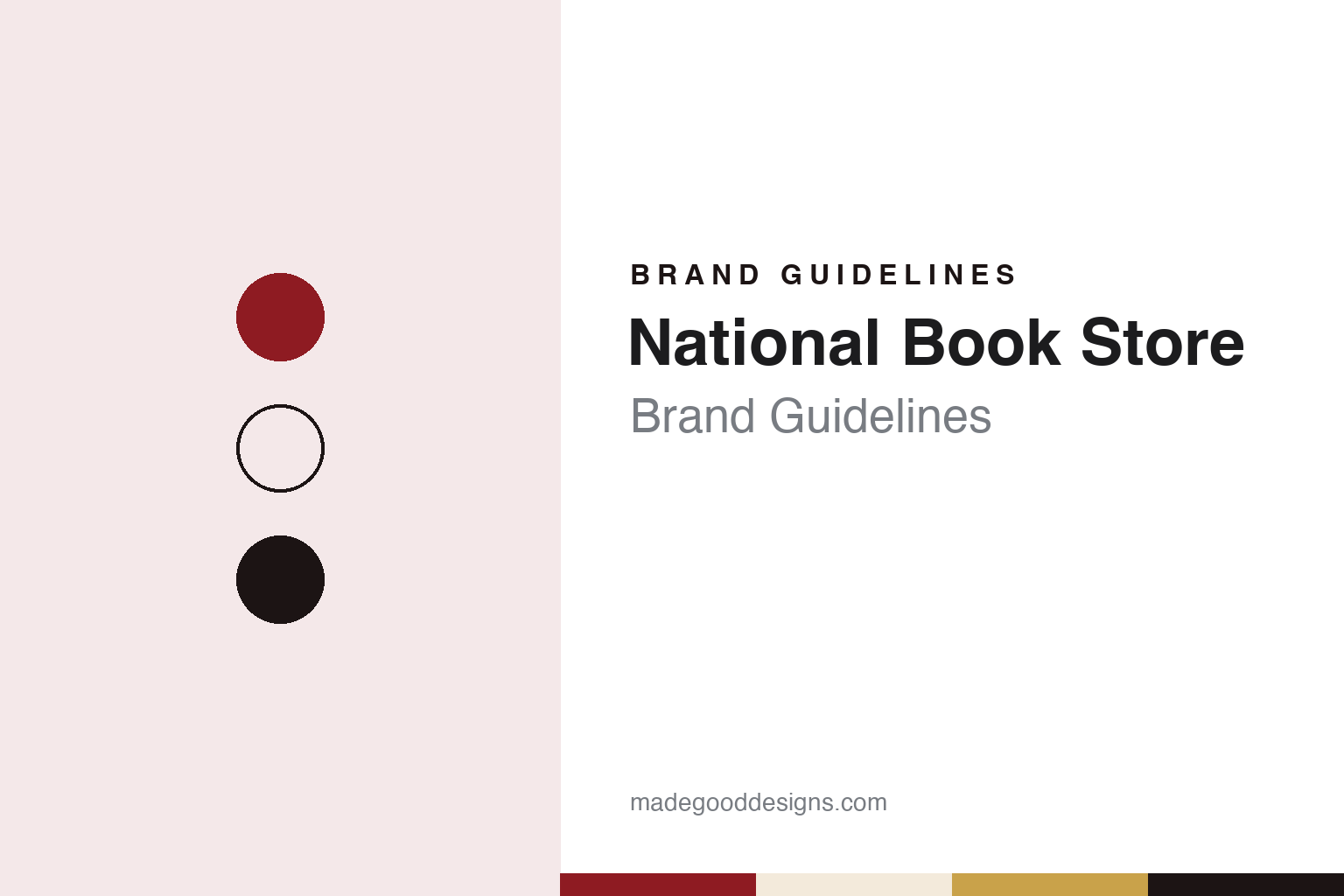
This guide’s National Book Store palette is Shopfront red #8E1B22, Ink #1C1414, Notebook cream #F3EADB, Pencil gold #C9A24A and Paper #FBF8F2. The tones are the guide’s own unofficial interpretation, not official National Book Store hex codes.
When was National Book Store founded?
National Book Store was founded in 1942, in Escolta, Manila.
Who founded National Book Store?
National Book Store was founded by Jose Ramos and Socorro Cancio-Ramos in 1942.