Babyshop Brand Guidelines
The 1973 Bahrain shop that started the Landmark Group.
Aa
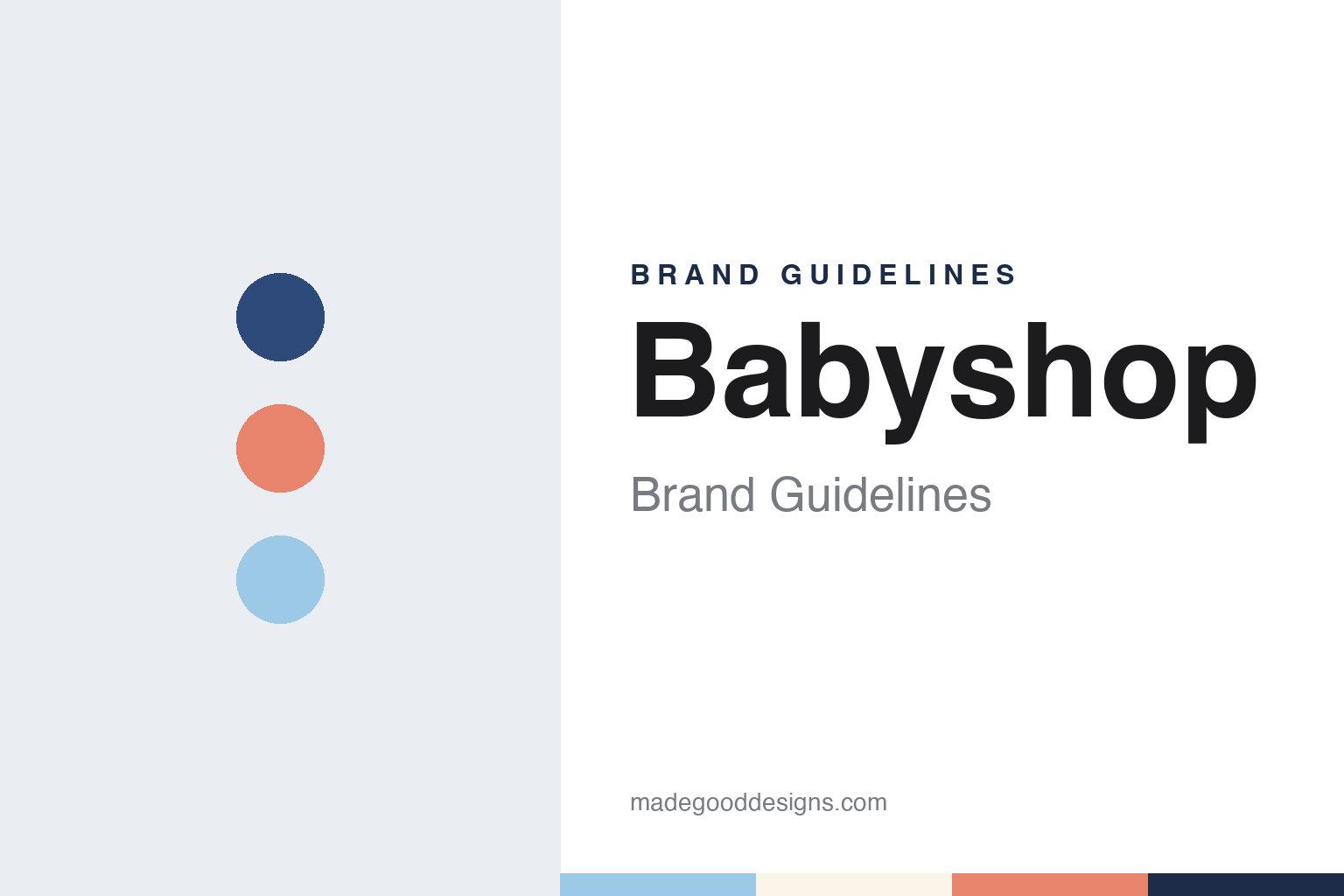
Two constants: a sky blue, coral and cream palette and a rounded sans register. Abstract homage — not a Babyshop product or mark; no logo, fascia or packaging is reproduced.
One shop in Bahrain
The store that started the Landmark Group.
Babyshop began as a single shop in Bahrain in 1973. English Wikipedia says it was opened by Micky Jagtiani, who had studied in London before moving to Bahrain to run a shop selling baby products and accessories, and that it was his first retail business and the base on which the Landmark Group was built. Khaleej Times gave the same founding year and place in January 2013, and The National wrote in November 2024 that Landmark “was founded in 1973 with a shop in Bahrain.” The group is now based in Dubai. In that 2024 report The National counted 22 home-grown brands, more than 2,200 outlets in 17 countries and more than 53,000 employees, with Babyshop listed alongside Centrepoint, Splash, Lifestyle, Max, Home Centre, Shoemart and Emax, and it named Renuka Jagtiani as the group’s chairwoman.
The early years come through mainly in the recollections of staff. In a 2011 Gulf News profile, the then chief executive Vinod Talreja said he arrived in Bahrain on 5 August 1982 to start as a junior salesperson at Babyshop, after an interview with Jagtiani in Mumbai, and worked his way up through sales, store management and buying, travelling with the chairman to meet suppliers. Another early recruit, Manu Jeswani, told Gulf News in 2010 that he began as a sales assistant at Babyshop in Bahrain in 1978 and became store manager in 1980. Customers there kept asking for children’s footwear, he said, and that request became the idea behind Shoe Mart, which he opened in Dubai in 1990.
Babyshop’s first store outside Bahrain opened in Sharjah, in the United Arab Emirates, in 1990, Khaleej Times reported in 2016. In August 2005 Landmark opened the first Centrepoint, in Kuwait. Emirates 24/7 wrote in 2009 that the format was created to bring four of the group’s core concepts, Babyshop, Shoe Mart, Splash and Lifestyle, under a single identity, and that in Saudi Arabia it traded as CityPlaza. Babyshop still runs standalone stores as well as sections inside Centrepoint, English Wikipedia says.
Colour
From Sharjah to Shanghai, Kuala Lumpur and Chennai.
Expansion came in steps. On 23 September 2007 Landmark opened its first store in China, a Babyshop of about 14,000 square feet in the Hongqiao district of Shanghai, Gulf News reported; at that point the group said it ran over 600 stores in 10 countries. By January 2013 Babyshop had 172 stores, 33 of them in the UAE, according to Khaleej Times, with outlets in Saudi Arabia, Qatar, Kuwait, Oman, Jordan, Egypt, Lebanon, Yemen, Libya, Sudan, Kenya, Tanzania, Uganda and Pakistan. Talreja told the paper that its franchise network had reached Libya, Uganda, Sudan and Tanzania the previous year, and that stores were adding children’s play areas and mother’s rooms.
In February 2016 Khaleej Times counted 235 outlets in 19 countries, with Saudi Arabia the biggest market at 116 shops and the UAE next at 47. Babyshop had opened in Thailand in December 2015 and in Nigeria in January 2016, the paper reported. Talreja said the chain served children from birth to 16, and that most of its products came from Asia, with China, India, South Korea and Taiwan the main source countries; the company sets its own quality requirements whatever the source market, he said. Landmark’s Shukran loyalty programme runs across Babyshop and the group’s other chains, the same report noted.
Southeast Asia followed. In October 2018 The Edge Malaysia reported on the opening of Babyshop’s fifth Malaysian store, a flagship at The Curve in Mutiara Damansara, Petaling Jaya, eight months after the first two at MyTown in Cheras and IOI City Mall in Puchong. The then chief executive, Richard Collins, described four merchandise categories carried over from the Gulf: fashion for newborns to ten-year-olds, baby basics, nursery and feeding, and toys. In January 2025 Babyshop opened its first store in India, at Express Avenue mall in Chennai, Apparel Resources reported, with a stroller test track on the shop floor and a “My Baby Expert” advice service. The chief executive named in that report was Ruban Shanmugarajah.
Typography
How Gulf retailers present themselves.
Gulf fashion, home and online retailers present themselves first through the places where people shop. In the UAE, Saudi Arabia, Kuwait and their neighbours, many chains trade from large mall units, and the store fascia, a name in lit letters above a wide entrance, is often the first piece of branding a shopper sees. Groups that run several chains often place them side by side in the same mall, or gather them under one umbrella name, so that a single visit can cover clothing, shoes, children’s goods and homeware.
Value-fashion and home chains speak through campaigns timed to the retail calendar: seasonal collections, catalogues and named sale events. Their identity work tends to show up in store refits as much as in advertising. A new logo usually arrives with a redesigned flagship, new signage and new in-store graphics, and then spreads to the rest of the estate store by store, sometimes over months or years.
Online retailers carry the same task onto app screens, product pages and delivery packaging. There the brand becomes a set of repeated elements: a wordmark, a colour, a tone of voice in notifications, and the boxes and bags that arrive at the door. Store groups in the region also run their own apps and click-and-collect services, so the line between the shop and the screen is less sharp than it once was.
Store names are usually plain and descriptive, and the companies publish them in English as they appear above the door. Corporate pages and dated press coverage give the facts behind those names: who founded each business and when, which family or group owns it, and whether its shares are listed on an exchange such as Tadawul, ADX or DFM. These guides draw on those dated sources and describe colour and type only as our own interpretation, with no logo or fascia reproduced.
Aa
A rounded, friendly sans for a children’s retailer. (Specimen set in Nunito, a sans STAND-IN; NOT the Babyshop logo.)
Babyshop
Online shelves, own labels and a new identity.
Babyshop was one of the three Landmark brands that went online in the group’s opening round of e-commerce. The National reported in March 2013 that the group had launched e-commerce sites for three of its retail brands the previous December, Emax, Babyshop and Splash, open at first only to customers in the UAE. By February 2016 Talreja told Khaleej Times that the full assortment was available online in the UAE. Speaking to Fast Company Middle East in April 2026, Shanmugarajah said that curation “used to live on the shop floor; now it lives in feeds, recommendation engines, and personalized homepages,” and that the chain still valued the instinct and editing of traditional merchandising, now informed by real-time data.
Alongside outside brands, the shelves carry the company’s own labels. The Edge Malaysia reported in 2018 that the in-house labels Juniors, Giggles and Eligo made up the bulk of Babyshop’s inventory in Malaysia, next to international names such as Chicco, Disney and Barbie. English Wikipedia adds Love Earth, a children’s clothing range introduced in 2021. At the Chennai opening the third-party ranges included Joie and Lego, Apparel Resources reported. In May 2026 Babyshop unveiled a new brand identity, Forbes Middle East noted in June 2026, describing it as the next phase of the brand across the region.
For a design guide, Babyshop shows how a plain, descriptive shop name can stay the signature of a chain across many countries and remain the oldest name in a large retail group. Compare Centrepoint, the Landmark format that houses it, and Shoe Mart, the footwear chain that grew out of its Bahrain store. For this guide we use a soft sky blue, a warm coral and cream with a rounded sans, an unofficial interpretation; no product or logo is reproduced.
Explore & save
Keep Babyshop’s identity on hand — save it to a board in the Made Good inspiration library.
Babyshop identity set
Pin the Babyshop sky blue, coral and cream palette and the rounded sans register to your own board.
Source & notes
Frequently Asked Questions
What font can I use to match the Babyshop look?
This guide describes Babyshop’s type as “A rounded, friendly sans for a children’s retailer”. Its type specimen is set in Nunito from Google Fonts as a stand-in; Nunito is not Babyshop’s own lettering.
What colours are in the Babyshop palette?
This guide’s Babyshop palette is Ink blue #1C2B47, Nursery sky #9CC9E6, Warm coral #E8846B, Cream #FBF4E8 and Soft mint #CFE8D9. The tones are the guide’s own unofficial interpretation, not official Babyshop hex codes.
When was Babyshop founded?
Babyshop was founded in 1973, in Bahrain. Babyshop is known for Children’s clothing, toys, nursery furniture.
Who founded Babyshop?
Babyshop was founded by Micky Jagtiani in 1973. Babyshop is known for Children’s clothing, toys, nursery furniture.