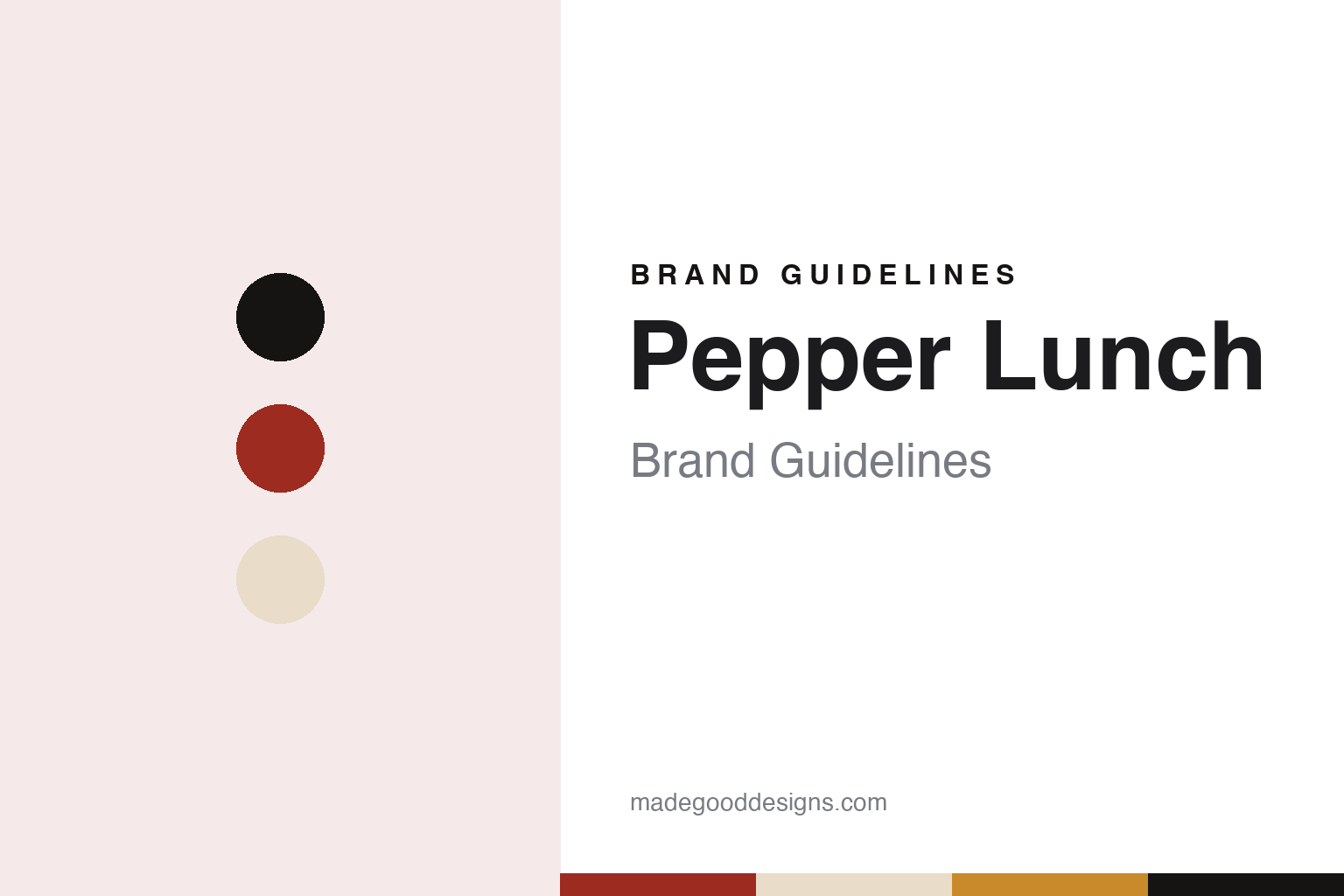
Pepper Lunch Brand Guidelines
The 1994 iron-plate steak chain, sold by its founder group in 2020.
Aa
Two constants: a Pepper Lunch red and iron black palette and a Sturdy sans register. Abstract homage — not a Pepper Lunch product or mark; no dish, plate or logo is reproduced.
From Kitchen Kuni
A steak cook’s side business.
Pepper Lunch grew out of a steak business in east Tokyo. Japanese Wikipedia says that Kunio Ichinose, a cook who had worked at the Sanno Hotel in Akasaka, opened a restaurant called Kitchen Kuni in Mukojima, in Sumida ward, in February 1970. It was incorporated as Yugen Kaisha Kuni in 1985, opened Steak Kuni restaurants from 1987, and was reorganised in August 1995 as Pepper Food Service, the company that would run Pepper Lunch for its first quarter-century.
The first Pepper Lunch opened in July 1994 at Ofuna, in Kanagawa prefecture, as a franchised shop; the first company-run shop followed at Asakusa, in Tokyo, that September, according to Japanese Wikipedia. Restaurant Dive, reporting in October 2024, also dates the brand to 1994. The first food-court shop opened in Kawagoe in March 2003, a setting that suited the format: in 2020, announcing its purchase of the business, the fund J-STAR described the concept’s strength in food courts, where low prices and quick service are needed, as Inside Retail Asia reported.
The idea is a hot iron plate. The menu centres on steak and beef pepper rice, in which rice and thinly sliced beef arrive raw on the plate and are mixed by the diner as they cook, Japanese Wikipedia explains; the company says its plates are heated to about 280 degrees Celsius and that most dishes reach the table in two to three minutes. Restaurant Dive described the result as a do-it-yourself form of teppanyaki, in which customers cook their own food on a very hot plate, and reported a spokesperson saying the shops need no prep or line cooks. Other regular dishes include cut steak and hamburg steak.
Pepper Food Service listed its shares on the Tokyo Stock Exchange’s Mothers market in September 2006. In September 2012 it opened Pepper Lunch Diner, a slower sit-down version, in Ueno, followed by branches in Akihabara and at the Huis Ten Bosch resort in 2013.
Colour
Franchised across Asia.
Pepper Lunch left Japan early in its life. Japanese Wikipedia dates the first South Korean shop, in Seoul, to November 2003, followed by Taipei in May 2005, Singapore in July 2005 and Beijing in December 2005; the chain withdrew from Taiwan in 2012 and returned when a Malaysian area franchisor took the rights, and a first shop in Suzhou opened in 2014. Inside Retail Asia wrote in July 2020 that the chain had expanded through Asia on a franchised basis, naming Vietnam, Singapore and Thailand.
By that summer the business counted 181 shops in Japan and 333 overseas, including the sister brands sold with it, according to Inside Retail Asia. The overseas menus have shifted to suit local diners: the company says its foreign shops offer more seafood and chicken, for customers who do not eat beef for religious or dietary reasons, along with iron-plate pasta, and that a sukiyaki dish has been popular abroad.
North America came later. Restaurant Dive reported in October 2024 that Pepper Lunch had signed its first North American development agreements in 2023 and then had five shops in the United States: three in California, one in Las Vegas and one in Guam, with more than 500 locations worldwide. The current operator’s own count, at the end of October 2026, is 581 shops in 17 countries and regions, including 192 in Japan, 96 in Indonesia, 82 in the Philippines, 55 in Thailand and 31 in Singapore; it also lists shops in Hong Kong, China, Australia, Mongolia, Canada and the United States, Guam included.
Typography
Japan’s fast-food and sushi chains.
Japan’s fast-food and conveyor-sushi chains present themselves first through the shop itself. A beef-bowl shop is often a single counter with stools, a curry or noodle shop a short line from order to tray, a sushi restaurant a lane of plates running past the tables. Many chains also run suburban roadside stores with car parks, table seating and drive-throughs, and units in station buildings and shopping-centre food courts, so the same name has to work on a tall roadside sign and on a narrow arcade front.
Ordering is part of the look. Many shops ask customers to buy a ticket from a machine before they sit down, and the machine’s screen, buttons and photographs become a menu in their own right; newer stores add self-checkout and mobile ordering. Conveyor-sushi chains add a piece of equipment of their own: the lane that carries plates past the seats.
Naming is usually plain. Signboards tend to state the dish as well as the name, and menus describe a bowl by what is on it, such as cheese, grated radish, kimchi or spring onion and egg, often in sizes from small to extra large. Some chains keep a word of their own for a familiar dish, and many publish their menus in English and Chinese for visitors.
Behind the shop front sits a listed company. Most of the large chains belong to parent groups listed on the Tokyo Stock Exchange that run several formats under separate names, and their corporate sites publish company histories, store counts and overseas subsidiaries year by year. Those pages, read alongside Japanese and English press, are the clearest record of when a chain opened its first store, when it went abroad and who owns it now.
Aa
A sturdy sans — plain and quick, like a sizzling plate set down. (Specimen set in Archivo, a sans STAND-IN; NOT the Pepper Lunch logo.)
Hot Palette
A 2020 sale and a new owner.
The founding group sold the chain in 2020. In July that year Inside Retail Asia, citing a Nikkei report, wrote that Pepper Food Service was selling the Pepper Lunch business to the Japanese investment fund J-STAR, together with smaller brands including Pepper Lunch Diner, Musashi Hamburg and CAB Steak, while it kept its Ikinari Steak chain. Japanese Wikipedia sets out the steps: on 1 June 2020 the business was split into a new company, JP; on 31 August 2020 a J-STAR-backed holding company, PLHD, acquired all of JP’s shares, and JP was renamed Hot Palette. On 1 January 2022 Hot Palette merged into PLHD, which took the Hot Palette name. Pepper Food Service continues separately with Ikinari Steak.
Hot Palette is based in Kameido, in Koto ward, Tokyo, and dates itself to 31 August 2020. Besides Pepper Lunch and the Pepper Lunch PLUS format, it runs Musashi Hamburg and Rocks Hamburg, and it supplies ingredients to its franchisees. It says the name joins “hot,” for food served sizzling, with a painter’s palette for a group of brands, and that its own logo, read as both a palette and a globe, carries a fork and spoon. The Pepper Lunch websites in Japan, the United States and Singapore all carry its name.
The Japanese website sorts the menu into pepper rice, steak, hamburg steak and curry, with lunch sets, a children’s menu and seasonal specials, and offers takeaway, delivery and mobile ordering through its own app. The company also promotes a yearly World Pepper Rice Day on 3 July.
For a design guide, Pepper Lunch shows how a single cooking device, the heated plate, can carry a brand from a Kanagawa franchise to more than a dozen countries and through a change of owner. Compare MOS Burger and Sukiya, two other Japanese fast-food chains. For this guide we use pepper red, iron black, rice cream and seared amber with a sturdy sans, an unofficial interpretation; no product or logo is reproduced.
Explore & save
Keep Pepper Lunch’s identity on hand — save it to a board in the Made Good inspiration library.
Pepper Lunch identity set
Pin the Pepper Lunch red and iron black palette and the Sturdy sans register to your own board.