loveholidays Brand Guidelines
A London online travel agency that sells flights and hotels together in a few clicks.
Aa
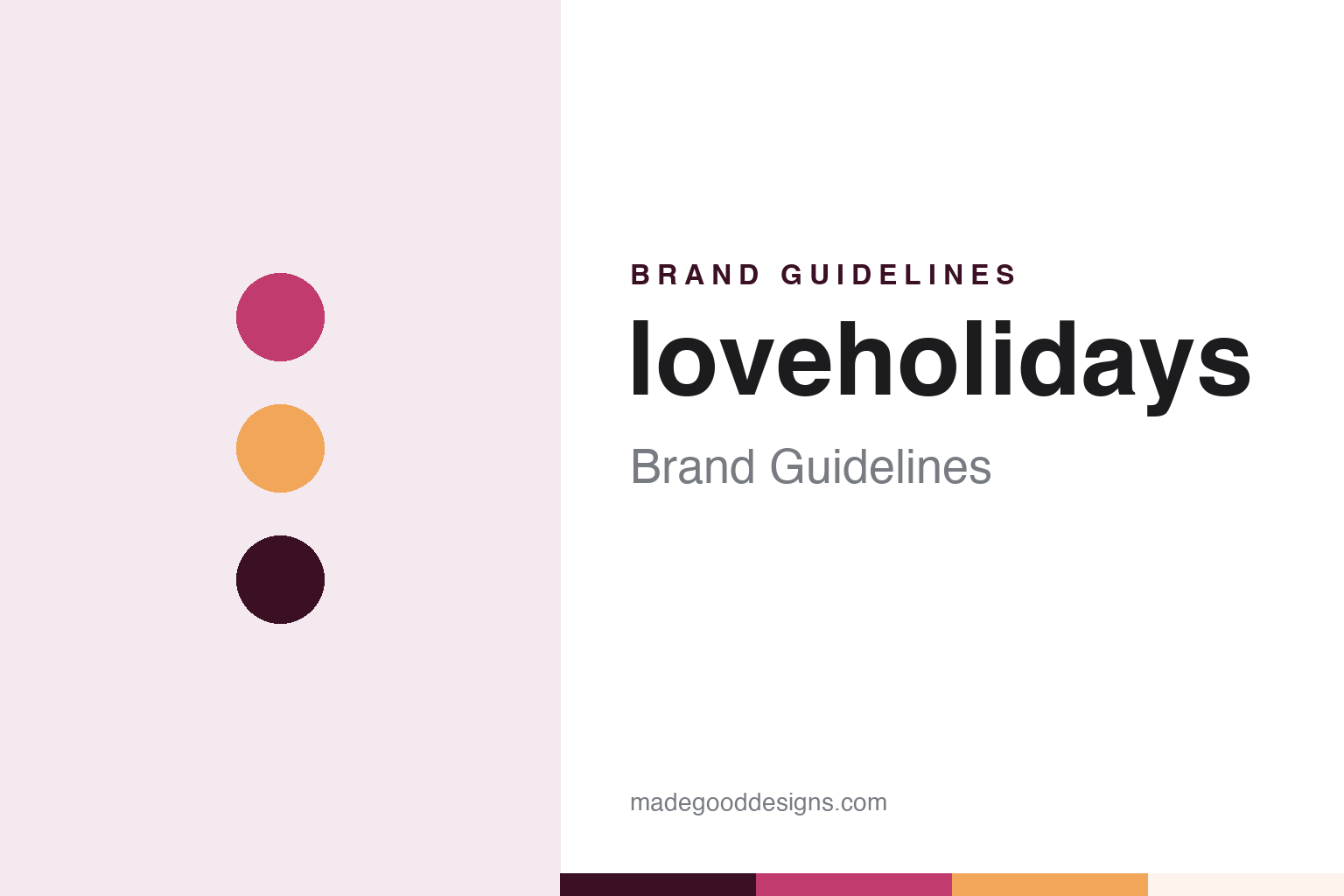
Two constants: a plum, raspberry and apricot palette and a rounded sans register. Abstract homage — not a loveholidays asset; no logo, wordmark or campaign image is reproduced.
Two founders, 2012
A UK online travel agency built on flight-and-hotel packages.
loveholidays is a UK online travel agency that sells package holidays: a flight and a hotel bought together, usually with transfers, through one website. It was founded in 2012 by Alex Francis and Jonny Marsh. Francis gave that year himself when the company announced new investment in May 2018, telling the travel trade site TravelMole that the business had grown significantly since he and Marsh started it in 2012. The founders write the name as one word, all in lower case, and the company and much of the trade press have kept that form.
The 2018 deal was the company’s first big change of ownership. TravelMole reported on 29 May 2018 that loveholidays had sold a majority stake to Livingbridge, a mid-market private equity investor. Both founders stayed with the business and continued to lead its senior management team, which was kept in place. Francis said the investment would let the company explore further growth in the UK and abroad, and that it would keep offering “short and long haul beach holidays.”
Livingbridge already knew the sector. In the same report Marsh pointed to the firm’s earlier backing of Enigma Travel, On the Beach and Travel Jigsaw, and described online “dynamic packaged” holidays — packages assembled on the spot from separately sourced flights and rooms — as a growing part of British holiday spending. That model, rather than a fleet of aircraft or a chain of hotels, is the core of the business.
The founders later stepped back from day-to-day control. According to a Business Leader interview published in July 2026, Donat Rétif, a telecoms and private equity executive, took over as chief executive from one of the two co-founders in December 2019; the founder still sits on the board and meets him six times a year but is otherwise, in Rétif’s words, “completely remote from the business now.” Rétif told Business Leader that he wrote a one-page agreement with the founder setting out how they would work together before the arrangement went to the board.
Colour
A marketplace that owns no planes and no hotels.
The company describes itself as a marketplace. In an interview with City A.M. in August 2024, Rétif drew the line between loveholidays and a tour operator such as Jet2 or easyJet holidays: “we do not own any airlines, we don’t own any hotels.” Instead, he said, the company brings together a large and fragmented supplier base and combines it into packages, so that a customer can buy a flight and a hotel “in a few clicks.” Customers see one price for the whole package rather than the individual parts, which he said lets suppliers offer deeper discounts without affecting their other sales.
Rétif presented that structure as a source of flexibility. Because the company has no exclusive deals to protect, he told City A.M., it can follow demand to newer destinations as well as long-established ones such as Mallorca and Greece; he named Albania, Romania and Tunisia as places where bookings had grown. He also said the company did not spend on TV advertising, and that in Germany it relied instead on social media and brand partnerships to build trust.
Germany was the first market outside the UK. City A.M. reported in August 2024 that loveholidays had entered Germany the previous year, and Rétif told Business Leader in July 2026 that the company chose it first because only a small share of German holidaymakers then booked online: “We wanted to prove that if we can do it in Germany, the rest will be easier.” He said the company found that younger German customers did not pay by card as expected, and that it brought in payment specialists before launching in the Netherlands and Scandinavia. By July 2026, Business Leader reported, loveholidays had expanded into eight countries.
The same interview gave a picture of the company’s size and shape: staff numbers had grown from roughly 100 to more than 400, all based in Hammersmith in west London, with around 900 more working in contact centres in India and South Africa. Rétif said that chat software now handles most customer conversations without a human agent, a figure the company gives rather than an independent measure.
One regulatory matter is on the public record. On 15 December 2020 the Competition and Markets Authority said it had investigated loveholidays after receiving hundreds of complaints from customers still waiting for refunds on package holidays cancelled that year. The CMA said the company had signed formal commitments, known as undertakings, to repay those customers in full by March 2021 at the latest, in two stages covering accommodation and flights, and that it would report its progress to the regulator.
Typography
Brochures, shop windows and booking pages.
Package-holiday operators and travel agencies sell something the customer cannot see before the trip, so the brand has to stand in for the holiday. In the shop era that meant printed brochures and the windows of high-street shops, filled with resort photographs and destination names. Online agencies moved the same job to booking pages, where search boxes, hotel photographs and a single package price do the work the brochure once did.
Television has been a second shop window. On the Beach aired its first TV advert in December 2013, a campaign filmed on Fuerteventura, according to English Wikipedia; loveholidays’ chief executive told City A.M. in 2024 that his company did not spend on TV advertising and leaned on social media and brand partnerships instead. Both approaches show the holiday rather than the company: sea, sand, pools and city streets.
Naming in the sector tends to be plain. Some brands describe the product or the destination, some carry a founder’s surname, and some are built to read as a web address. Holiday ranges and sub-brands are usually named for the kind of trip they sell, such as beach, city break, long haul or cruise, so a customer can tell them apart at a glance.
Corporate pages tell a different story from the booking pages: who founded the company and where, which investors have owned it, when it listed or was sold, and, for some firms in this set, when the business collapsed or was absorbed into another group. This guide sets out what dated sources record about each brand, and marks what rests only on the company’s own word.
Aa
A rounded sans for a lower-case name. (Specimen set in Nunito, a sans STAND-IN; NOT the loveholidays logo.)
loveholidays
One lower-case word, sold online.
loveholidays has no high-street shops and, as Rétif described it in 2024, no aircraft or hotels of its own, so its identity lives almost entirely on screens: the website, the app, search results and social media. The name itself does much of the work. Written as a single lower-case word, it reads as a web address as much as a company name, and the founders used that form in their own statements to the trade press in 2018.
The company’s growth story has been told mainly through interviews with its chief executive. In City A.M. in 2024, Rétif said young couples were the company’s main customers and that it wanted to build products for families as well, following customers “from a couple in their 20s to a family with young kids” and onwards. In Business Leader in 2026 he named a partnership with Ryanair among the agreements the company had reached with airlines, retailers and banks.
Ownership has stayed private. TravelMole’s 2018 report remains the dated record of Livingbridge buying its majority stake, and the founders’ continued presence on the board was described by Business Leader in 2026.
For a design guide, loveholidays shows how a travel seller with no shops, planes or hotels can build a brand from a name, a website and a booking flow. Compare On the Beach, another UK online package-holiday seller once backed by Livingbridge, and Jet2, the airline and tour operator Rétif named as a different kind of business. For this guide we use plum, raspberry and apricot with a rounded sans, an unofficial interpretation; no product or logo is reproduced.
Explore & save
Keep loveholidays’s identity on hand — save it to a board in the Made Good inspiration library.
loveholidays identity set
Pin the loveholidays plum, raspberry and apricot palette and the rounded sans register to your own board.