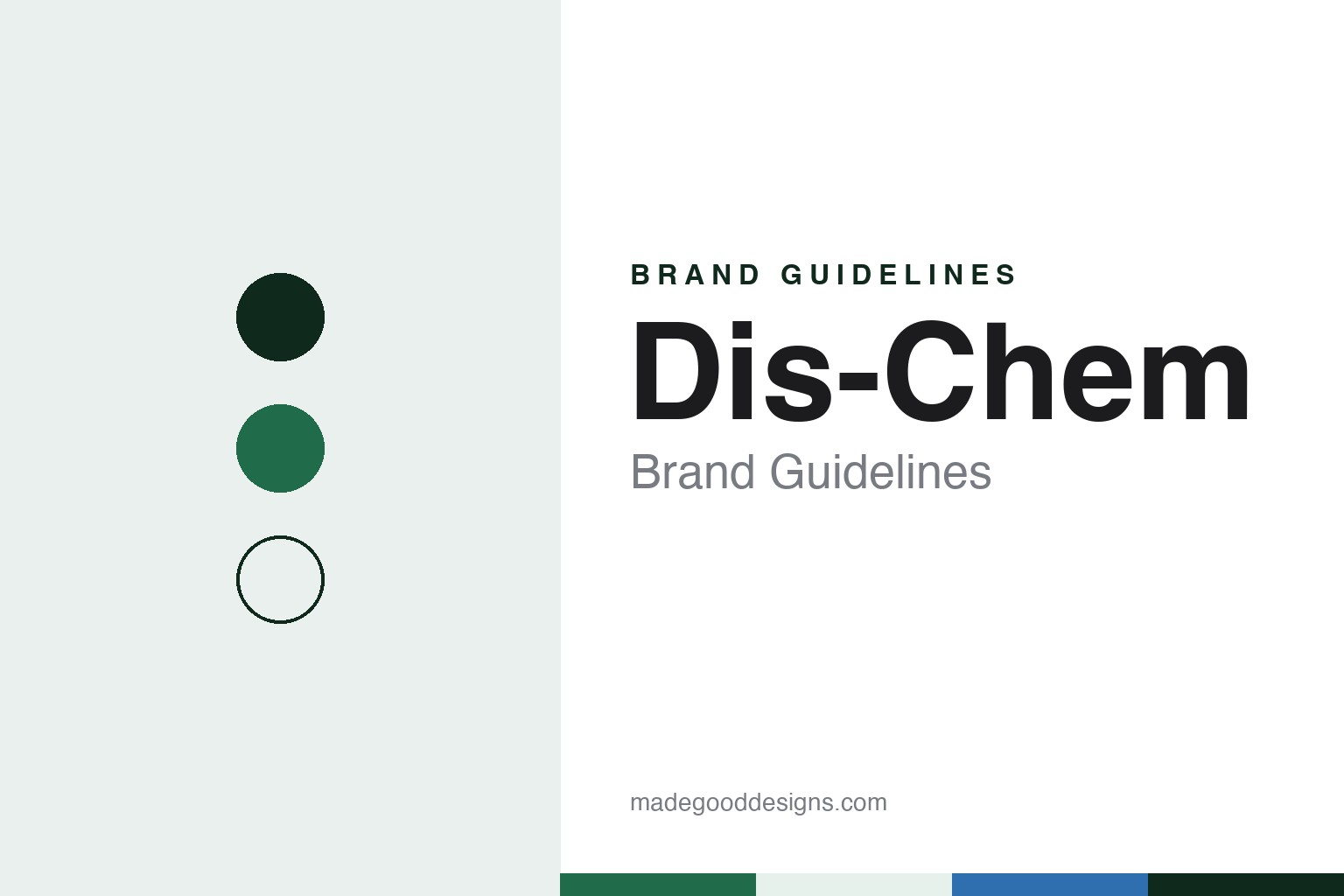
Dis-Chem Brand Guidelines
A 1978 Mondeor pharmacy, a 2016 listing and a Midrand head office.
Aa
Two constants: a dispensary green, ink and aisle blue palette and an open geometric sans register. Abstract homage — not a Dis-Chem product or mark; no logo, fascia or pack is reproduced.
Mondeor
Two pharmacists and one shop.
Dis-Chem began in 1978 as a single pharmacy in Mondeor, a suburb in the south of Johannesburg, English Wikipedia says. Its founders were two pharmacists, Ivan and Lynette Saltzman, a married couple. Speaking to the SA Jewish Report in November 2021, Ivan Saltzman recalled that at the start the shop had the same products and the same prices as every other pharmacy, and that it became clear to him the business would have to offer something different to grow.
The difference was the discount pharmacy. English Wikipedia credits the couple with introducing that idea to South Africa, selling product categories that pharmacies had not been able to stock under the restrictive laws of the time.
For most of its history Dis-Chem was a family business. Ivan Saltzman ran it as chief executive, and the SA Jewish Report described a company that, more than 40 years after its founding, still had the couple at its centre, with their sons working in the business. Lynette Saltzman founded the Dis-Chem Foundation in 2006, the paper reported. By November 2021 the group had more than 200 pharmacies across South Africa, Namibia and Botswana and directly employed more than 23,000 full-time staff, according to the same report.
Expansion beyond South Africa started in 2014, when Dis-Chem opened a store in Windhoek, Namibia, English Wikipedia says. Its head office and main distribution centre are in Midrand, between Johannesburg and Pretoria; Moneyweb reported in January 2024 that the group had bought that property from a trust connected to its founders and directors, after earlier buying three warehouses from related entities in January 2022, so that related parties would no longer own the core distribution sites it leased. In its 2020 integrated report the group had acknowledged concerns about conflicts of interest and related-party transactions, said it managed them strictly and had increased disclosure, and said it was working to sell its distribution centres, Moneyweb noted.
Colour
A listing, then a family stake sold down.
The family business became a public company in November 2016. Dis-Chem Pharmacies Limited says it has been listed on the Johannesburg Stock Exchange since that month, and English Wikipedia says 27.5% of the share capital was offered in the listing. The shares trade under the code DCP, and the company places itself in the exchange’s Food and Drug Retailers industry.
The founders stayed the biggest shareholders for some years. In 2021 they sold part of their stake in three transactions — a bookbuild to institutional investors, a sale to senior executives and a sale to a consortium of black economic empowerment investors — leaving them with 35.1%, Moneyweb reported in January 2024. The same report named Coronation Fund Managers, with 20%, and the Public Investment Corporation, with 10%, as the next-biggest holders at the time.
Leadership has also moved on from the founding generation. By February 2025 the chief executive was Rui Morais, who gave the group’s trading update that month, The Star reported.
The group runs retail pharmacies alongside its own wholesale and distribution arm, which also supplies independent pharmacies, the company says. It also runs private-label and exclusive ranges, the company says. It also runs clinics in some stores, the company says.
Typography
Malls, fascias and own labels.
South African retailers meet most of their customers in shopping centres, high streets and filling-station forecourts, so the store fascia does much of the identity work. A single group often runs several formats under related names, from large food halls and hypermarkets to small convenience shops and standalone clothing or liquor stores, and the name above the door usually tells the shopper which format they have walked into.
Own-label ranges carry the brand inside the store. Grocers and fashion chains sell food, clothing and homeware under their own names or under house labels, so the same letters, colours and type appear on shelf tickets, packaging, carrier bags and staff uniforms as well as on the shopfront. Loyalty cards and store cards extend that identity into wallets and phone apps.
Campaign graphics follow the retail calendar. Weekly specials, seasonal catalogues and back-to-school, holiday and sporting promotions are published in print, in store and online, and the companies’ own websites keep many of those leaflets and campaign pages available to browse. For a designer, these are the plainest record of how a chain uses its palette and type at speed.
The corporate side is just as public. Many of the large South African chains are listed on the JSE, and their investor websites publish annual reports, results presentations and history pages that name founders, parent groups, acquisitions and listing dates. Store counts and country lists in those reports are dated to a financial year, so they describe the business at that moment rather than for all time.
Aa
An open geometric sans for a big-store register. (Specimen set in Plus Jakarta Sans, a sans STAND-IN; NOT the Dis-Chem logo.)
Dis-Chem
Pharmacies, Baby City and a franchise.
Acquisitions widened the group after the listing. In May 2020 Dis-Chem agreed to buy Baby City, a baby and mother-care chain, from its founding shareholders; the Competition Tribunal approved the deal in late November 2020, and Dis-Chem said in December that all conditions had been met and that the purchase took effect on 1 January 2021, Business Report reported. The stores now trade as Dis-Chem Baby City.
Wholesale reaches beyond the group’s own shops through The Local Choice (TLC), a franchise network for independent pharmacies. In February 2025 The Star reported that Dis-Chem operated 333 retail stores in South Africa — 286 Dis-Chem Pharmacy stores and 47 Dis-Chem Baby City stores — and that the TLC franchise had grown to 230 stores, from 200 a year earlier. The same report said the group was adding new stores into the festive season, and that its wholesale sales to independent pharmacies had grown.
Dis-Chem sells both in its stores and online, and stocks third-party brands beside its own private-label lines, English Wikipedia says. The group keeps its corporate reporting, results and exchange announcements on a separate investor website, dischemgroup.com, apart from its shopping site.
Store numbers should always be read with their dates: more than 200 pharmacies in November 2021, according to the SA Jewish Report, and 333 South African stores in February 2025, according to The Star. Dis-Chem also trades in Namibia and Botswana.
For a design guide, Dis-Chem shows how a founder-led pharmacy can grow into a listed group while keeping one direct, descriptive name over the door. Compare Clicks, the Cape Town chain that also sells health and beauty goods alongside its pharmacies, and Pick n Pay, another South African retailer with a long founder-family history. For this guide we use a dispensary green, a forest ink and an aisle blue with a sans, an unofficial interpretation; no product or logo is reproduced.
Explore & save
Keep Dis-Chem’s identity on hand — save it to a board in the Made Good inspiration library.
Dis-Chem identity set
Pin the Dis-Chem dispensary green, ink and aisle blue palette and the open geometric sans register to your own board.