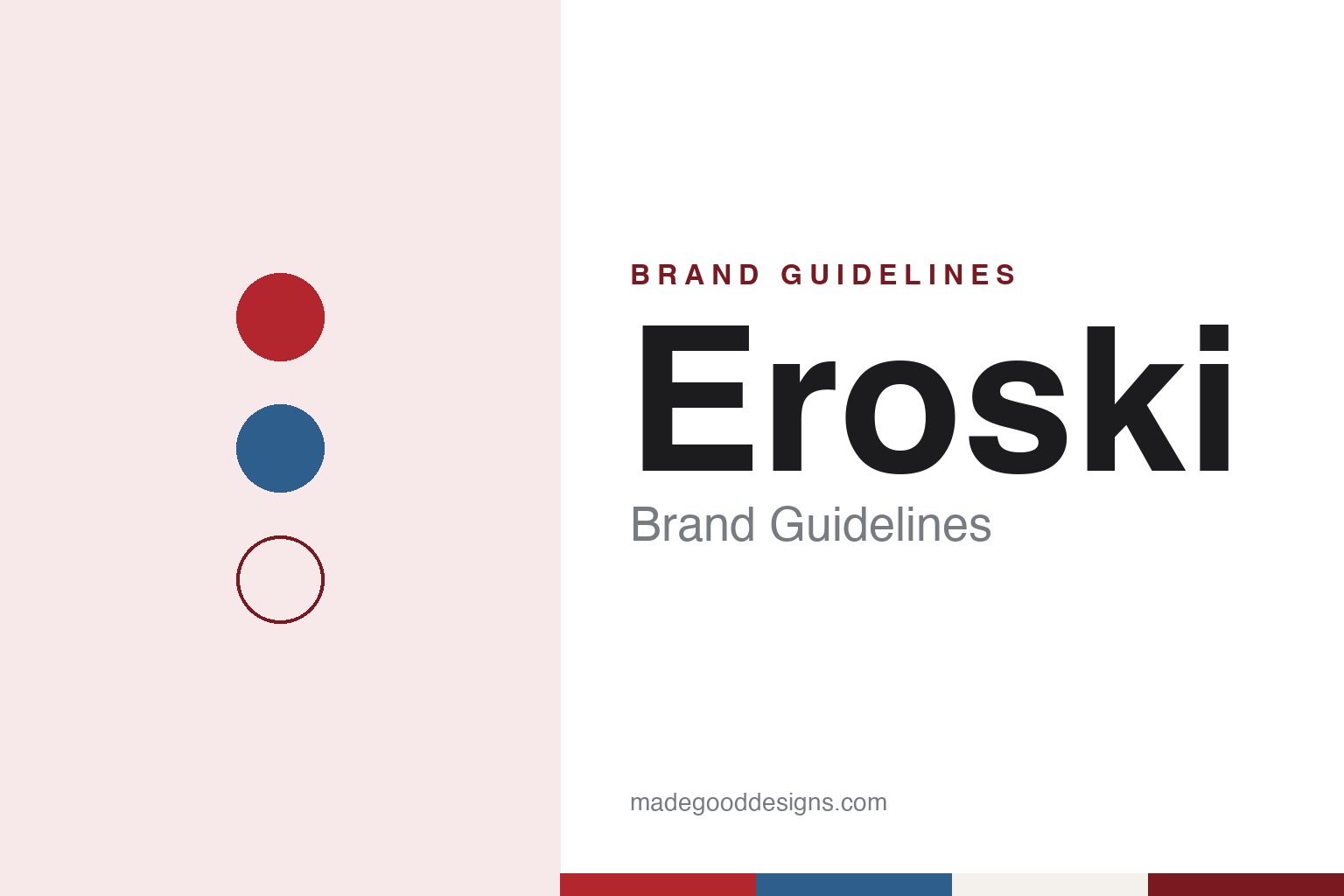
Eroski Brand Guidelines
A Basque cooperative that put plain white labels on Spanish shelves.
Aa
Two constants: a red, blue and white palette and a plain-label grotesque register. Abstract homage — not an Eroski product or mark; no logo, pack or store sign is reproduced.
Comerco
Small Basque consumer cooperatives joining forces.
Eroski began as a merger of small consumer cooperatives in the Basque provinces of Bizkaia and Gipuzkoa in 1969. The new organisation was first called Comerco; it changed its name to Eroski the following year, according to both the timeline of the Mondragon cooperative group and the International Directory of Company Histories entry on Grupo Eroski, published by Gale and carried by Encyclopedia.com. Sources give different numbers of founding cooperatives: Mondragon’s timeline says five, the Gale history and English Wikipedia say ten, and Spanish Wikipedia says seven.
The Gale history places the merger in a wider shift. By the end of the 1960s the Basque region had more than 40 cooperatives, among them a growing number of consumer cooperatives, and the arrival of self-service supermarkets and centralised buying made it hard for small shops to compete. Backed by the cooperative bank Caja Laboral, Eroski expanded across the region, opening supermarkets and taking in other cooperatives. During the economic crisis of the 1970s it adopted a hybrid structure in which both workers and consumers are members, the same source says, and Mondragon’s timeline also describes it as a cooperative combining worker members and consumer members.
The name is Basque. English and Spanish Wikipedia both explain it as a contraction of erosi, to buy, and toki, place, which Spanish Wikipedia renders as “a place to buy.” The head office is in Elorrio, in Bizkaia, and Eroski is part of the distribution division of the Mondragon Corporation.
Spanish Wikipedia sets out the governance: consumer members and worker members sit in equal numbers on Eroski’s governing council and general assembly, with one person, one vote, and the composition is renewed every four years. It also dates a project approved in 2009 that opened membership of the cooperative to all employees. In September 2026 Cinco Días reported that 8,300 of the group’s 28,200 workers were cooperative members.
Colour
White packs, black letters, and a name over every door.
Eroski’s clearest design story is its own label. In a December 2022 history of supermarket own brands in Spain, Vozpópuli reported that Eroski put its first own-label products on sale in 1977, inspired by the Swiss chain Migros. They were called “white label” goods because white was the dominant colour on the pack, and, the paper said, with little effort spent on design, each one named the product in large black letters. The first items chosen were basics: a detergent, biscuits, coffee and stock cubes. Spanish Wikipedia adds that six white-pack products started the range, and that the term marca blanca then spread to all retailer brands in Spain.
The labels have since multiplied into tiers. Spanish Wikipedia lists ranges including Eroski Basic, Eroski Natur for fresh meat, fish and fruit, and Eroski Seleqtia for selected foods, plus Belle for perfumery; Vozpópuli mentioned Eroski Bio and a vegan line, Eroski Veggie, being launched in 2022. Spanish Wikipedia notes that Eroski packs carry product information in Spanish, Basque, Catalan and Galician.
The store names followed a long route to one brand. According to the Gale history, after a 1997 merger with the Madrid group Unide, Galicia’s Vegonsa and the Balearic group Mercat, Eroski kept its own name for hypermarkets but used its partner Consum’s name for supermarkets and, from 1999, Consum’s Charter format for small city shops. When the Valencian cooperative Consum left the partnership at the start of 2004, taking about 450 stores and the Consum and Charter names, Eroski reorganised its network in April 2004: hypermarkets stayed Eroski, supermarkets became Eroski Center and small shops Eroski City. English Wikipedia says the change followed customers calling every shop “Eroski” whatever the sign said.
Spanish Wikipedia also records the cooperative’s consumer magazine, Eroski Consumer, dated to 1974, published in print and online.
Typography
Design and documentation.
Spain’s high-street chains present themselves through their stores as much as through their advertising. Shop windows, store interiors and the logo over the door are where the fashion groups show each change of identity, and they announce those changes in company statements that trade papers such as FashionUnited then report, describe and date.
Inditex runs its chains as separate store brands, each with its own name, logo and stores. Its group head office is in Arteixo, near A Coruña; Pull&Bear is run from Narón in the same province; Bershka, Massimo Dutti, Oysho and Lefties from the Tordera–Palafolls complex in Catalonia; and Stradivarius from Cerdanyola del Vallès, according to FashionUnited in February 2025. Between 2019 and 2023 the group gave Zara, Stradivarius, its own corporate identity, Pull&Bear and Bershka new logos in turn, and moved their stores towards bright, neutral interiors in which the clothes supply the colour; since then several chains have added warmer materials, zoned rooms and spaces for music and social media.
The perfumery and grocery chains in this series are covered in the same way: by the store formats, own-label ranges and logos they publish, described only as the companies or dated sources name them, and without claims about what their products do.
Ownership is part of each identity too. Marta Ortega Pérez became Inditex’s non-executive chair on 1 April 2022, FashionUnited reported in April 2023; other companies in this series are privately held or run as cooperatives. Each guide that follows takes its founders, owners and listings from corporate pages and dated press, and describes every owner only in its business role.
Aa
A plain, sturdy grotesque for white-label lettering. (Specimen set in Archivo, a sans STAND-IN; NOT the Eroski logo.)
Eroski
Caprabo, sales of hypermarkets and a smaller network.
The group grew by acquisition and then shrank to cut debt. English Wikipedia says Eroski bought the Catalan supermarket chain Caprabo in 2007; Spanish Wikipedia gives the stake as 74 per cent that year, rising to 99 per cent in 2012, and says Caprabo shops began replacing their own label with Eroski’s. The group also holds Familia in Asturias, Castile and León and Galicia, Aprop in the Balearic Islands, a half share in the Galician business Vegalsa, and the sportswear chain Forum Sport, according to Spanish Wikipedia.
Spanish Wikipedia records the disposals that followed: the sale of 36 hypermarkets and 22 petrol stations to Carrefour agreed in 2016, the sale of 103 If perfume shops and the If name to Douglas in 2017, and the sale of a further group of hypermarkets to Family Cash agreed in 2019, after which several regions lost their Eroski hypermarkets. Cinco Días reported in September 2026 that the cooperative had earlier reduced its business perimeter by selling stores to reduce debt, and was now refurbishing shops, 56 of them in the second quarter of its year.
As of September 2026, Cinco Días said, Eroski had 1,508 establishments, including hypermarkets, supermarkets, opticians, sports shops and cash & carry outlets, of which 41.77 per cent were franchised. Its network is concentrated on Spain’s northern Cantabrian coast and in the Balearic Islands, and the paper named Rosa Carabel as chief executive. English Wikipedia counted five Eroski stores in Gibraltar as of August 2024.
Eroski and Mercadona meet in the Basque Country: El Independiente reported in 2020 that Mercadona did not open there until October 2014, partly because of local operators led by Eroski.
For a design guide, Eroski shows how a cooperative can turn a plain white pack with black lettering into a lasting retail idea, and fold many shop names into one. Compare Mercadona, the Valencian own-label chain, and Carrefour. For this guide we use a cooperative red, a deep brick, a harbour blue and a warm white with a sturdy grotesque, an unofficial interpretation; no product or logo is reproduced.
Explore & save
Keep Eroski’s identity on hand — save it to a board in the Made Good inspiration library.
Eroski identity set
Pin the Eroski red, blue and white palette and the plain-label grotesque register to your own board.