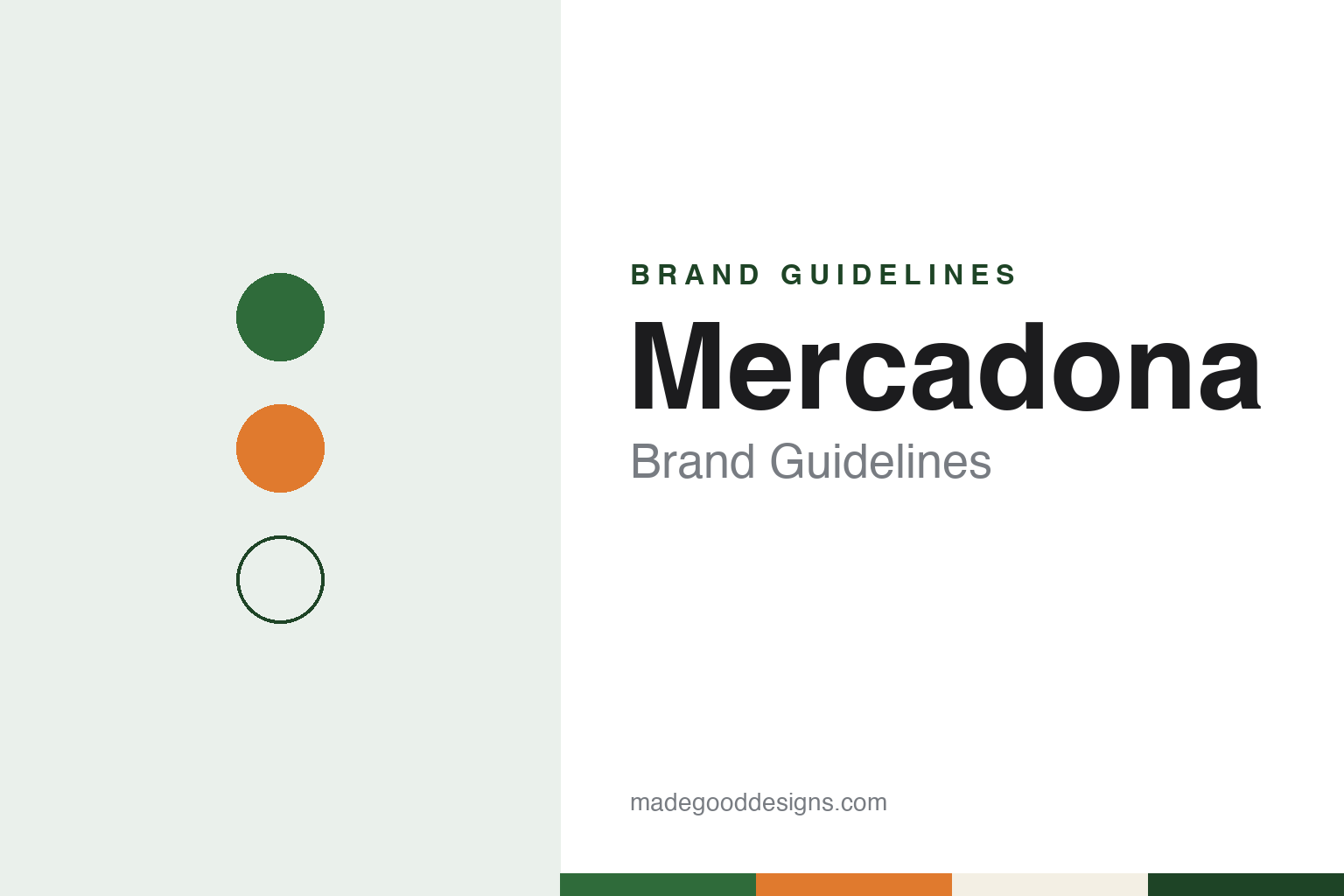
Mercadona Brand Guidelines
A Valencian grocer that built its shelves around its own labels.
Aa
Two constants: a green, orange and cream palette and a friendly grocer sans register. Abstract homage — not a Mercadona product or mark; no logo, pack or store sign is reproduced.
Cárnicas Roig
A meat business near Valencia that turned some of its shops into grocers.
Mercadona grew out of a family meat business on the edge of Valencia. Its founders were Francisco Roig Ballester and Trinidad Alfonso Mocholí, whose company, Cárnicas Roig, supplied meat to shops around the city. In a 2020 feature, El Independiente described it as a slaughterhouse that, over time, became a set of premises combining the cutting and storing of meat with counters selling to the public. The couple decided that grocery retail was worth pursuing in its own right, turned some of those premises into food shops, and opened them in 1977 under the new name Mercadona.
The place usually given for the first shop is Tavernes Blanques, a town just north of Valencia that, the same newspaper said, was known for its concentration of meat plants, among them the Roig family’s. English Wikipedia also gives Tavernes Blanques as the founding place. Spanish Wikipedia names Puebla de Farnals as the company’s origin and Albalat dels Sorells, also in the province of Valencia, as the seat of its head office.
The name itself has two stories. For years it was said to come from the Valencian words mercat de dona, a “women’s market.” El Independiente reported that Juan Roig, one of the founders’ sons, set that aside at a conference: the family had noticed an Italian pasta brand of the time called Mercadonna, dropped one “n,” and applied to register the name with the Spanish patent and trademark office on 15 March 1977. Spanish Wikipedia gives both versions.
In 1981 Juan Roig bought his parents’ company, which then had eight grocery shops in Valencia,, according to English and Spanish Wikipedia. He has led it since, and in 2026 he presented its annual results as president. Spanish Wikipedia lists the regional chains Mercadona bought as it grew: Superette in Valencia in 1988, Cesta in 1989 to reach Madrid, Dinos and Super Aguilar in 1991, and the Catalan chains Paquer, Superama and Vilaró in 1998.
Colour
Hacendado, Deliplus, Bosque Verde and Compy.
Mercadona’s visual world is carried less by advertising than by its own labels. Spanish Wikipedia says the company created Hacendado for food, Deliplus for cosmetics and personal care, Bosque Verde for household cleaning and Compy for pet products, and dates all four to 1996. Vozpópuli, in a 2022 history of supermarket own labels in Spain, also gave 1996 as the year Mercadona brought its own brands into its shops, and said the first product to carry the Hacendado name was a one-litre carton of whole milk.
The registry story is longer. El Independiente reported in 2020 that the Hacendado name had been entered in the official register in 1987, linked to a bottle of wine that never reached the shelves, and that the company first put it before the public in 1992, printed on a milk carton, the same year it says Deliplus and Bosque Verde appeared. The two newspapers therefore differ on the launch year, and both dates appear in print.
Spanish Wikipedia describes the system behind the labels: instead of negotiating with many suppliers, Mercadona works with long-term partner manufacturers it calls interproveedores, which make products sold under the supermarket’s names. El Independiente reported in 2020 that the company had updated that word to “totalers” for suppliers working for it on an exclusive basis.
That in-house vocabulary is part of the brand. The same 2020 article noted that staff at every level call the customer “el Jefe,” the boss, and that the warehouses which pick and send online orders are called colmenas, or hives. Spanish Wikipedia notes that criticism of the own-label model has come mainly from suppliers whose branded products were removed from the shelves.
For designers, the result is a supermarket where one family of names, each tied to a category, repeats across thousands of products, so that the own-label packaging does much of the work a logo campaign would do elsewhere.
Typography
Design and documentation.
Spain’s high-street chains present themselves through their stores as much as through their advertising. Shop windows, store interiors and the logo over the door are where the fashion groups show each change of identity, and they announce those changes in company statements that trade papers such as FashionUnited then report, describe and date.
Inditex runs its chains as separate store brands, each with its own name, logo and stores. Its group head office is in Arteixo, near A Coruña; Pull&Bear is run from Narón in the same province; Bershka, Massimo Dutti, Oysho and Lefties from the Tordera–Palafolls complex in Catalonia; and Stradivarius from Cerdanyola del Vallès, according to FashionUnited in February 2025. Between 2019 and 2023 the group gave Zara, Stradivarius, its own corporate identity, Pull&Bear and Bershka new logos in turn, and moved their stores towards bright, neutral interiors in which the clothes supply the colour; since then several chains have added warmer materials, zoned rooms and spaces for music and social media.
The perfumery and grocery chains in this series are covered in the same way: by the store formats, own-label ranges and logos they publish, described only as the companies or dated sources name them, and without claims about what their products do.
Ownership is part of each identity too. Marta Ortega Pérez became Inditex’s non-executive chair on 1 April 2022, FashionUnited reported in April 2023; other companies in this series are privately held or run as cooperatives. Each guide that follows takes its founders, owners and listings from corporate pages and dated press, and describes every owner only in its business role.
Aa
A friendly, rounded grocer sans. (Specimen set in Figtree, a sans STAND-IN; NOT the Mercadona logo.)
Mercadona
From Valencia to every province, then Portugal.
Mercadona spread across Spain slowly. El Independiente reported in 2020 that the company did not open in the Basque Country until October 2014, in Vitoria, in a region where local operators led by Eroski were strong; its first shop in Ceuta followed in September 2018 and one in Melilla three months later. The same article said that in 2004 the management committee decided to keep its Spanish shops closed on Sundays and public holidays, while staff in Portugal do work on Sundays.
Portugal is the one market outside Spain. Spanish Wikipedia dates the first Portuguese store to 2019; English Wikipedia counted 1,637 stores in Spain, covering all 52 provinces plus Ceuta and Melilla, and 39 in Portugal as of January 2026.
When the company presented its 2025 results in Paterna in March 2026, El Independiente reported that it had 1,672 supermarkets, having opened 43, closed 45 and refurbished 14 during 2025, and employed 107,500 people in Spain and 7,500 in Portugal. It ran six colmenas for online orders and was setting up a seventh in Madrid’s Vallecas district.
At the same presentation Juan Roig introduced a new store layout called “Tienda 9”. He described it, the newspaper said, as giving more space to fresh food and making shopping quicker and simpler, with all frozen products gathered in one zone. Spanish Wikipedia records an earlier full refit of the chain between 2017 and 2022, with more room for fresh produce. The company remains family-controlled: Spanish Wikipedia, citing 2016 data, says most of the capital is held by the Roig family.
For a design guide, Mercadona shows how a retailer can make its own-label names, rather than a single mascot or campaign, the most visible part of its identity. Compare Eroski, the Basque cooperative chain, and Carrefour, a French group with a large Spanish network. For this guide we use a market green, a deep leaf green, an orange and a cream with a rounded sans, an unofficial interpretation; no product or logo is reproduced.
Explore & save
Keep Mercadona’s identity on hand — save it to a board in the Made Good inspiration library.
Mercadona identity set
Pin the Mercadona green, orange and cream palette and the friendly grocer sans register to your own board.