Pick n Pay Brand Guidelines
Four Cape Town stores, a 1968 listing and the Boxer IPO.
Aa
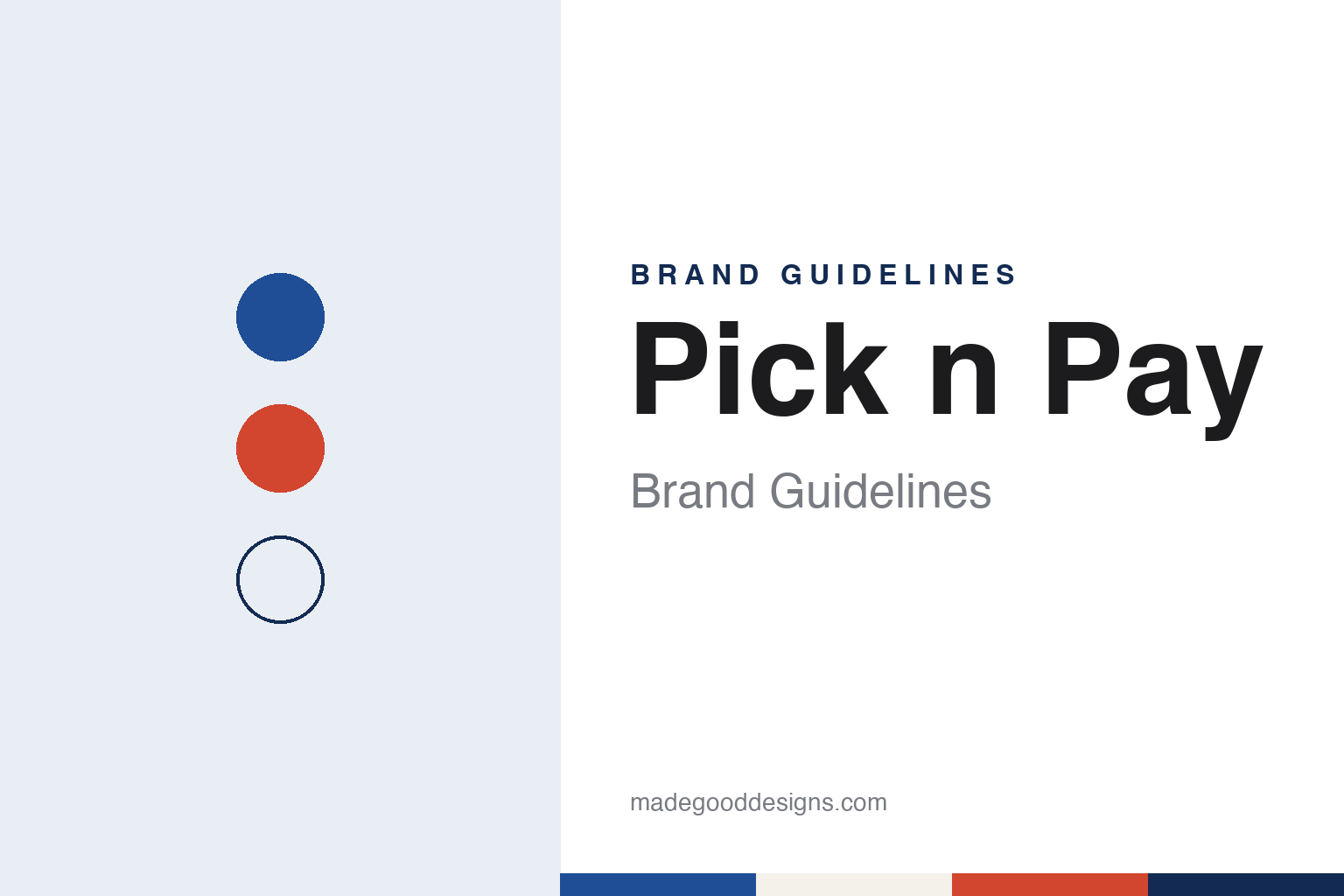
Two constants: a blue, cream and red palette and a rounded grocer sans register. Abstract homage — not a Pick n Pay product or mark; no logo, fascia or pack is reproduced.
Four small stores
A Checkers manager starts again in Cape Town.
Pick n Pay began in Cape Town with four small shops. The company says Raymond and Wendy Ackerman founded it in 1967 after buying four small stores in the city; English Wikipedia dates the purchase of those first four Pick n Pay stores, from the retailer Jack Goldin, to 1966.
Raymond Ackerman had run supermarkets before. The company says he joined Ackermans, the clothing chain his father had founded, as a trainee manager in 1951, and was put in charge of launching the Checkers supermarkets for the Greatermans group in 1955. English Wikipedia says that over nine years he took Checkers from 4 stores to 85 before leaving Greatermans in 1966. English Wikipedia notes that Checkers still trades in South Africa as a major competitor to Pick n Pay.
Growth came quickly. The company says Pick n Pay went public on the Johannesburg Stock Exchange in September 1968, and that its first hypermarket opened at Boksburg, east of Johannesburg, in 1975; English Wikipedia describes the format as a department store and supermarket under one roof. By the late 1980s, the company says, it had 12 hypermarkets and 81 supermarkets across South Africa.
Franchising followed in the 1990s. English Wikipedia says the first franchised Pick n Pay opened in Westville, KwaZulu-Natal, in 1993, with the first Western Cape franchise at Durbanville in 1994; that the group took a majority stake in the Score supermarket group in 1994; and that it acquired the discount chain Boxer Superstores in 2002. The Score stores were later converted into Pick n Pay or Boxer franchises.
Colour
A new mark in 2007 and a family of formats.
For four decades the Pick n Pay name was written with an apostrophe. When the retailer unveiled a new logo, new colours and a new brand line in November 2007, Sowetan still styled it “Pick ’n Pay.” The paper reported on 13 November 2007 that the identity was created by Landor, the UK-based brand consultancy, working with the South African advertising agency Young and Rubicam, and that it would be rolled out across a chain of more than 400 stores over the following two years. The same report quoted a local marketer who disliked the new mark. Today the company writes its name Pick n Pay, without the apostrophe, and uses the short form PnP.
The identity now has to stretch across many fascias. English Wikipedia lists Pick n Pay supermarkets, hypermarkets, Pick n Pay Clothing stores, liquor stores and the Pick n Pay Express forecourt shops, which it says trade at BP filling stations. It describes supermarkets of roughly 2,900 square metres on average and hypermarkets of about 13,000, and says some franchised stores trade under the QualiSave banner in lower- and middle-income areas. The first franchised Pick n Pay Clothing store opened in 2003, according to the same source.
Loyalty and online services carry the name too. English Wikipedia says the Smart Shopper loyalty programme launched in 2011, giving customers a card onto which cash back is loaded at the till, and that it is linked to partner schemes including BP. Online, the group sells through its own website, the asap! one-hour delivery service and the Mr D app. In March 2025, English Wikipedia says, Pick n Pay opened a 50,000-square-metre store at Westown Square in Shongweni, KwaZulu-Natal, with an expanded fresh section, an in-store bakery and a coffee bar.
Typography
How South African retailers present themselves.
South African retailers meet most of their customers in shopping centres, high streets and filling-station forecourts, so the store fascia does much of the identity work. A single group often runs several formats under related names, from large food halls and hypermarkets to small convenience shops and standalone clothing or liquor stores, and the name above the door usually tells the shopper which format they have walked into.
Own-label ranges carry the brand inside the store. Grocers and fashion chains sell food, clothing and homeware under their own names or under house labels, so the same letters, colours and type appear on shelf tickets, packaging, carrier bags and staff uniforms as well as on the shopfront. Loyalty cards and store cards extend that identity into wallets and phone apps.
Campaign graphics follow the retail calendar. Weekly specials, seasonal catalogues and back-to-school, holiday and sporting promotions are published in print, in store and online, and the companies’ own websites keep many of those leaflets and campaign pages available to browse. For a designer, these are the plainest record of how a chain uses its palette and type at speed.
The corporate side is just as public. Many of the large South African chains are listed on the JSE, and their investor websites publish annual reports, results presentations and history pages that name founders, parent groups, acquisitions and listing dates. Store counts and country lists in those reports are dated to a financial year, so they describe the business at that moment rather than for all time.
Aa
A rounded sans — the 2007 identity was created by Landor with Young and Rubicam. (Specimen set in Nunito Sans, a sans STAND-IN; NOT the Pick n Pay logo.)
Pick n Pay
Boxer goes to the JSE.
The biggest recent change came through Boxer. Business Report wrote on 12 November 2024 that Pick n Pay planned to list Boxer on the JSE on 28 November, with a secondary listing on A2X, as the second step of a two-step recapitalisation that had begun with a rights offer earlier in the year. The paper said Boxer had 489 stores at the end of August 2024, against 35 when Pick n Pay bought it in 2002, and that it had started out in smaller towns such as Mtubatuba, Nqutu, Ulundi and Burgersfort before moving into city centres and townships. Pick n Pay planned to keep a majority of about 60 to 65 percent.
Boxer listed on the JSE main board on 28 November 2024, under the share code BOX, Moneyweb reported the same day. About a third of Boxer’s issued shares were placed with investors, the exchange said. Boxer now has its own investor website.
The core supermarket business has been reshaped since. English Wikipedia says the group had no stores in Namibia from 1 July 2025, and that by May 2026 it had closed 56 stores across South Africa, 39 of them company-owned, as part of its turnaround. At the end of its 2026 financial year, the company says, the group operated 2,261 stores across six countries in southern Africa, covering food, grocery, clothing, liquor and general merchandise.
For a design guide, Pick n Pay shows how a grocer’s mark has to work across supermarkets, forecourt shops, clothing stores and a loyalty card at once, and how a discount sister brand can grow strong enough to stand on its own. Compare Shoprite, another South African grocer, and Woolworths, another Cape Town retailer with a large food business. For this guide we use a mid blue, a deep ink blue, cream and a market red with a rounded sans, an unofficial interpretation; no product or logo is reproduced.
Explore & save
Keep Pick n Pay’s identity on hand — save it to a board in the Made Good inspiration library.
Pick n Pay identity set
Pin the Pick n Pay blue, cream and red palette and the rounded grocer sans register to your own board.