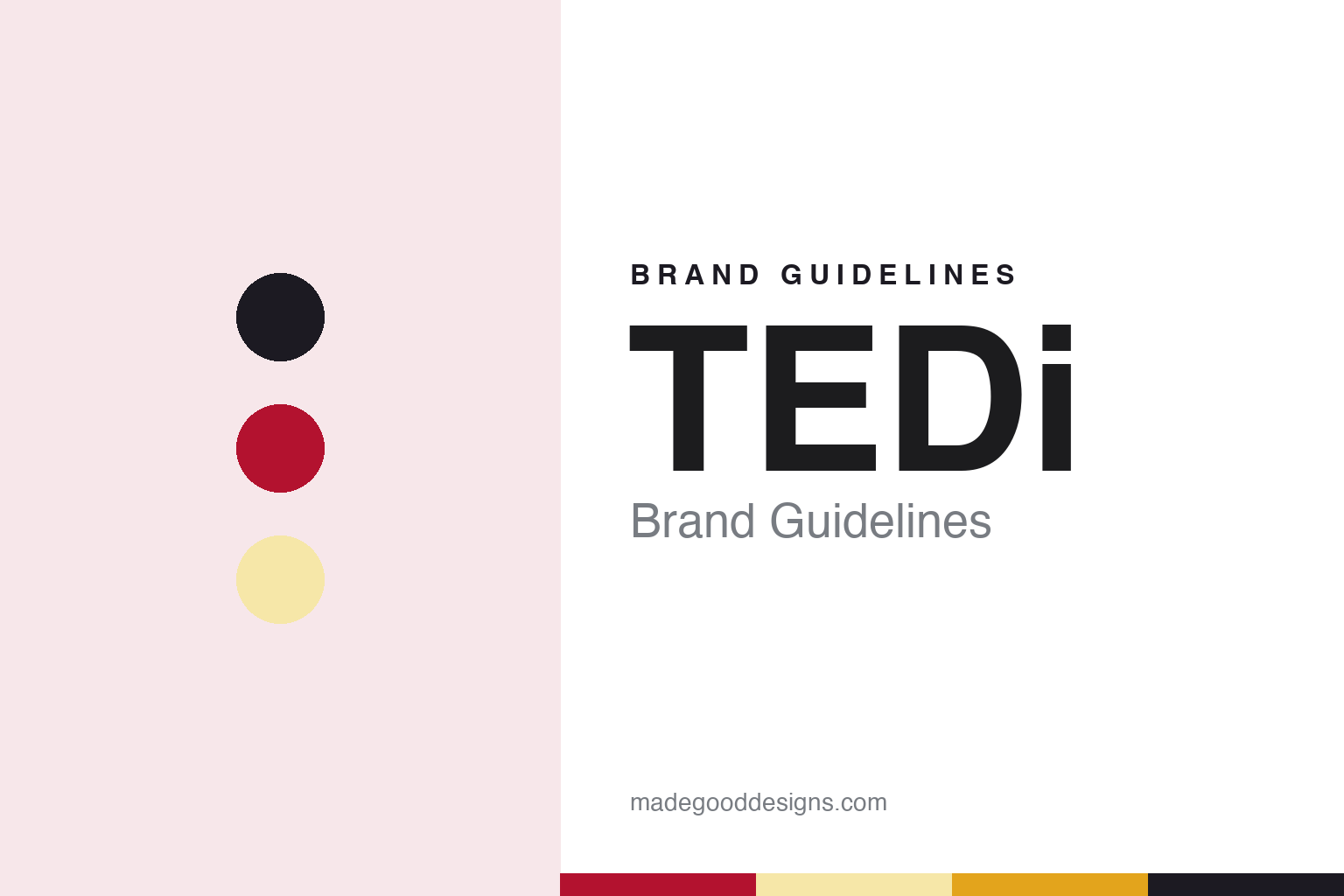
TEDi Brand Guidelines
Top Euro Discount: the Dortmund non-food store in 15 countries.
Aa
Two constants: a TEDi cherry red and sunflower palette and a Rounded sans register. Abstract homage — not a TEDi product or mark; no logo, mascot or fascia is reproduced.
Top Euro Discount
A Tengelmann idea from the KiK stable.
TEDi is a German non-food discount chain with its head office in Dortmund. Its name began as an abbreviation: German Wikipedia says the chain was first styled T€Di, short for Top Euro Discount, and that the retail group Tengelmann conceived it to bring the idea of the American one-dollar store to Germany. It was set up as an offshoot of KiK, the textile discounter in which Tengelmann then held a stake. English Wikipedia adds that the current branding has dropped the euro sign and simply reads TEDi.
The opening date depends on the source. German and English Wikipedia both date the first store to August 2003, in Hagen, and record that TEDi GmbH & Co. KG was entered in the commercial register on 25 September 2004. The company’s own history page gives 2004 as the year it introduced its trading concept and opened its first store, and its company page says it was “founded in Dortmund in 2004.” It says it closed that first year with about 120 branches across Germany, adding two stores a week on average.
Growth was quick by the company’s own count: the 250th store opened in August 2005, the 400th in July 2006 — the year it introduced its mascot, the TEDi bear — and the 500th in May 2007, a date German Wikipedia also gives. The company says it had more than 650 stores and about 6,000 employees by 2008. In May 2010 the 1,000th store opened in Moordorf, in East Frisia, a milestone recorded both by the company and by German Wikipedia.
The business is run from a large site in Dortmund-Brackel. The company says its administration and logistics there cover about 125,000 square metres, that a second warehouse of 17,000 square metres was finished by the end of 2010, and that it moved into a further distribution warehouse at Kamen, in Westphalia, in 2021.
Colour
Fifteen countries and a store refit.
TEDi went abroad in May 2011, with a store in Graz, Austria. Slovenia followed in June 2012 with a store in Murska Sobota, then Slovakia in 2013 and Spain in 2015, according to German Wikipedia; the company adds Croatia in 2017, Italy and Poland in 2018 and the Czech Republic in 2020. When the European Commission reviewed a change of ownership in March 2021, its decision listed TEDi as trading in nine countries. The company’s history then records Hungary, with a store in Pápa, in August 2021; Romania, at Baia Mare, in March 2022; and Portugal, at Guimarães, in November 2022. In 2023, it says, it opened its 3,000th store, in Dortmund, and entered Bulgaria, France and Belgium, taking it to 15 countries. Its company page now gives a figure of about 3,700 branches.
The range is wide rather than deep. German Wikipedia describes household, party, DIY and electrical goods, stationery and toys, and drugstore and cosmetics products, with seasonal lines on top; English Wikipedia says a store carries between 3,000 and 11,000 products, depending on its size. German Wikipedia also says stores are placed for passing trade, many of them in shopping centres and small-town high streets, often next to other large chains.
The look of the stores changed over the 2010s. The company says that in its tenth year, 2014, it began renovating every branch, with imitation wood flooring, a reworked product presentation and LED ceiling lighting; it counts about a fifth of shops converted by May 2015, a third in 2016 and half by 2017, and says it refined the concept again in 2018. German Wikipedia dates the programme from 2013 to 2018. TEDi aired its first television advertising in October 2017, four short films for German television plus an online spot, German Wikipedia says.
Online selling has come and gone. German Wikipedia records a first web shop from 2013 to March 2019, an eBay shop from the summer of 2020 and a new own shop at the end of that year, closed on 30 April 2022; both times the company said its strength lay in physical stores. Two side projects ended quickly: the budget format Black.de, with around 50 stores in 2016, was wound up a year later and its stores converted to TEDi, and in January 2018 TEDi took over 63 German stores of the Dutch chain Xenos, with their staff, German Wikipedia says.
Typography
Design and documentation.
Discount and variety retailers tend to put their offer into the name itself. Some chains take a price as their name, as Poundland did in 1990 and 99p Stores did after it; others use initials, a family name or a short invented word. When a chain built on a single price begins to sell items above it, the name stays on the fascia while the range changes behind it, and advertising rules can then limit what the shop is allowed to say about its prices.
The fascia carries most of the identity. A shop sign on a high street or retail park usually pairs the name with a short strapline, such as B&M’s “Big Brands, Big Savings,” described by The Grocer in 2020. Inside, the same name and colours tend to repeat on aisle headers, shelf tickets, seasonal end displays and carrier bags, so that a shopper sees one consistent mark from the car park to the till.
Own-label naming is a quieter part of the system. Variety chains often sell well-known brands alongside goods under their own labels, and some suppliers prefer their products to appear under a retailer’s name rather than their own. Formats are named in the same plain way: a home store, a local convenience shop, an express branch, each a variation on the parent name rather than a separate brand.
The corporate side is published separately. Listed or formerly listed chains keep investor pages with dated histories of founders, owners, acquisitions and listings, and those pages, read alongside independent press, are a dependable guide to who owns a fascia at any given time. In this sector ownership changes often, through buyouts, listings, sales and administrations, and the guides in this series give those changes with their dates.
Aa
A rounded, friendly sans for a name built from initials. (Specimen set in Rubik, a sans STAND-IN; NOT the TEDi logo.)
TEDi
A Dortmund owner since 2021.
TEDi’s ownership was settled in 2021. A European Commission decision of 24 March 2021 cleared B.H. Holding GmbH of Dortmund to take sole control of TEDi, which until then it had controlled jointly with Tengelmann; the Commission raised no objections, and its decision notes that the same holding also owned the Woolworth chain in Germany, then with more than 400 stores. FashionUnited reported on 4 May 2021 that the exchange had closed: Tengelmann had bought the H.H. group’s shares in KiK at the start of January and sold its minority stake in TEDi on 30 April, so that KiK belonged wholly to Tengelmann and TEDi became “part of the H.H. Unternehmensgruppe.” The prices were not disclosed. German Wikipedia puts Tengelmann’s former stake at 30 percent.
Expansion continued at home. FashionUnited reported in December 2024 that TEDi had agreed to take over 84 stores of Pfennigpfeiffer, a non-food discounter founded in 1990 and based in Landsberg, in Saxony-Anhalt, with branches across Bavaria, Berlin and eastern Germany; TEDi said all of the staff would be taken on. In March 2025 the same publication reported, citing TEDi, that the Bundeskartellamt, Germany’s competition authority, had approved the deal, and that the stores would first keep trading as Pfennigpfeiffer before being converted to the TEDi format step by step. In April 2025, German Wikipedia says, TEDi opened a store of about 3,000 square metres of selling space in Flensburg.
For a design guide, TEDi shows how a name built from initials can lose its currency sign and keep its letters, with a bear mascot doing the friendly work. Compare Pepco, another European variety chain growing across the continent, and Dollar Tree, the American single-price model TEDi was built to echo. For this guide we use a cherry red, a sunflower yellow and an ink with a rounded sans, an unofficial interpretation; no product or logo is reproduced.
Explore & save
Keep TEDi’s identity on hand — save it to a board in the Made Good inspiration library.
TEDi identity set
Pin the TEDi cherry red and sunflower palette and the Rounded sans register to your own board.