Dollarama Brand Guidelines
A 1992 Matane store, green-and-yellow signs and a Rossy family chain.
Aa
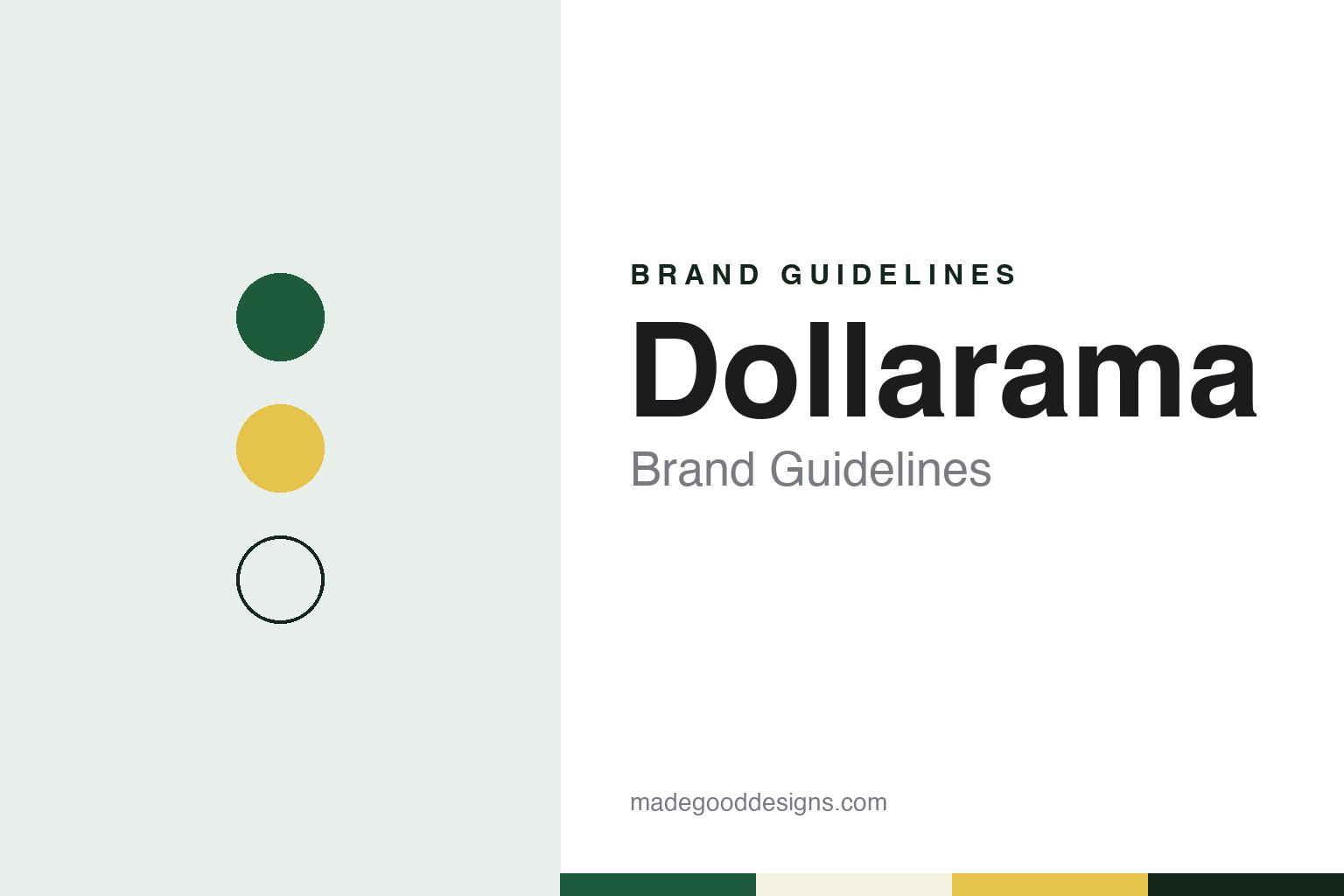
Two constants: a Dollarama green and yellow palette and a plain retail sans register. Abstract homage — not a Dollarama product or mark; no sign, logo or packaging is reproduced.
S. Rossy
Three generations of variety stores before the first Dollarama.
Dollarama grew out of a much older Montreal business. According to a profile by John Daly in The Globe and Mail’s Report on Business magazine in March 2012, Salim Rossy arrived in Montreal from Lebanon in the early 1900s and worked as a peddler before opening the first of several S. Rossy Inc. general stores on Craig Street, near the waterfront, in 1910. His son George Rossy became president in 1937 and turned the shops towards the five-and-dime model, the Globe reported; Dollarama’s own history page says he ran the company until 1973, when it had 20 stores.
George’s son Larry Rossy then took charge. By the late 1980s he had built the chain to 44 outlets, broad general variety stores selling low-priced goods, the Globe reported. English Wikipedia says the shops operated under the corporate name S. Rossy Inc. but traded simply as Rossy. As American five-and-dime chains moved up-market, Rossy chose to narrow his offer to a single low price, the Globe said, starting with dollar sections inside the Rossy stores.
In 1992 a friend suggested an all-dollar store in Matane, a fishing town in the Gaspé, on the grounds that nobody would notice if it failed. The first Dollarama there was a small shop of about 2,000 square feet, and a second soon followed in nearby Mont-Joli, the Globe reported. The company dates that first store to April 1992 and says the first Dollarama outside Quebec opened the same year in Grand Falls, New Brunswick, followed by Ontario in 1994. English Wikipedia places the Matane store in the Les Promenades du St-Laurent shopping centre and says the remaining Rossy stores were closed or converted to Dollarama by about 2000.
Growth came one store at a time. By 2001 there were more than 200 outlets, about three quarters of them in Quebec, the Globe reported, and the company says it added 60 Ontario locations that year after another chain went bankrupt.
Colour
Direct sourcing, a fixed layout and bright signs.
The Globe profile credits much of Dollarama’s model to an early decision to buy directly from manufacturers rather than through wholesalers, which let the chain keep a consistent range at its single price. Larry Rossy told the magazine the company had been importing from China since 1992. In 2012 he described a basement “store” at the Montreal head office, used as an archive of samples bought on buying trips, holding most of the roughly 4,000 items a typical Dollarama stocked; the company aimed to change about a quarter of its range each year.
The same article set out a store plan that reads like a design system. Seasonal goods such as wrapping paper, cards and party plates sat to the right of the entrance; kitchen utensils lined the far left wall; snacks and drinks filled the middle aisles in front of the tills; and larger everyday items such as paper towels, food and small hardware were further back. Most stores were about 10,000 square feet. The writer described Dollarama’s “glaring bright green and yellow signs” as being as common in many Canadian cities as Tim Hortons.
The single price did not last. The Globe reported that rising costs led Dollarama to add three higher price points in 2009, and the company’s history lists further steps in 2012, 2015 and 2022, when it set its ceiling at five dollars. Payment changed too: English Wikipedia says the stores took cash only until Interac debit arrived in 2008, gift cards followed in 2011 and credit cards were accepted across the chain by 2018. An online shop selling selected items by the case opened in January 2019, according to the company and English Wikipedia.
The company says all of its stores are corporately owned and operated, in cities and small towns alike, and describes its range as general merchandise, consumables and seasonal goods.
Typography
How discount and variety retailers present themselves.
Discount and variety retailers tend to put their offer into the name itself. Some chains take a price as their name, as Poundland did in 1990 and 99p Stores did after it; others use initials, a family name or a short invented word. When a chain built on a single price begins to sell items above it, the name stays on the fascia while the range changes behind it, and advertising rules can then limit what the shop is allowed to say about its prices.
The fascia carries most of the identity. A shop sign on a high street or retail park usually pairs the name with a short strapline, such as B&M’s “Big Brands, Big Savings,” described by The Grocer in 2020. Inside, the same name and colours tend to repeat on aisle headers, shelf tickets, seasonal end displays and carrier bags, so that a shopper sees one consistent mark from the car park to the till.
Own-label naming is a quieter part of the system. Variety chains often sell well-known brands alongside goods under their own labels, and some suppliers prefer their products to appear under a retailer’s name rather than their own. Formats are named in the same plain way: a home store, a local convenience shop, an express branch, each a variation on the parent name rather than a separate brand.
The corporate side is published separately. Listed or formerly listed chains keep investor pages with dated histories of founders, owners, acquisitions and listings, and those pages, read alongside independent press, are a dependable guide to who owns a fascia at any given time. In this sector ownership changes often, through buyouts, listings, sales and administrations, and the guides in this series give those changes with their dates.
Aa
A plain, heavy retail sans in the spirit of shopfront lettering. (Specimen set in Archivo, a sans STAND-IN; NOT the Dollarama logo.)
Dollarama Inc.
Private equity, a Toronto listing and stores on three continents.
In 2004, with about 335 stores, Larry Rossy sold an 80% stake to funds controlled by Bain Capital, the Globe reported; the company’s own history gives nearly 350 stores across six provinces. Bain kept Rossy as chief executive and his son Neil Rossy as chief merchandising officer, according to the Globe, and the chain reached every Canadian province by 2006 and moved its head office to the Town of Mount Royal, beside Montreal, in 2007, the company says.
Dollarama went public in October 2009, and its shares trade on the Toronto Stock Exchange under the symbol “DOL.” Bain sold out in stages, the Globe reported, selling its last stake in June 2011. The company says it opened its 700th store in 2012 and its 1,000th in 2015. In 2016 Neil Rossy became president and chief executive, with Larry Rossy as executive chairman until 2018, when he was named chairman emeritus, according to the company.
The business then looked abroad. In 2013 Dollarama signed an agreement to share expertise and sourcing with Dollarcity, a chain then based in El Salvador and Guatemala; English Wikipedia and the company say Dollarama took a 50.1% stake in 2019 and raised it to 60.1% in 2024, and that Dollarcity entered Peru in 2021. In Australia, Dollarama’s acquisition of the discount chain The Reject Shop was completed by scheme of arrangement in July 2025, Inside Retail Australia reported on 22 July 2025, after which The Reject Shop asked to leave the Australian Securities Exchange. The company now says it has more than 2,700 locations in seven countries on three continents.
For a design guide, Dollarama shows how a family variety chain can turn one price and one store plan into a national format, with signs bright enough to be noticed by a business magazine. Compare Dollar Tree, the American chain that the Globe noted had entered Canada in 2010, and Family Dollar. For this guide we use a shopfront green, a sign yellow and a cream with a sans, an unofficial interpretation; no product or logo is reproduced.
Explore & save
Keep Dollarama’s identity on hand — save it to a board in the Made Good inspiration library.
Dollarama identity set
Pin the Dollarama green and yellow palette and the plain retail sans register to your own board.