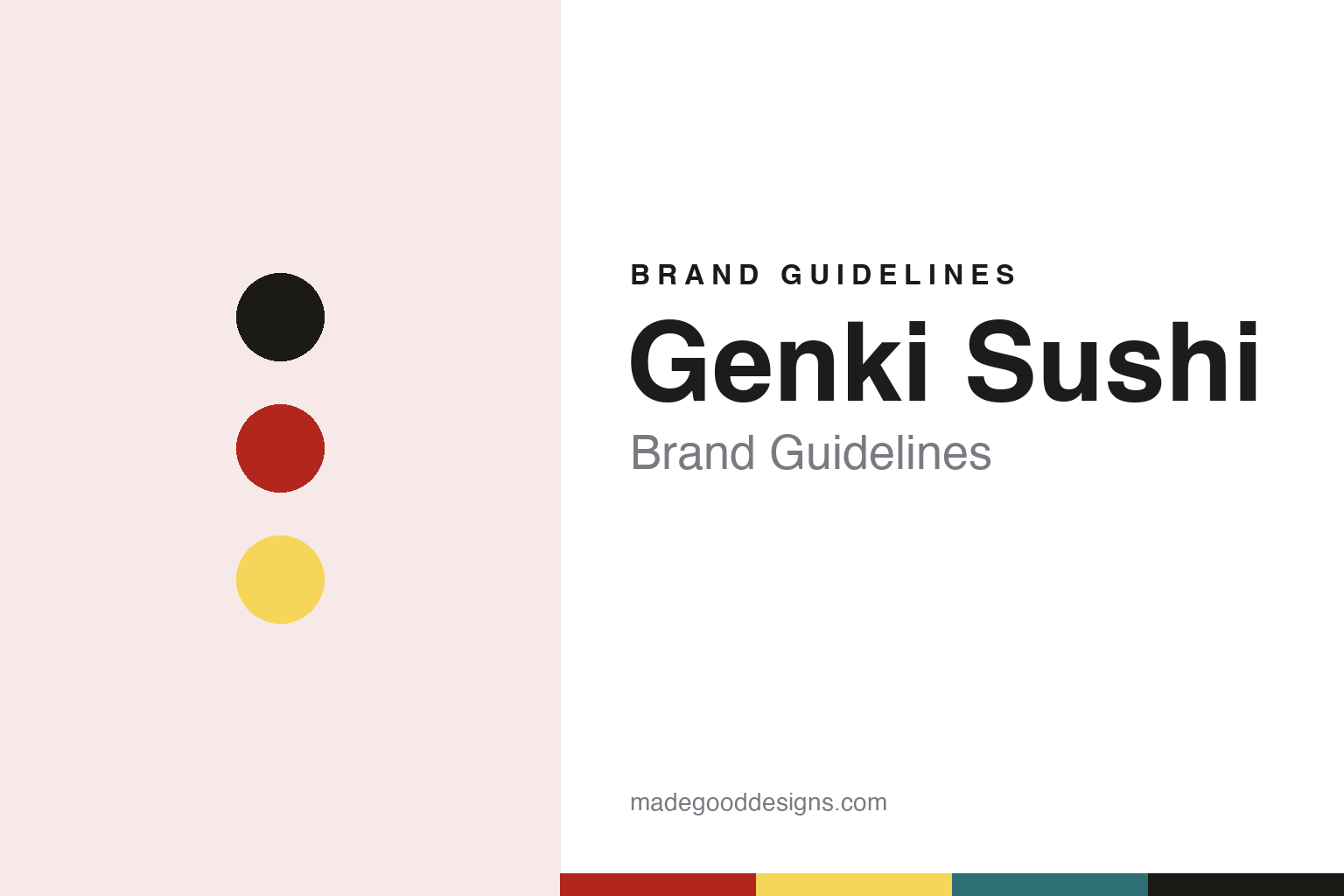
Genki Sushi Brand Guidelines
A 1968 Utsunomiya sushi counter, renamed in 1990 and grown abroad.
Aa
Two constants: a Genki Sushi yellow and red palette and a Rounded sans register. Abstract homage — not a Genki Sushi product or mark; no sign, logo or character is reproduced.
From Genroku to Genki
A station-front counter in Utsunomiya.
Genki Sushi began as somebody else’s sign. In December 1968 its first shop opened in front of Tobu Utsunomiya station, in Tochigi prefecture north of Tokyo, as a franchisee of Genroku Sushi, the Osaka conveyor-belt chain, according to the company’s own history and a two-part report by Toyo Keizai Online in September 2025. Japanese Wikipedia names the founder as Fumio Saito. A second, suburban shop followed at Ozo in 1975, and in July 1979 the business was incorporated in Utsunomiya as Genroku Shoji; it became Genroku KK in 1984 after signing a trademark agreement with the regional Genroku franchisor.
The Genki name arrived with independence. In February 1990 the company ended its Genroku trademark contract, and in March 1990 it renamed itself Genki Sushi and began trading under the new mark, the company says. Japanese Wikipedia adds that a new symbol came with the name: a yellow sign showing a child’s face with red cheeks. The shares were registered for over-the-counter trading in 1991, listed on the Tokyo Stock Exchange’s second section in 1997 and moved to the first section in 2002.
The 1990s were the chain’s busiest decade at home. Toyo Keizai reported that it added around fifteen shops a year after 1990, passed 100 shops in 1995 and reached 120 to 130 in the late 1990s. Those were small shops near stations, built around a central kitchen ringed by a U-shaped counter. As larger rivals opened roadside restaurants with family tables and uniform low pricing, the format lost ground; by the time of the 2008 downturn the Genki Sushi estate had fallen to about 60 shops, the magazine reported.
The company answered with new names. It opened Sushi Ondo, a flat-price format, in 1999, the upmarket Senryo the same year, and Uobei in Kawagoe in 2009. In 2011, when many of its stores in the north Kanto and Tohoku regions had to save power, it trialled taking every order by touch panel with the belt switched off; customers took to it, Toyo Keizai reported, and in July 2012 the first order-only Uobei opened at Dogenzaka in Shibuya, with two-tier express lanes carrying plates from kitchen to table. From around 2010 no new Genki Sushi shops opened in Japan; by the end of September 2025 eight remained, according to the same report.
Colour
Hawaii first, then Asia.
Abroad, the story ran the other way. The company set up a wholly owned subsidiary, Genki Sushi Hawaii, in May 1992, and the first Hawaii shop opened in September 1993, the company says. A company representative told Toyo Keizai that the founder saw Hawaii as a step toward the American mainland, and the conveyor format looked new to local diners. The paper notes that Kura Sushi first went overseas in 2009, Sushiro in 2011 and Hama Sushi in 2014, so Genki Sushi had a long head start.
Growth outside Japan came largely through franchise partners. The company history lists a franchise agreement with a Singapore partner for Asia and Oceania in 1993, a first Singapore shop in 1994 and a first Hong Kong shop in March 1995; Malaysia and Taiwan followed. Some of those agreements ran out and were later replaced: the original Singapore and Malaysia contracts ended in 2008, and the company re-entered Singapore in 2011 and Malaysia in 2018. In 2005 it signed a franchise for six Middle East countries, and a Kuwait shop opened in 2007. English Wikipedia says the Hong Kong restaurants are run by Maxim’s Caterers.
The United States mainland came next. A first shop opened in Washington state in December 2008 and in California in February 2012; Indonesia followed in 2009, mainland China in 2010, the Philippines in 2015, Cambodia in 2016, Australia in 2017, Myanmar in 2018 and Vietnam in 2025, according to the company’s timeline. It passed 100 overseas shops in September 2013 and 200 in January 2020. Toyo Keizai counted more than 240 overseas shops at the end of September 2025, against fewer than 200 across all of the group’s brands in Japan.
The overseas shops changed format too. The company introduced an express lane and touch panels at its Ala Moana shop in Hawaii in July 2013, and from the mid-2010s its overseas Genki Sushi restaurants moved to the same non-rotating style as Uobei, a company representative told Toyo Keizai, with plates delivered on model bullet trains. Menus follow local tastes: the magazine mentions poke-style gunkan and spicy tuna in Hawaii and seared salmon with sauces in Southeast Asia.
Typography
Japan’s fast-food and sushi chains.
Japan’s fast-food and conveyor-sushi chains present themselves first through the shop itself. A beef-bowl shop is often a single counter with stools, a curry or noodle shop a short line from order to tray, a sushi restaurant a lane of plates running past the tables. Many chains also run suburban roadside stores with car parks, table seating and drive-throughs, and units in station buildings and shopping-centre food courts, so the same name has to work on a tall roadside sign and on a narrow arcade front.
Ordering is part of the look. Many shops ask customers to buy a ticket from a machine before they sit down, and the machine’s screen, buttons and photographs become a menu in their own right; newer stores add self-checkout and mobile ordering. Conveyor-sushi chains add a piece of equipment of their own: the lane that carries plates past the seats.
Naming is usually plain. Signboards tend to state the dish as well as the name, and menus describe a bowl by what is on it, such as cheese, grated radish, kimchi or spring onion and egg, often in sizes from small to extra large. Some chains keep a word of their own for a familiar dish, and many publish their menus in English and Chinese for visitors.
Behind the shop front sits a listed company. Most of the large chains belong to parent groups listed on the Tokyo Stock Exchange that run several formats under separate names, and their corporate sites publish company histories, store counts and overseas subsidiaries year by year. Those pages, read alongside Japanese and English press, are the clearest record of when a chain opened its first store, when it went abroad and who owns it now.
Aa
A rounded sans — friendly, like the 1990 shop sign. (Specimen set in M PLUS Rounded 1c, a sans STAND-IN; NOT the Genki Sushi logo.)
Genki Global Dining Concepts
One owner, two sushi names.
Ownership settled in the 2010s. The rice wholesaler Shinmei took a stake in May 2012, and after a friendly tender offer Genki Sushi became a subsidiary of Shinmei Holdings in June 2015, the company says; Japanese Wikipedia gives Shinmei’s holding as about 41 percent in March 2026. A business tie-up with Kappa Create, agreed in 2013, was ended in 2014, and a capital tie-up with the Sushiro group lasted from 2017 to 2019. In August 2024 the company changed its name to Genki Global Dining Concepts and opened a Tokyo head office; it moved its registered office to Tokyo that December and opened a second head office in Utsunomiya in 2025. Its shares trade on the Tokyo Stock Exchange’s Standard market.
The group has kept adding brands and businesses. In April 2026 it made Food Odyssey, which runs the Sushi Sushi chain of about 180 shops in Australia, a subsidiary, the company says, and in January 2026 it opened its first Osaka-style yakiniku restaurant under the name Uma Katsu, in Tochigi.
The split between names became a problem of its own. Inside Japan the group trades mainly as Uobei; outside it, as Genki Sushi; visitors to Japan who knew Genki Sushi at home rarely realised that Uobei was the same company, Toyo Keizai reported. The answer, opened on 10 October 2025 a short walk from JR Ueno station, was a combined shop signed “GENKI SUSHI × Uobei,” mixing the domestic menu with dishes popular in the group’s overseas markets. In December 2025 the company introduced two mascot characters, Genki-kun and Tekka-maru.
For a design guide, Genki Sushi shows how a chain’s name can fade at home and grow abroad, and how a cheerful 1990 shop sign has outlived the counters it was made for. Compare Sushiro and Kura Sushi, two of the chains that went abroad later. For this guide we use sign yellow, cheek red, sea teal and ink with a rounded sans, an unofficial interpretation; no product or logo is reproduced.
Explore & save
Keep Genki Sushi’s identity on hand — save it to a board in the Made Good inspiration library.
Genki Sushi identity set
Pin the Genki Sushi yellow and red palette and the Rounded sans register to your own board.