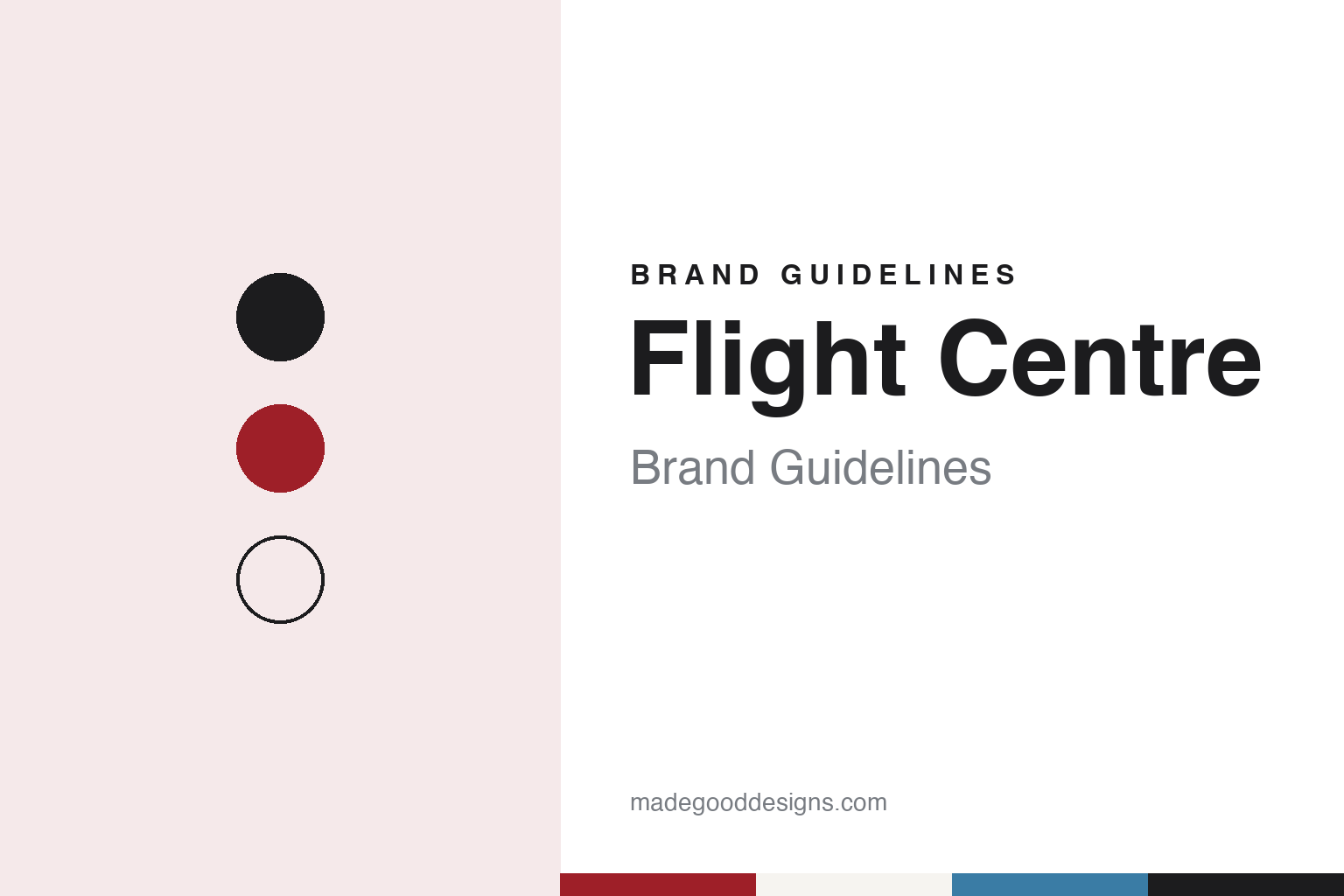
Flight Centre Brand Guidelines
A Top Deck bus, a 1982 shop and a pilot called the Captain.
Aa
Two constants: a red, ink and sky-blue palette and a shopfront sans register. Abstract homage — not a Flight Centre asset; no logo, character or advertisement is reproduced.
From Top Deck to Flight Centre
A double-decker bus, then a discount ticket shop.
Flight Centre grew out of a bus company. Graham Turner, known inside the business as “Skroo,” started Top Deck Travel in London with one double-decker bus in 1973, and by 1980 it ran more than 70 buses on tours around Europe, the investment writer Lawrence Lam reported in an interview with Turner for Firstlinks in February 2024. The buses were fitted with a kitchen and sleeping space for long overland trips, and the first advertisements went into a weekly London travel paper read by Australians and New Zealanders, Firstlinks said. The group’s own 40th-anniversary history says the first tour, with a friend, went through Spain, Portugal and Morocco.
The business that became Flight Centre opened in 1982. English Wikipedia names Graham Turner and Geoff Harris as co-founders and says it began with a store in Sydney; Firstlinks says the first stores, in Brisbane, Sydney and Melbourne, were opened as joint ventures to keep the cash needed low. The idea came from London’s discount air-ticket sellers, known there as “bucket shops,” which Turner had seen at work. Airfare discounting was restricted in Australia at the time and the rules changed a few years later, Firstlinks reported; Turner recalled promotions chalked deliberately messily on shopfront blackboards to draw bargain hunters.
The company history says Flight Centre listed on the Australian Securities Exchange in 1995, and that its own staff bought more than a quarter of the shares on offer. In the same decade it moved abroad: its first South African store opened in Johannesburg in December 1994, and Flight Centre UK and Flight Centre Canada opened in 1995, English Wikipedia says. The group has kept its headquarters in Brisbane, Queensland.
Colour
A pilot, a shopfront and a family of brands.
The name says what the first shops sold: flights. Over four decades the company added holidays, cruises, foreign exchange and business travel, mostly under other names. In 2026 its corporate site says Flight Centre Travel Group has company-owned leisure and corporate travel businesses in 24 countries and licenses its name in a further 90, and that it runs more than 30 brands. Those named on the site include Corporate Traveller, FCM, Travel Associates and the online agency Aunt Betty. In the United States it trades through Liberty Travel and GOGO Worldwide Vacations, which the company history says it bought at the end of 2007; English Wikipedia lists the student travel site StudentUniverse, bought in December 2015, and the tailor-made holiday company Scott Dunn, bought in January 2023, among later additions.
The most recognisable figure in Flight Centre advertising is the Captain, a uniformed airline-pilot character. The company history dates his first appearance to the late 1980s, alongside the slogan “Lowest Airfares Guaranteed.” In April 2021 the trade title B&T reported a new global campaign, “There’s Nowhere We Haven’t Been,” made by Flight Centre Australia’s in-house creative team and run in Australia, New Zealand, the UK, Canada and South Africa. Instead of an actor, it cast an employee with 19 years at the company as the main captain, beside a crew of co-captains who were also staff, chosen to represent each country the brand works in.
The same campaign changed the tagline to “Experience our experience,” a line meant to point at the combined knowledge of the agents, B&T reported, quoting the company’s global head of brand. A microsite built with Flip Creative let visitors find out “what type of captain” they were, and the brand opened a worldwide TikTok account with videos made by its own staff. The shop still matters to the identity in a way it does not for online-only agencies: the general manager in Australia told B&T that customers could reach the brand “in-store, over the phone, online and across social media.” The company history also describes the airfare and holiday expos it began running at the Brisbane Convention Centre in the mid-1990s and later took across Australia and New Zealand.
Typography
How travel agencies present themselves.
Package-holiday operators and travel agencies sell something the customer cannot see before the trip, so the brand has to stand in for the holiday. In the shop era that meant printed brochures and the windows of high-street shops, filled with resort photographs and destination names. Online agencies moved the same job to booking pages, where search boxes, hotel photographs and a single package price do the work the brochure once did.
Television has been a second shop window. On the Beach aired its first TV advert in December 2013, a campaign filmed on Fuerteventura, according to English Wikipedia; loveholidays’ chief executive told City A.M. in 2024 that his company did not spend on TV advertising and leaned on social media and brand partnerships instead. Both approaches show the holiday rather than the company: sea, sand, pools and city streets.
Naming in the sector tends to be plain. Some brands describe the product or the destination, some carry a founder’s surname, and some are built to read as a web address. Holiday ranges and sub-brands are usually named for the kind of trip they sell, such as beach, city break, long haul or cruise, so a customer can tell them apart at a glance.
Corporate pages tell a different story from the booking pages: who founded the company and where, which investors have owned it, when it listed or was sold, and, for some firms in this set, when the business collapsed or was absorbed into another group. This guide sets out what dated sources record about each brand, and marks what rests only on the company’s own word.
Aa
A sturdy, plain sans for window cards and fare boards. (Specimen set in Archivo, a sans STAND-IN; NOT the Flight Centre logo.)
Flight Centre
A High Court case and a hard 2020.
The company’s record includes a competition case. Between 2005 and 2009 Flight Centre approached Singapore Airlines, Malaysia Airlines and Emirates, asking them to stop selling fares on their own websites below those available to travel agents, and threatened to stop selling their tickets if they did not agree, ABC News reported. The Australian Competition and Consumer Commission (ACCC) brought the case; a first Federal Court penalty was overturned on appeal, and on 14 December 2016 the High Court of Australia found, four justices to one, that Flight Centre had contravened competition law, and sent the matter back for penalty. In April 2018 the Full Federal Court ordered Flight Centre to pay penalties for attempting to induce the three airlines into price-fixing arrangements, the ACCC said.
The group’s own history calls 2020 the year it had to make “some of the hardest decisions” in its past. Its shares were suspended from trading on the ASX from 23 March to 7 April 2020, English Wikipedia says, and the company history says more than 15,000 people were stood down as borders closed and airlines grounded their fleets. The group raised new equity in April 2020 and closed further stores later that year, English Wikipedia says. In November 2025 it launched World360 Rewards, a loyalty programme in Australia; the company’s news pages describe it as the programme of Flight Centre, Cruiseabout and Travel Associates.
For a design guide, Flight Centre shows how a high-street travel brand can be carried by a character, a tagline and a shop window as much as by a logo. Compare Trailfinders, a London-founded travel agency, and Expedia, an online booking brand. For this guide we use a shopfront red, ink and a sky blue with a sans, an unofficial interpretation; no product or logo is reproduced.
Explore & save
Keep Flight Centre’s identity on hand — save it to a board in the Made Good inspiration library.
Flight Centre identity set
Pin the Flight Centre red, ink and sky-blue palette and the shopfront sans register to your own board.