Carluccio’s Brand Guidelines
A 1991 Neal Street shop, Landmark in 2010 and Boparan in 2020.
Aa
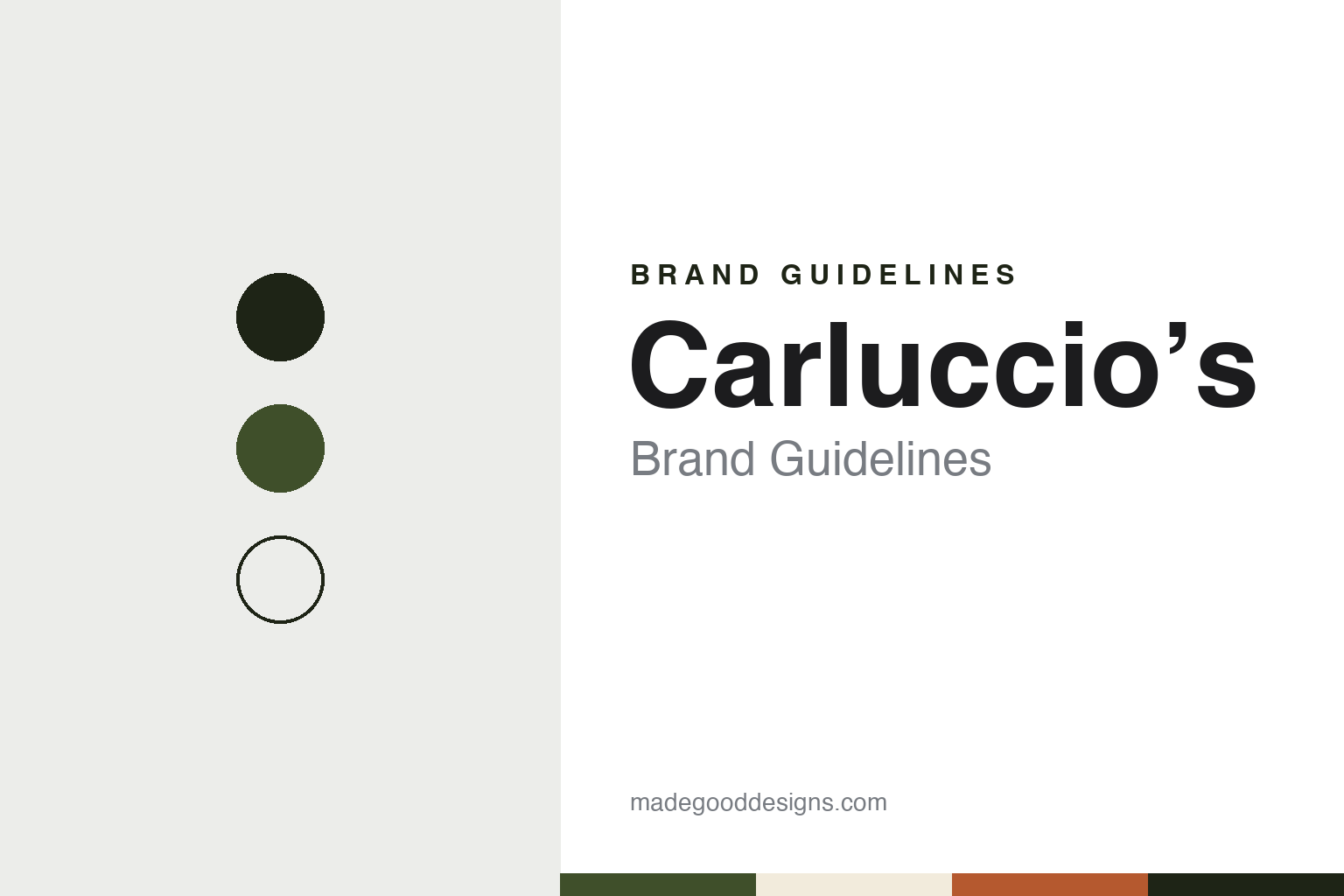
Two constants: a Carluccio’s olive and terracotta palette and a Deli serif register. Abstract homage — not a Carluccio’s product or mark; no label, logo or pack is reproduced.
Neal Street
A food shop before a restaurant.
Carluccio’s began as a shop. The company’s website says that in 1991 Antonio and Priscilla Carluccio opened a food shop in Neal Street, London, stocking regional Italian ingredients, each label, it says, written by hand; the company describes the pair travelling across Italy’s regions in search of ingredients for the shelves. English Wikipedia gives the same year for the shop, and The Caterer, reporting in May 2020, described the business as first founded by Antonio Carluccio in 1991.
The restaurants came later. In 1999 the first Carluccio’s Caffè opened in Market Place, London, according to both the company and English Wikipedia, and The National of Abu Dhabi dated the chain’s founding to 1999 in a 2018 report. English Wikipedia says the chain expanded first across south-east England and then across the UK, and that the company listed on the Alternative Investment Market in London in 2005.
The format mixed a restaurant with a shop from the start. The company says it keeps a deli in each of its restaurants, so that diners can take home fresh pasta, olive oils and other Italian ingredients, and Restaurant Online described the business in March 2020 as a “restaurant and deli group.” Today the website runs as a shop as well as a restaurant guide, selling pasta, sauces, panettone and Christmas hampers online, with a restaurant finder and table booking alongside.
Colour
Landmark, two restructurings and Boparan.
The chain’s first change of owner came from abroad. In September 2010 Restaurant Online reported that the Carluccio’s board had backed a takeover offer from Landmark, the Dubai retail group, which was already the chain’s franchise partner in the Middle East and ran three Carluccio’s restaurants in Dubai. Landmark already held a small stake and made its bid through a newly formed company called C1 Acquisitions. At the time, the same report said, Carluccio’s was finalising four new UK sites, amid talk that the chain would reach 50 restaurants by the end of that year. English Wikipedia says shareholders approved the deal and that it completed in October 2010; The National confirmed in 2018 that Landmark had bought the chain in 2010.
Under Landmark the chain went through two restructurings. In 2018 creditors approved a company voluntary arrangement, supervised by KPMG, under which up to 30 of its 103 UK restaurants would close, while its Middle East branches were not affected, The National reported on 1 July 2018. The company blamed weaker consumer spending, more competition and higher costs for labour, ingredients, rent and taxes. The remaining restaurants were kept on their existing rents, and Landmark said it would put new money into upgrading them, a programme its UK chief executive described as a reinvigoration of the estate.
On 30 March 2020, after restaurants across Britain had closed under government guidance ten days earlier, Carluccio’s entered administration, with the advisory firm FRP appointed as joint administrators to the 71-strong restaurant and deli group, Restaurant Online reported. Its operation in Ireland and its franchise business in the Middle East were outside the process. The administrators looked at a sale of all or part of the business, or mothballing it.
The brand was sold in May 2020. The Caterer reported on 22 May 2020 that Boparan Restaurant Group (BRG), the operator of Giraffe and Ed’s Easy Diner, had confirmed it was taking on the Carluccio’s brand and 30 trading sites, and that the remaining restaurants had closed permanently. BRG said it also intended to take on the Carluccio’s franchise partnership in the United Arab Emirates and Qatar. Its other restaurant brands at the time included Slim Chickens, Fishworks and Cinnamon.
Typography
Design and documentation.
Britain’s Italian restaurant chains tend to tell their stories through a room and an oven. Pizza Express traces itself to a single pizzeria on Wardour Street in Soho, opened in 1965 with an oven brought from Italy, according to accounts in MCA and Restaurant Online in 2018. Franco Manca, which began in Brixton Market in 2008, says its founders built their own oven there before opening anywhere else.
Menus and naming are usually plain. Dishes are listed by ingredient and region rather than by invented brand names, and some chains publish where those ingredients come from: Franco Manca’s pages run through its flour, tomatoes, cheeses and coffee one by one. Restaurant names lean on a founder, a place or a simple description; Franco Manca, the company says, means “Franco is missing,” after the man who ran the market pizzeria before it.
The corporate pages tell a second story, about owners. Many of these chains have passed between founders, stock-market listings and investment firms. In 2014 City A.M. noted that the private equity firm Cinven’s Gondola group ran Pizza Express alongside Zizzi and ASK Italian; Franco Manca was bought by the listed group Fulham Shore in 2015, and Fulham Shore by the Tokyo-listed Toridoll in 2023.
Restructurings are part of that record too. Company voluntary arrangements, which let a business close restaurants and reset its leases with creditors’ approval, were used by Pizza Express in 2020 and announced by Franco Manca’s owner in 2026, according to trade press reports. Each guide in this series sets out what can be checked about a chain, who founded it, who owns it and what has changed, and marks what rests on the company’s own word.
Aa
A warm deli serif, like a shop label. (Specimen set in Fraunces, a serif STAND-IN; NOT the Carluccio’s logo.)
Carluccio’s
A shop name stretched into new formats.
BRG then stretched the name into new formats. On 3 June 2021, The Caterer reported, the first Caffè Carluccio’s coffee shop opened inside a Sainsbury’s supermarket at St Albans, serving coffee, fruit ices, all-day breakfast and ciabatta sandwiches, alongside retail products. The same partnership with Sainsbury’s added a hot and cold deli counter, Carluccio’s Counter, at the supermarket’s Leamington Spa store. BRG said at the time that it wanted to take the café concept to travel hubs, city centres and neighbourhoods across the UK, and English Wikipedia records the same announcement.
The restaurant estate is now far smaller than it was in 2018. In November 2026 the Carluccio’s website lists 18 restaurants, among them sites at St Pancras International and Manchester Piccadilly stations, in Cambridge, Southampton and Stratford-upon-Avon, and one in Dublin. Several sit in shopping centres or hotels rather than on high streets, and each, the company says, includes a deli.
The brand’s visual story runs back to the shop. The company’s own account dwells on sourcing ingredients from Italy’s regions and on handwritten labels, and its website today presents the business as much through its deli range, from pasta and pesto to panettone and hampers, as through its dining rooms. That shop-first identity has outlasted a listed company, an overseas owner, a creditors’ arrangement, an administration and a new owner.
For a design guide, Carluccio’s shows how a food shop’s name can be carried into restaurants, cafés and supermarket counters. Compare Zizzi, another British Italian chain, and Pizza Express, another London-founded Italian chain. For this guide we use an olive green, a terracotta and parchment with a serif, an unofficial interpretation; no product or logo is reproduced.
Explore & save
Keep Carluccio’s’s identity on hand — save it to a board in the Made Good inspiration library.
Carluccio’s identity set
Pin the Carluccio’s olive and terracotta palette and the Deli serif register to your own board.