Gourmet Burger Kitchen Brand Guidelines
The London burger kitchen started by three New Zealanders in 2001.
Aa
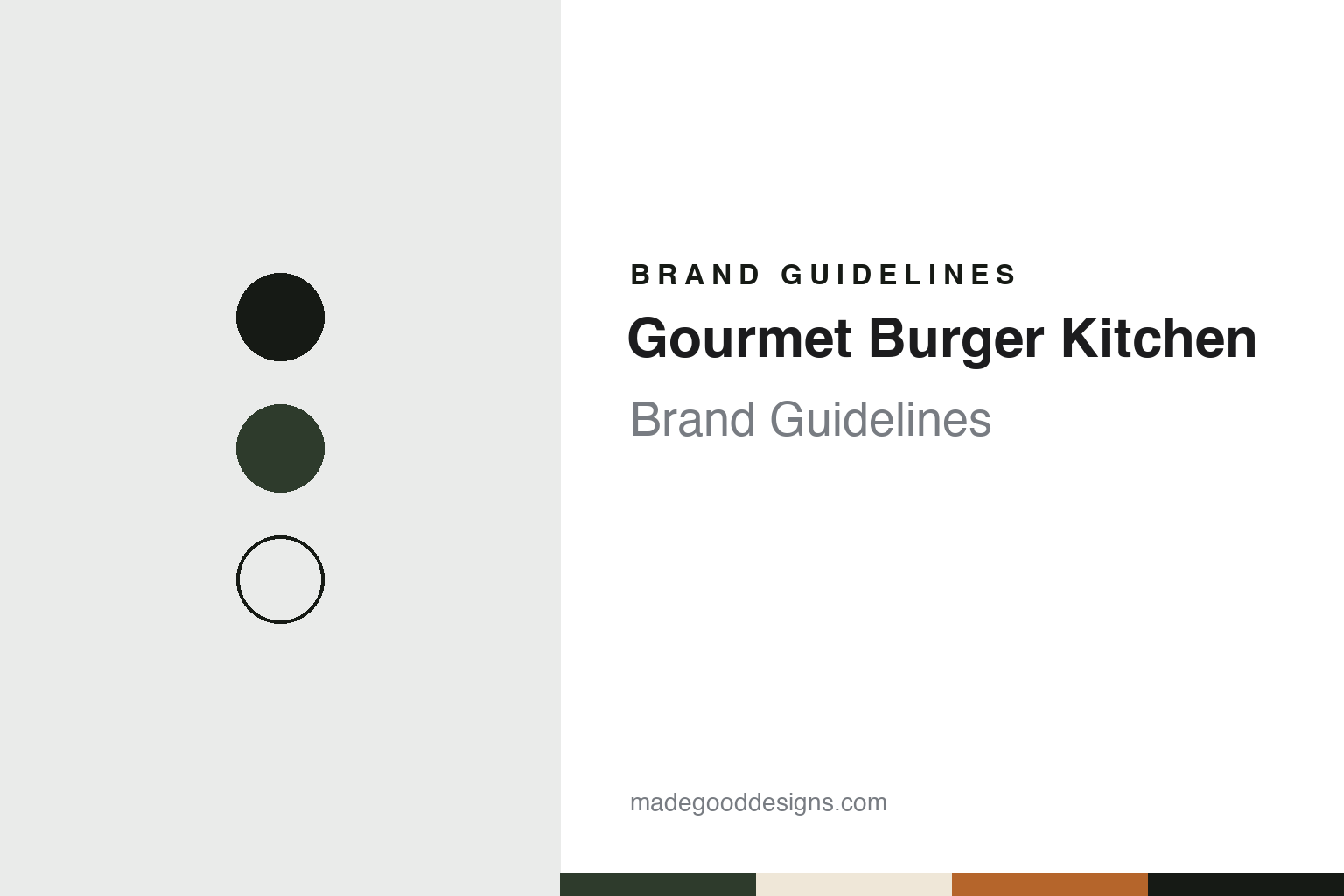
Two constants: a grill green, charcoal and ember palette and a heavy grotesque register. Abstract homage — not a GBK product or mark; no logo, sign or packaging is reproduced.
A Kiwi kitchen in London
Three New Zealanders and a menu by Peter Gordon.
Gourmet Burger Kitchen, shortened almost everywhere to GBK, began in London in 2001. English Wikipedia says it was started by three New Zealanders, Adam Wills, Greg Driscoll and Brandon Allen, and that the New Zealand-born, London-based chef Peter Gordon oversaw the development of the menu. The first restaurant, it says, was in Battersea, in south-west London, and its success led to further openings across the capital. The company’s own website still dates the brand to that year, describing a kitchen that has made burgers “since way back in 2001.”
The founders did not keep the business for long. English Wikipedia says that in 2005 they sold it to Clapham House Group, a listed restaurant company that also owned The Real Greek, and that Clapham House took the chain to more than fifty restaurants across the UK. A New Zealand thread stayed in the restaurants, English Wikipedia adds, as a reference to the background of the original owners.
Colour
Four owners in fifteen years.
GBK’s ownership history is a guide to the British casual-dining market of the 2010s. On 17 September 2010 the BBC reported that the UK arm of Nando’s had agreed to buy Clapham House Group, “the company behind Gourmet Burger Kitchen (GBK) and The Real Greek.” At that point there were 53 GBK branches, the BBC said, and Nando’s argued that Clapham’s brands needed investment to grow in a weak economy. English Wikipedia names the buyer as Capricorn Ventures, the group behind Nando’s in Britain, and says the chain grew to around sixty restaurants under its ownership, with franchised restaurants abroad in places including Ireland and Dubai.
In September 2016 the South African restaurant group Famous Brands bought the company, according to English Wikipedia. Famous Brands also owns Wimpy in the UK, the Guardian noted in 2020. The timing was difficult. On 24 October 2018 the BBC reported that GBK, then running about 80 restaurants in the UK, had filed for a company voluntary arrangement, an insolvency process that lets a business close unprofitable sites, and had earmarked 17 restaurants for closure. Its managing director blamed a “challenging casual dining” market and rents that were too high. The process was run by the accountancy firm Grant Thornton, and the other 68 restaurants were to keep trading as normal, the BBC said.
The decisive change came two years later. On 14 October 2020 the Guardian reported that GBK had been bought out of administration in a pre-pack deal by the businesses of the food industrialist behind 2 Sisters Food Group, which run restaurants as Boparan Restaurant Group. The buyer took on 35 restaurants, while 26 other sites closed. The Guardian reported that the chain had been for sale while it struggled through the closures of 2020, and that its difficulties dated back to the 2018 arrangement with landlords. Boparan Restaurant Group had bought Carluccio’s earlier that year, and also ran Giraffe and Ed’s Easy Diner.
Under its new owner GBK has shared a company with fried-chicken and other burger brands. Restaurant Online reported on 30 September 2025 that the GBK business, owned by Boparan Restaurant Group, which also operates Slim Chickens and Carl’s Jr. in the UK, had returned to profit in its 2024 accounts.
Typography
Design and documentation.
Britain’s fast-casual and restaurant-group chains sit between the quick-service counter and the traditional sit-down restaurant. Many of them began as a single London room and grew into groups of dozens or hundreds of sites, and their identities are built as much from the room, the menu and the tone of voice as from a logo. Wagamama’s website, for example, describes its format through communal benches, open kitchens and food served in bowls as soon as it is ready.
The format often comes from somewhere else. Some chains borrow a setting from abroad — a Tokyo ramen bar, a Bombay Irani café, a street-food stall — and rebuild it for British high streets, shopping centres and railway stations. The restaurant guide Harden’s, writing in 2018, credited one such chain with popularising communal, canteen-style dining in Britain. Others are built around a single dish, such as a burger, a bowl of noodles or a plate of sushi, and keep the menu short enough to repeat across many sites.
Naming is usually plain and descriptive. Dishes are listed by what they are, sometimes in the language of the food’s home country, and restaurants are named after their street or district. Some groups give each site its own story or decorative theme; others keep every branch close to a single template so that a guest knows what to expect anywhere in the estate.
Ownership is part of the story. Founders often appear on the companies’ own pages, while trade titles such as Restaurant Online record the private-equity owners, listed groups, takeovers and restructurings that follow. This guide sets out what can be checked about each brand — who founded it, who owns it, and where it trades — and marks clearly what rests only on the company’s own word.
Aa
A heavy grotesque — three letters, G, B and K. (Specimen set in Archivo Black, a sans STAND-IN; NOT the GBK logo.)
GBK today
A smaller chain inside a larger group.
The chain is now much smaller than it was. On the same day in September 2025, Restaurant Online reported that Honest Burgers was set to acquire 12 GBK restaurants, to be converted into Honest Burgers sites in London, the Midlands, the South East and East Anglia, and that the deal would leave GBK with around a dozen restaurants. Boparan Restaurant Group said the sale would let GBK focus on delivery, which it called its “core growth area.” The Caterer reported the purchase as made on 30 September 2025, and Restaurant Online confirmed in October 2025 that Honest had bought the 12 restaurants.
GBK’s website, in November 2026, lists restaurants including Waterloo, Belsize Park, Oxford, Norwich, Bracknell and Birmingham’s Brindleyplace, alongside delivery through the main ordering apps, an app with rewards, gift cards and click-and-collect. Its menu copy is about the meat: the company says its patties are 100% British, grass-fed beef from cuts of chuck, brisket and flank with 30-day dry-aged steak, chargrilled and served in an artisan bun with homemade sauces. Its home-page heading calls the kitchen “masters of the medium rare,” and it says it keeps “trying out new ideas” in the kitchen. Those are the company’s own descriptions.
The three letters do much of the brand work. The company signs itself GBK across its website, its app and its delivery listings, and when the BBC reported the 2010 sale it already gave the short form in brackets after the full name.
For a design guide, Gourmet Burger Kitchen shows how a brand can outlast four owners and two insolvency processes by holding on to a short, stable name. Compare Honest Burgers, which bought a dozen of its restaurants in 2025, and Byron, its long-time high-street rival. For this guide we use a grill green, charcoal and an ember orange with a heavy sans, an unofficial interpretation; no product or logo is reproduced.
Explore & save
Keep Gourmet Burger Kitchen’s identity on hand — save it to a board in the Made Good inspiration library.
GBK identity set
Pin the grill green, charcoal and ember palette and the heavy grotesque register to your own board.