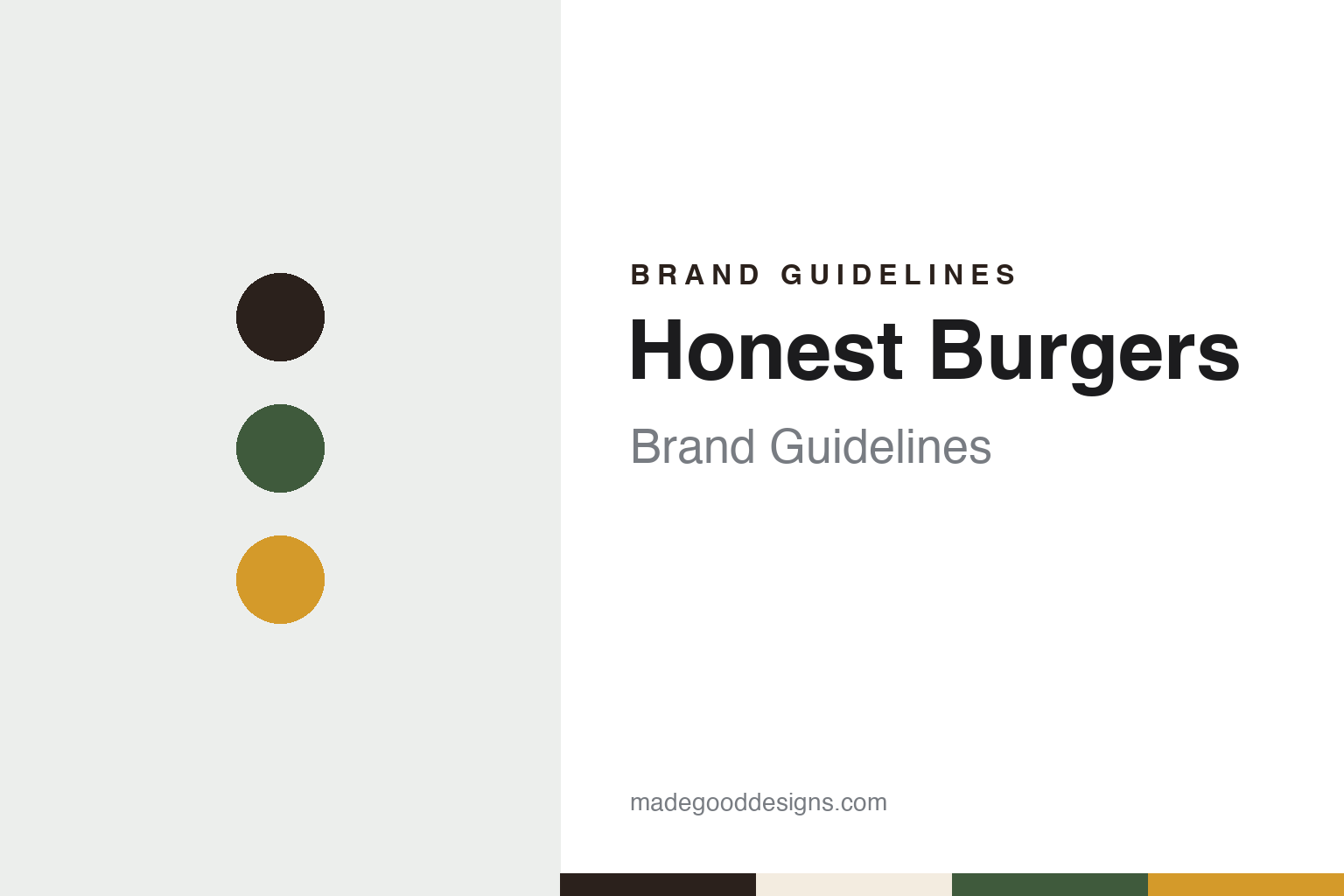
Honest Burgers Brand Guidelines
A festival stall that became a London burger chain.
Aa
Two constants: a char, butcher-paper and rosemary palette and a slab serif register. Abstract homage — not an Honest Burgers asset; no logo, menu or sign is reproduced.
From Brighton to Brixton
A food-festival stall, then a small room in a covered market.
Honest Burgers started out in 2009 in Brighton, where the friends Tom Barton and Philip Eeles cooked British burgers at a local food festival, Restaurant Online reported in September 2025. English Wikipedia also gives 2009 as the founding year. The business took on a permanent address two years later: Restaurant Online wrote in August 2024 that the pair opened their first permanent restaurant in London’s Brixton in 2011, and Restaurant Online itself, in October 2024, described the group as launched in 2011.
That first room was small. Reviewing it in September 2013, Time Out called it a “tiny burger joint” in Brixton Village, the covered market, where diners queued by leaving a phone number with staff, who texted them when a seat came free. The menu it described had five choices: a plain burger, a cheese burger, the “honest” with bacon and cheese, a rotating special and a vegetable fritter. The beef came from the London butcher Ginger Pig, served in a glazed bun, and the chips were seasoned with rosemary salt, which Time Out called the restaurant’s signature. The drinks list was short, with ale from Redchurch, a Bethnal Green brewery, and a local ginger beer.
By January 2015 there were nine restaurants. Restaurant Online credited the launch to Barton, Eeles and Dorian Waite, a former operations director at the Côte chain, and reported that the group had recently opened in Venn Street, Clapham, had a site secured at an Old Street office development and was looking at Brighton for its first restaurant outside London.
Colour
Private-equity backing and a steady roll-out.
The same January 2015 report carried the deal that shaped the company’s next decade. Active Private Equity — now known as Active Partners, and at the time also a backer of the LEON chain and Evans Cycles — took a 50 per cent stake in Honest Burgers, with one of its co-founders joining the board and Santander also involved in the funding, Restaurant Online reported. Ten years later the trade title still described the business as “Active Partners-backed,” in an October 2025 report on its accounts.
Branches followed beyond London: English Wikipedia lists branches as far from London as Cardiff, Liverpool and Manchester. In February 2023 the Evening Standard counted 34 Honest restaurants in London, and by August 2024 Restaurant Online put the group at 39 restaurants across England and Wales.
Leadership changed in 2024. Restaurant Online reported in August of that year that chief executive Thomas Kelly, a former McDonald’s and Costa Coffee executive who had joined in January, would move to the chair after eight months, with finance director Matt Brandon stepping in as interim chief executive; by 2025 the trade press was naming Brandon as chief executive.
The group also had a brush with the tax authority. In December 2023 City A.M. reported that HMRC had filed a winding-up petition against the company after talks on a time-to-pay arrangement for a tax bill fell through; the company told the paper the bill had then been paid and the petition withdrawn.
Alongside the main restaurants, Honest tried a quicker format. In October 2024 Restaurant Online reported plans to turn its restaurant near London’s Liverpool Street station into the first site of a smash-burger offshoot, and The Caterer reported in September 2025 that the first Honest “Smash + Grab” had opened at Liverpool Street at the end of 2024.
Typography
British fast-casual chains.
Britain’s fast-casual and restaurant-group chains sit between the quick-service counter and the traditional sit-down restaurant. Many of them began as a single London room and grew into groups of dozens or hundreds of sites, and their identities are built as much from the room, the menu and the tone of voice as from a logo. Wagamama’s website, for example, describes its format through communal benches, open kitchens and food served in bowls as soon as it is ready.
The format often comes from somewhere else. Some chains borrow a setting from abroad — a Tokyo ramen bar, a Bombay Irani café, a street-food stall — and rebuild it for British high streets, shopping centres and railway stations. The restaurant guide Harden’s, writing in 2018, credited one such chain with popularising communal, canteen-style dining in Britain. Others are built around a single dish, such as a burger, a bowl of noodles or a plate of sushi, and keep the menu short enough to repeat across many sites.
Naming is usually plain and descriptive. Dishes are listed by what they are, sometimes in the language of the food’s home country, and restaurants are named after their street or district. Some groups give each site its own story or decorative theme; others keep every branch close to a single template so that a guest knows what to expect anywhere in the estate.
Ownership is part of the story. Founders often appear on the companies’ own pages, while trade titles such as Restaurant Online record the private-equity owners, listed groups, takeovers and restructurings that follow. This guide sets out what can be checked about each brand — who founded it, who owns it, and where it trades — and marks clearly what rests only on the company’s own word.
Aa
A sturdy slab serif for a chalkboard-and-butcher’s-paper register. (Specimen set in Zilla Slab, a serif STAND-IN; NOT the Honest Burgers logo.)
Honest Burgers
Twelve former GBK sites and a bigger estate.
A bigger step came in September 2025. The Caterer reported on 30 September 2025 that Honest Burgers had acquired 12 restaurants from Gourmet Burger Kitchen, which had been owned by Boparan Restaurant Group since 2020. The sites, spread across London, the Midlands, the South East and East Anglia, were to be converted into Honest Burgers restaurants rather than into the Smash + Grab format, and the deal took the Honest estate past 50 sites. The trade title said the purchase was funded by existing shareholders and a senior debt package from OakNorth, money that would also go into a new central prep kitchen. Restaurant Online confirmed in October 2025 that Honest had bought the 12 restaurants the month before. Boparan said the sale let GBK concentrate on delivery.
What has stayed constant in the coverage is a narrow menu built around the burger and the rosemary-salted chips, set in rooms that began in a covered market. In its report on the deal, Restaurant Online described Honest as a “better-burger” brand and noted that GBK, launched in 2001, had run around 60 restaurants at its peak.
For a design guide, Honest Burgers shows how a short menu, a plain name and a signature side can carry a brand from a single market unit to a national chain. Compare Five Guys, an American burger chain with its own short menu, and Gourmet Burger Kitchen, the London chain that sold Honest a dozen of its sites. For this guide we use a dark char brown, butcher’s-paper cream, a rosemary green and a mustard yellow with a slab serif, an unofficial interpretation; no product or logo is reproduced.
Explore & save
Keep Honest Burgers’s identity on hand — save it to a board in the Made Good inspiration library.
Honest Burgers identity set
Pin the Honest Burgers char, butcher-paper and rosemary palette and the slab serif register to your own board.