Doutor Brand Guidelines
A Tokyo roaster that put a self-service counter in nine square metres of Harajuku.
Aa
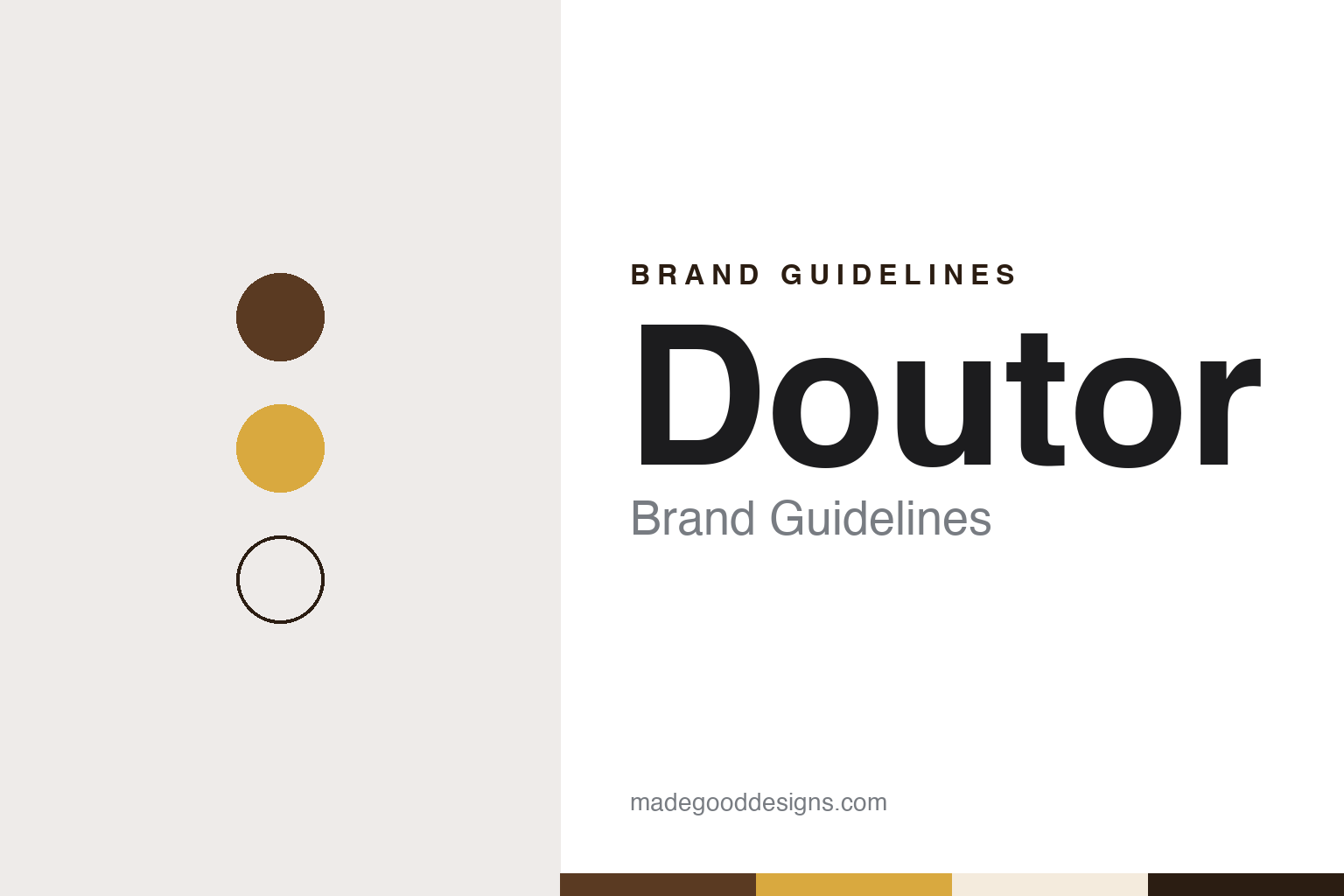
Two constants: a roast brown, gold and foam palette and a rounded geometric sans register. Abstract homage — not a Doutor product or mark; no cup, logo or shop sign is reproduced.
A roaster named after a street
From São Paulo lodgings to a Tokyo roastery.
Doutor began as a coffee business rather than a café. The company says it was set up in April 1962 in Tokyo as a small roasting and wholesale firm, founded by Hiromichi Toriba when he was 24; Japanese Wikipedia places that first office in Minato ward. Before that Toriba had worked on a coffee farm in Brazil, and the name comes from his lodgings there: the company says he lived on Rua Doutor Pinto Ferraz in São Paulo, a street named after a jurist. Doutor is Portuguese for “doctor,” and Japanese Wikipedia notes that the Japanese reading, “Dotōru,” follows the pronunciation used by Japanese emigrants in Brazil rather than standard Portuguese.
The roaster moved into retail over the following decade. According to the company’s own timeline, it opened a directly run shop called Café Doutor in Ginza in 1970; a trip to Europe in 1971 gave Toriba the idea for a new kind of coffee shop; and in July 1972 it opened the first Café Colorado, in Yokohama, which Japanese Wikipedia describes as the first format Doutor franchised. The business became a joint-stock company in 1976.
The format that carries the name arrived in April 1980: the first Doutor Coffee Shop, outside Harajuku station in Shibuya. English Wikipedia dates the opening to 18 April 1980 and gives the shop’s size as nine square metres, and The Star of Malaysia described the same “teeny-tiny” Harajuku outlet in February 2017. SoraNews24, writing in March 2024, still introduced Doutor as a coffee shop “born in Tokyo’s trendy Harajuku district in 1980.” In the same year, the company says, it moved its roasting to a plant in Funabashi, Chiba, now called its Kanto plant.
Colour
Self-service counters, several shop formats and an open-flame roaster.
The Doutor Coffee Shop is a self-service counter selling coffee, sandwiches and cakes, Japanese Wikipedia says, and staff inside the company often call it DCS. Growth was steady. The company opened a training school for franchise owners, the IRP management institute, in 1987, the year Japanese Wikipedia says the chain reached 100 shops; it says the Doutor Coffee Shop passed 1,000 shops in Japan in 2004; and Japanese Wikipedia records that a shop in Matsue, Shimane, opened in October 2015 completed its presence in all 47 prefectures, before the closure of the only shop in Shiga in 2021.
Alongside the Doutor Coffee Shop and Café Colorado, the company lists Excelsior Caffé, an espresso-led café opened in 1999 and modelled on an Italian bar, according to Japanese Wikipedia; Le Café Doutor, opened in 1998; Café Mauka Meadows, from 1996, named after the company’s coffee farm on the island of Hawaii; and later formats such as a book-and-coffee café and Doutor Coffee Farm shops, both opened in 2017.
The coffee itself is roasted in Japan. The company names two plants, the Kanto plant in Funabashi and a Kansai plant at Kato in Hyogo, opened in 2002. It says it opened its own farm, Mauka Meadows, in Hawaii in 1991; English Wikipedia adds a second plantation in 1995, and in 2017 Doutor’s master roaster told The Star that its beans come from more than 10,000 plantations, including its own two in Kona. Doutor roasts with open flame rather than hot air, English Wikipedia says, and The Star reported that because flame roasting traditionally handles only small batches, Doutor developed its own industrial open-flame roasting equipment.
The current identity dates from 1998. For its 35th anniversary, the company says, it adopted a new corporate identity whose symbol uses the letters D and C, for Doutor Coffee, to suggest the surface of a cup of coffee. The wordmark adds an accent to the final O of DOUTOR so that English speakers read it as “Dotōru” rather than “Dowter,” the company explains. It started a rebranding project for the Doutor Coffee Shop in 2010. Seasonal menus are part of the shop’s public face: SoraNews24 reported in March 2024 that the chain had offered cherry-blossom drinks and sweets for many years, including an iced sakura au lait served with pieces of sakura-flavoured warabi mochi.
Typography
Counters, cups and corporate pages.
Coffee-shop chains are brands people meet at the counter. The cup handed over, the sleeve around it, the menu board behind the barista and the sign over the door all carry the name, and the companies show them in their own photographs and on their own websites. A chain that buys another often keeps the second name on the shop front, so one owner can run several looks on the same high street.
Naming is usually plain and close to the product. Chains name house blends, seasonal drinks and loyalty schemes in their own voice, borrow words from Italian or from their home language, and describe store formats by where they sit: high streets, railway and underground stations, airports, shopping centres and, more recently, drive-throughs. Some keep a single format; others add kiosks and cafés inside other retailers.
Ownership is where the stories diverge. Many chains began with one café and a founder, then passed through private equity firms, family investment companies or stock-market listings, and some have gone private again. Corporate pages tell the founding story, while independent trade press and national newspapers record the deals, the restructurings, the court rulings and the openings abroad, with dates.
This guide sets out what can be checked about each chain: who founded it and where, who owns it now, how it grew and what it says about its coffee and baking. Where a fact rests only on the company’s own word, it is given as the company’s claim. The palette and typeface shown are our own unofficial interpretation, not the brand’s.
Aa
A rounded geometric sans for a short, accented wordmark. (Specimen set in Montserrat, a sans STAND-IN; NOT the Doutor logo.)
Doutor-Nichires
A listed company that became half of a holding group.
Doutor raised money from the public in stages. Japanese Wikipedia says its shares were registered for over-the-counter trading in August 1993 and listed on the first section of the Tokyo Stock Exchange in November 2000. In 2007 the company combined with Nippon Restaurant System, the operator of the Yomenya Goemon pasta restaurants: the two firms reached a basic agreement in April 2007 and a final agreement in May, and on 1 October 2007 they formed a joint holding company, Doutor-Nichires Holdings, Japanese Wikipedia says. Doutor Coffee itself was delisted and became a wholly owned subsidiary, while the holding company took the listing.
Inside the group, Doutor Coffee remains the roasting and coffee-shop business. The company gives its head office as Shibuya, Tokyo, where it moved in 1999 according to Japanese Wikipedia, and lists 435 directly run shops as of February 2026. Its other businesses have included supplying Doutor-branded products to convenience stores from 1998 and taking over the Café Lamill coffee shops and Nina’s tea shops, along with the French restaurant Aux Bacchanales, in 2010, according to Japanese Wikipedia; the company says it set up a company called Les Deux to run them.
Abroad, Doutor has grown through partners. In February 2017 The Star reported outlets in Taiwan, South Korea and Singapore, and three new shops in Malaysia, opened in late 2016 with the Texchem Group, the operator of the Sushi King restaurants, as local partner. The same report put the number of Doutor outlets in Japan at more than 900.
For a design guide, Doutor shows how a roaster’s name, borrowed from a São Paulo street, became a compact counter brand with a corrective accent built into its wordmark. Compare Komeda, another Japanese chain built on franchised shops, and % Arabica, a Japanese coffee brand of a very different shape. For this guide we use a roast brown, a harvest gold and a milk-foam cream with a sans, an unofficial interpretation; no product or logo is reproduced.
Explore & save
Keep Doutor’s identity on hand — save it to a board in the Made Good inspiration library.
Doutor identity set
Pin the Doutor roast brown, gold and foam palette and the rounded geometric sans register to your own board.