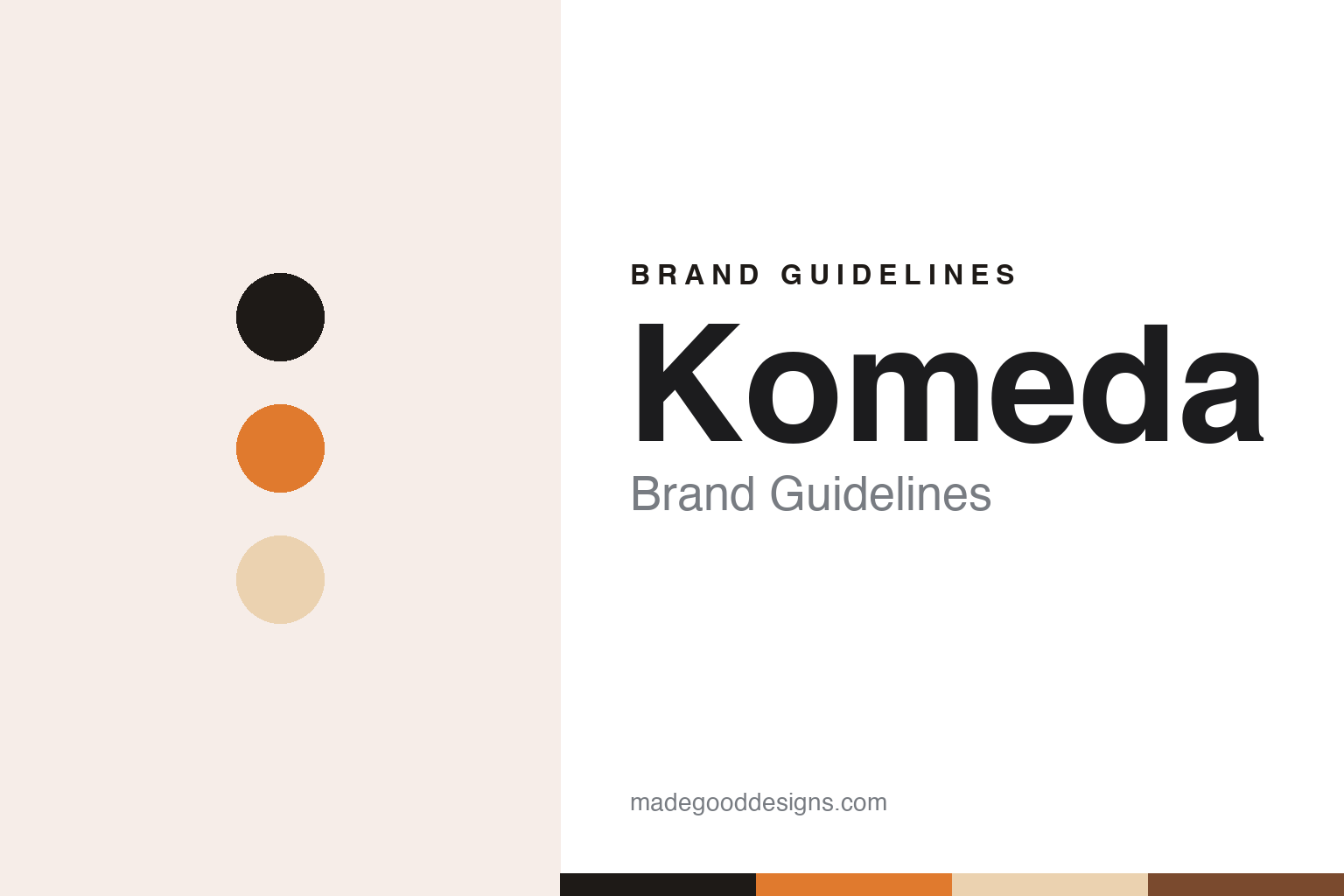
Komeda Brand Guidelines
A Nagoya coffee house that franchised the kissaten.
Aa
Two constants: a signboard black, orange and brick palette and a brush-inflected serif register. Abstract homage — not a Komeda product or mark; no sign, mascot, cup or logo is reproduced.
Taro of the rice shop
A single Nagoya coffee shop that became a franchise.
Komeda began as one coffee shop in Nagoya. The company says Taro Kato opened it in January 1968; Japanese Wikipedia gives February 1968 and places the shop in a building in Nishi ward, after Kato closed an earlier eatery elsewhere in the city. The name is a pun on his family business: his family ran a rice shop, and “Komeda” comes from “Kome-ya no Taro,” Taro of the rice shop, Japanese Wikipedia says. English Wikipedia gives the same origin, noting that kome means rice.
Expansion started early. From 1970 Komeda grew first as a voluntary chain and later as a franchise, and it became a company, Komeda Coffee-ten, in August 1975, according to Japanese Wikipedia. The fourth shop, at Takaoka in Nagoya, opened in 1972. SoraNews24 visited it in June 2023 and found it unrenovated: a small room with three counter seats and six tables, wooden furnishings, walls and floors, and a menu close to that of other Komeda shops. Fans call the first ten branches the “Old Komedas,” the site reported; the second shop, at Kikui, closed in 2014, and the main shop, at Kamiyama-cho, was rebuilt in 2022.
The company says its signature dessert, Shiro-Noir, went on sale in February 1977. Japanese Wikipedia describes it as a warm Danish pastry topped with soft-serve ice cream, its name joining the Japanese shiro, white, and the French noir, black. A new company, Komeda, was set up in April 1993 to run the franchise, which by then had 85 member shops, Japanese Wikipedia says.
Colour
A calligraphed sign, a timber room and the morning service.
The shop sign is orange lettering on black. According to Japanese Wikipedia, it was written by the calligrapher Tarumoto Juson, whose pupil the founder had been. The chain’s mascot, a moustached gentleman, was drawn after a regular customer who studied at a design school was asked to create it, and shows “a gentleman of medieval Europe drinking coffee,” the same source says.
The buildings follow a pattern. Most Komeda shops are stand-alone buildings with brick accents on a light orange facade and red awnings, SoraNews24 wrote in 2023. Inside, Japanese Wikipedia says, the chain uses wood, plaster and brick, with wooden chairs, following an architects’ rule of thumb that people feel settled when timber fills about four-tenths of what they see. Ceilings and partitions are set high to balance openness with privacy, suburban shops often come with large car parks, and magazines and newspapers are left out to read. Japanese Wikipedia compares the result to an old-style kissaten rather than a modern café, and says the cups and saucers are made in Arita ware, with some shops using Mino ware or other makers.
The service is Nagoya’s. Until 11 a.m., Japanese Wikipedia says, a drink order comes with toast and a boiled egg, egg salad or sweet red-bean paste at no extra charge, the regional custom known as morning service; English Wikipedia also lists Ogura toast and seasonal shaved ice. Later in the day drinks come with a small bean snack, Japanese Wikipedia says, and SoraNews24 was given fried mochi strips at Takaoka. Coffee for most shops is brewed at the company’s own plants and delivered for heating, Japanese Wikipedia says; the company lists coffee plants in eastern Japan, opened in 2018, and in Kyushu, opened in 2023, alongside a bread plant in Chiba from 2015.
Komeda has also tried new formats under separate names: the Japanese-style café Okagean, opened in 1999; KOMEDA is □, a café with a fully plant-based menu, opened in Higashi-Ginza in July 2020; the BAKERY ADEMOK bakeries in Okinawa; and, the company says, a rice-ball shop called Komeya no Taro, opened in Tokyo in February 2025.
Typography
Counters, cups and corporate pages.
Coffee-shop chains are brands people meet at the counter. The cup handed over, the sleeve around it, the menu board behind the barista and the sign over the door all carry the name, and the companies show them in their own photographs and on their own websites. A chain that buys another often keeps the second name on the shop front, so one owner can run several looks on the same high street.
Naming is usually plain and close to the product. Chains name house blends, seasonal drinks and loyalty schemes in their own voice, borrow words from Italian or from their home language, and describe store formats by where they sit: high streets, railway and underground stations, airports, shopping centres and, more recently, drive-throughs. Some keep a single format; others add kiosks and cafés inside other retailers.
Ownership is where the stories diverge. Many chains began with one café and a founder, then passed through private equity firms, family investment companies or stock-market listings, and some have gone private again. Corporate pages tell the founding story, while independent trade press and national newspapers record the deals, the restructurings, the court rulings and the openings abroad, with dates.
This guide sets out what can be checked about each chain: who founded it and where, who owns it now, how it grew and what it says about its coffee and baking. Where a fact rests only on the company’s own word, it is given as the company’s claim. The palette and typeface shown are our own unofficial interpretation, not the brand’s.
Aa
A brush-inflected serif, a nod to a sign written by a calligrapher. (Specimen set in Zen Old Mincho, a serif STAND-IN; NOT the Komeda logo.)
Komeda Holdings
Two funds, a listing and a push abroad.
Komeda left family ownership in 2008. In April that year, Japanese Wikipedia says, the business passed to a company backed by a fund advised by Advantage Partners, with a 78 per cent stake, and the drinks maker Pokka took 12 per cent; in February 2013 those shares went to a company backed by MBK Partners, an Asian investment fund. In November 2014 a holding company, Komeda Holdings, was formed above the operating company. It listed on the first section of the Tokyo Stock Exchange on 29 June 2016 and on the Nagoya Stock Exchange that December, and in April 2022 moved to the Tokyo Prime and Nagoya Premier markets, the company says. In June 2019, Japanese Wikipedia adds, it formed a capital and business tie-up with Mitsubishi Corporation.
Komeda’s shops stayed in the Tokai region for decades, Japanese Wikipedia says. The company dates its first shop in the Kanto area to Yokohama in 2003 and its first in Tokyo’s 23 wards to 2007; a shop in Aomori in June 2019 completed its presence in all 47 prefectures. Abroad, its first franchised shop opened in Shanghai in April 2016, followed by Taipei in 2018, Hong Kong in October 2022 and Bali in January 2023. In March 2025 it took a 70 per cent stake in Poon Resources of Singapore, whose restaurant brands now appear in its store list. As of February 2026, the company says, it ran 1,079 Komeda’s Coffee shops and 18 Okagean shops.
Most of those are franchised. Japanese Wikipedia says only 28 Komeda’s Coffee shops were directly run in December 2023, and that service is broadly uniform without a strict manual, so menus vary slightly by owner and region.
For a design guide, Komeda shows how a single calligraphed sign, a mascot and a timber interior can carry a franchise across a country without a rigid rulebook. Compare Doutor, the Tokyo self-service chain, and % Arabica. For this guide we use signboard black, lantern orange, brick red and plaster with a serif, an unofficial interpretation; no product or logo is reproduced.
Explore & save
Keep Komeda’s identity on hand — save it to a board in the Made Good inspiration library.
Komeda identity set
Pin the Komeda signboard black, orange and brick palette and the brush-inflected serif register to your own board.