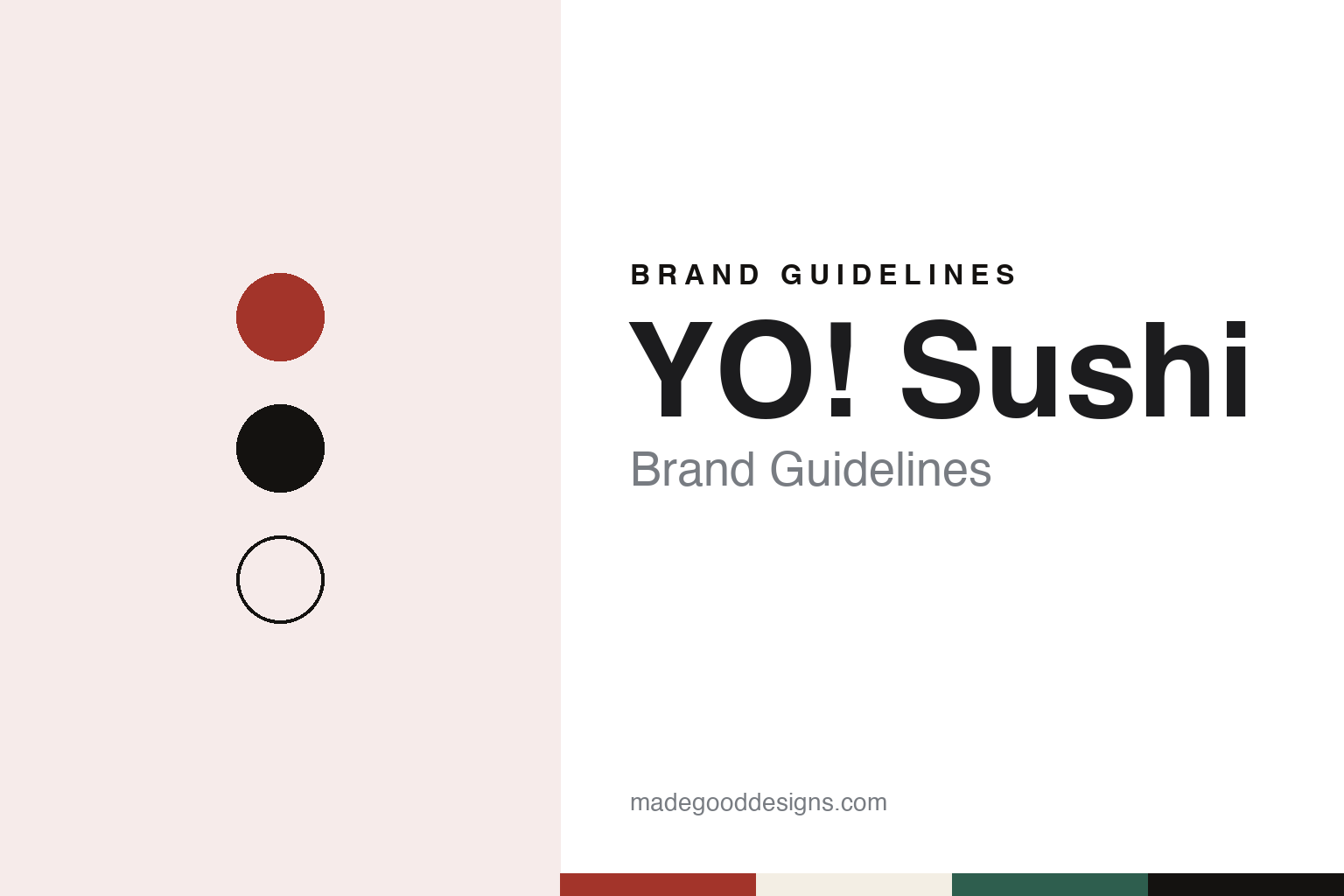
YO! Sushi Brand Guidelines
The Soho conveyor-belt sushi bar that became a kiosk brand.
Aa
Two constants: a vermilion, sumi black and rice-paper palette and a geometric sans register. Abstract homage — not a YO! product or mark; no dish, logo or sign is reproduced.
Soho, 1997
A conveyor belt in a London dining room.
YO! Sushi opened its first restaurant in Soho, London, in January 1997. English Wikipedia names the founder as the British entrepreneur Simon Woodroffe, and Restaurant Online’s October 2026 survey of the British sushi market also dates the brand to 1997 and to Soho. The format was kaiten, the Japanese conveyor-belt style: English Wikipedia describes dishes prepared in a theatre-style kitchen in plain view of diners and set on a thin belt that carries them around the room, so that guests take what they want as it passes.
The early estate grew through department stores and shopping centres. English Wikipedia lists a second restaurant in Harvey Nichols, a first site outside London in Manchester’s Selfridges in 2002, and a first franchise, in Dubai, in 2003, by which time the company had twelve restaurants. Franchises in Dublin and Moscow followed in 2007, and the encyclopedia dates the fiftieth company-owned restaurant to April 2010, in London. By June 2014 it counted more than seventy restaurants. Beyond Britain, English Wikipedia lists restaurants in Ireland and across the Gulf, in the United Arab Emirates, Saudi Arabia, Bahrain and Kuwait. A move into the United States began with a stand-alone restaurant in Boston in October 2016 and another in Manhattan’s Flatiron District in March 2017; English Wikipedia says all of the American restaurants had closed by 2018.
The ownership story starts in 2015, when the private-equity firm Mayfair Equity Partners first invested in YO!, Restaurant Online reported in June 2023. Under that ownership the business bought the Canadian sushi business Bento Sushi in 2017 and Taiko Foods, a supplier of sushi to supermarkets, in 2018, and then merged with the American sushi-kiosk business Snowfox. Restaurant Online dated that merger to 2019 in its 2023 report and to early 2020 in a September 2020 report; the combined business took the name Snowfox Group in 2021.
Colour
From the belt to the kiosk.
In October 2019 the brand changed its name. Creative Boom reported on 29 October 2019 that the London agency Zag had overhauled the whole brand and that the chain had been officially renamed YO!, dropping the word “Sushi”. The new identity, the magazine said, was made with traditional Japanese art media such as woodcut and ink alongside digital media, to bring out the colours and textures of the food and to work across a set of new formats. Those formats included a new-look kaiten belt in Ashford, a full-service izakaya at Westfield White City, which opened at the start of October 2019, and a “grab and perch” counter at Manchester Piccadilly.
The move away from the belt was already under way a year later. YO! closed its whole estate in March 2020 and began reopening sites in August with a pre-ordering system, and Restaurant Online noted that in the years before, the company had been shifting its portfolio away from conveyor-belt restaurants and into retail. On 1 September 2020 its creditors approved a company voluntary arrangement supervised by Deloitte, under which 19 restaurants closed permanently and nine leased sites it no longer traded from were given up, the magazine reported the next day.
Retail has since become a large part of the picture. In its October 2026 survey, Restaurant Online put the YO! estate at around 500 locations across restaurants and kiosks, many of the kiosks inside Tesco supermarkets, and described a menu of sushi alongside a wider range of hot street food. The same report recorded new YO! To Go grab-and-go sites in Heathrow’s Terminal 2B and Terminal 4, trading alongside existing YO! restaurants in Terminals 2 and 3.
Typography
How British restaurant groups present themselves.
Britain’s fast-casual and restaurant-group chains sit between the quick-service counter and the traditional sit-down restaurant. Many of them began as a single London room and grew into groups of dozens or hundreds of sites, and their identities are built as much from the room, the menu and the tone of voice as from a logo. Wagamama’s website, for example, describes its format through communal benches, open kitchens and food served in bowls as soon as it is ready.
The format often comes from somewhere else. Some chains borrow a setting from abroad — a Tokyo ramen bar, a Bombay Irani café, a street-food stall — and rebuild it for British high streets, shopping centres and railway stations. The restaurant guide Harden’s, writing in 2018, credited one such chain with popularising communal, canteen-style dining in Britain. Others are built around a single dish, such as a burger, a bowl of noodles or a plate of sushi, and keep the menu short enough to repeat across many sites.
Naming is usually plain and descriptive. Dishes are listed by what they are, sometimes in the language of the food’s home country, and restaurants are named after their street or district. Some groups give each site its own story or decorative theme; others keep every branch close to a single template so that a guest knows what to expect anywhere in the estate.
Ownership is part of the story. Founders often appear on the companies’ own pages, while trade titles such as Restaurant Online record the private-equity owners, listed groups, takeovers and restructurings that follow. This guide sets out what can be checked about each brand — who founded it, who owns it, and where it trades — and marks clearly what rests only on the company’s own word.
Aa
A short name with an exclamation mark. (Specimen set in Space Grotesk, a sans STAND-IN; NOT the YO! logo.)
YO!
A Japanese owner and a new group name.
In June 2023 the Japanese foodservice company Zensho Holdings agreed to buy Snowfox Group, the operator of YO!, from Mayfair Equity Partners, Restaurant Online reported; in Japan, Zensho runs the beef-bowl chain Sukiya and the Hama-sushi restaurants. The Grocer reported on 23 September 2023 that the acquisition had completed after final regulatory approval. On 31 July 2024 Snowfox Group became the Wonderfield Group, a name meant to bring the company’s brands under one roof, Restaurant Online reported that day; at that date its UK brands were YO!, Panku and Taiko, with Bento in Canada and Snowfox in the United States. The group said then that it employed more than 5,500 people across 16 countries and supplied more than 7,000 stores and 9,000 kiosks. Zensho had also brought one of its own brands to Britain that year, opening an Ichikokudo Hokkaido Ramen restaurant on Wardour Street in Soho, a short walk from where YO! began.
That leaves YO! as a consumer brand inside a larger Japanese-owned food group that also makes and supplies sushi. The 2019 identity is the brand’s documented design reference point: a two-letter name with an exclamation mark, and imagery cut and drawn by hand in woodcut and ink, applied to formats that run from the belt restaurant to the supermarket kiosk and the airport counter.
For a design guide, YO! shows how one short, punctuated name can travel from a conveyor-belt dining room in Soho to a supermarket chiller and a Heathrow kiosk. Compare itsu, the other London sushi brand founded in 1997, and Wagamama. For this guide we use a deep vermilion, sumi black and rice-paper white with a geometric sans, an unofficial interpretation; no product or logo is reproduced.
Explore & save
Keep YO! Sushi’s identity on hand — save it to a board in the Made Good inspiration library.
YO! identity set
Pin the vermilion, sumi black and rice-paper palette and the geometric sans register to your own board.