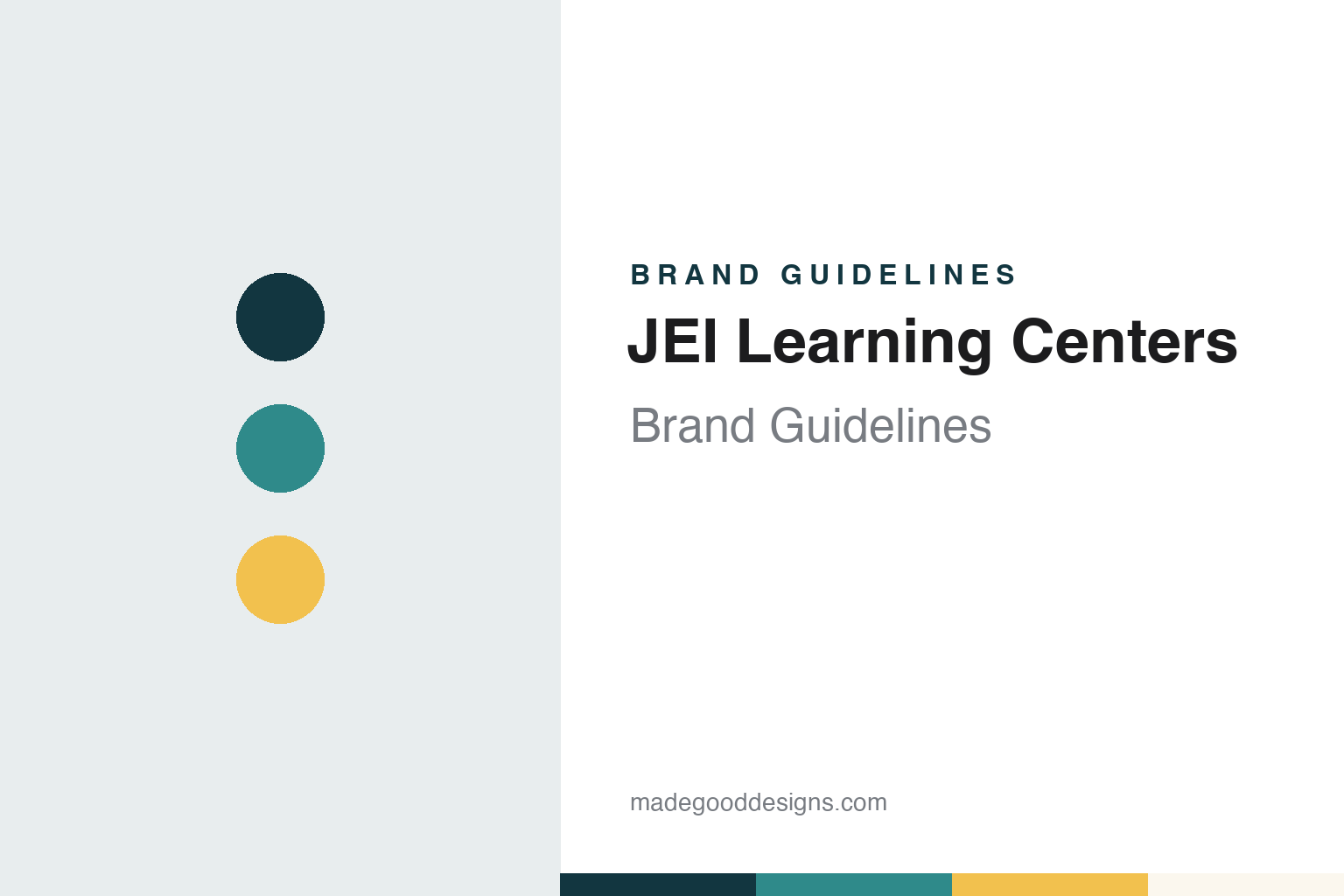
JEI Learning Centers Brand Guidelines
A Seoul workbook method that crossed the Pacific.
Aa
Two constants: a teal, slate and pencil-yellow palette and a rounded sans register. Abstract homage — not a JEI product or mark; no workbook, logo or centre sign is reproduced.
Jaeneung
A Seoul company, a method and three letters.
JEI Learning Centers are the overseas branch of Jaeneung Education (재능교육), a Seoul education company founded in 1977. Korean Wikipedia says the company began that year under an earlier corporate name and took the name Jaeneung Education in 1987; its founder, Sung Hoon Park — the spelling the company’s American website uses — developed the study system and materials himself, and the first of them, an arithmetic course in levels A to D, went on sale in 1981.
The company calls its approach self-learning, in Korean seuseuro, “by oneself.” Its American website describes the JEI Self-Learning Method as a self-paced, individual programme that teaches mathematical and language concepts “in small, easy-to-follow steps,” and calls the student, the instructor and the parent at home a “triad.” Korean Wikipedia dates a computer-based diagnostic assessment to 1986 and names the current management system JEI ALIS, an adaptive system that sets each learner’s starting point and pace.
Overseas expansion began in 1992 with a branch in Los Angeles, Korean Wikipedia says, followed by New York, Japan and northeast China in 1994, New Zealand in 1995 and Australia and Hong Kong in 1997. The company’s American website says Park “brought the JEI Self-Learning Method to the United States and established JEI Learning Centers, LLC. in 1992,” and lists later moves into Canada, Hong Kong, China, India, Australia and New Zealand.
The three letters came later. Korean Wikipedia says the English wordmark JEI, short for Jaeneung Educational Institute, was adopted in 2001, the year the company changed its corporate identity. The American website gives the vision as “A Better Life Through Better Education,” a line Korean Wikipedia also uses for the company in Korean, and describes the mission as improving children’s study habits through a steady supply of customised workbooks.
Colour
Weekly workbooks, a franchise and an app.
The product at the centre of the brand is paper. JEI describes its materials as programmed workbooks: a new concept or skill arrives in each weekly book, and an interim test follows each one. The company lists four features — clearly defined objectives laid out with detailed illustrations, small steps, a spiral structure that returns to earlier skills, and mastery of each skill before the next. Outside Korea, English Wikipedia says, JEI offers nine programmes adapted for local use in English, Chinese and Korean; the American site names Math, Problem Solving Math, English, Reading & Writing and a programme called Brain Safari.
The centres themselves are franchised. JEI’s franchise pages set out six steps, from an information packet and an interview to signing an agreement, choosing a site, a New Franchise Training programme and a grand opening. The company says its centre directors take part in monthly meetings, on-site training and annual seminars, and its American headquarters is in New Jersey, with a corporate office in Los Angeles.
In Korea the same method is sold in two ways: home visits, in which a teacher calls on the family, and centres. Korean Wikipedia dates the launch of the Jaeneung Self-Learning Center brand in Korea to 2013 and a smaller classroom format to 2024. Its domestic list runs from mathematics and Korean reading to English, Chinese characters and a thinking-skills course called Thinking Pizza, launched in 1998.
The paper has gone online too. On 7 December 2020 The Asia Business Daily reported that Jaeneung Education was adding a three-way video class system to its counselling app, Jaeneungirang, so that a video lesson, grading and correction, and chat could run at once; the paper said the aim was to bring the one-to-one feedback of offline workbooks online.
Typography
Tutoring brands and how they present themselves.
Tutoring brands sell something hard to picture: time with a teacher and steady practice. So they make it visible in other ways. The centre front is the first of them. Explore Learning says it opened its first centre in 2001 right beside the entrance of a supermarket in Chelmsford, so that parents could leave a child to work while they shopped; Kip McGrath says it began in 1976 in a family garage in Maitland, New South Wales, before growing into a franchise of locally run centres.
The second is the screen. Many of these companies now present their teaching through their own software, and give it a name of its own. Explore Learning calls its adaptive platform Compass and fills it with avatars and named characters; Kip McGrath calls its learning management system KipLearn and points parents to a portal for progress reports and bookings. Programme names, reward schemes and four-step “how it works” sequences do much of the explaining on their websites.
The third is the corporate page. A tutoring brand is often a network rather than a single business: franchisees run centres under one name while the company supplies curriculum, training and systems, as Kip McGrath’s 2026 shareholder documents describe. Ownership pages matter too. Explore Learning has been backed by Graphite Capital since a 2012 buyout, according to the trade title Unquote, and Kip McGrath, listed in Australia, became the subject of a takeover by Crimson Consulting in 2026.
This guide sets out what can be checked about each brand — who founded it, who owns it, how many centres it reports and where — and marks clearly what rests only on the company’s own word. Centre and student numbers are given as each source states them, with dates, because they change from year to year.
Aa
A friendly rounded sans for a children’s workbook brand. (Specimen set in Nunito, a sans STAND-IN; NOT the JEI logo.)
JEI
A learning company that also prints, broadcasts and builds.
JEI is the visible tip of a larger group. Korean Wikipedia describes the Jaeneung group as an education and culture business that, around Jaeneung Education, runs publishing, printing, distribution and IT companies, a training institute, a school foundation and a cultural foundation. It dates the printing and computer companies to 1993, the distribution company to 1994 and a children’s cable channel, now Jaeneung TV, to 1998.
Culture is part of the brand. English Wikipedia says the company has run a poetry recitation contest with the Society of Korean Poets since 1991, followed by a storytelling contest from 2001. It also says JEI owns and runs the JCC Art Center in Hyehwa-dong, Seoul, designed by the Japanese architect Tadao Ando; Korean Wikipedia dates the opening of JCC, the company’s cultural centre, to 2015. The group’s head office is in Jongno-gu, in central Seoul. English Wikipedia adds that the founder was named an honorary poet by the Society of Korean Poets for promoting poetry recitation.
Abroad, the brand runs as a family of national sites. The American website links to separate JEI sites for Canada, Australia, New Zealand, Hong Kong and China, and English Wikipedia says the overseas courses come in English, Chinese and Korean versions, with Chinese editions of the mathematics, English and Thinking Pizza programmes.
For a design guide, JEI shows how a brand can carry a single method — small steps on paper, checked each week — from a Seoul publisher to franchised centres across several countries under three letters. Compare Eye Level, another Korean learning programme taken abroad, and Kumon, a worksheet method from Japan. For this guide we use teal, slate and a pencil yellow with a rounded sans, an unofficial interpretation; no product or logo is reproduced.
Explore & save
Keep JEI Learning Centers’s identity on hand — save it to a board in the Made Good inspiration library.
JEI identity set
Pin the JEI teal, slate and pencil-yellow palette and the rounded sans register to your own board.